What a data clean room is and when it is worth the effort
Updated: October 2026. Merged with my second post on clean rooms, removed unsourced market figures and corrected the claim that Chrome was dropping third-party cookies.
A data clean room is a controlled environment where two or more companies run agreed queries on their combined customer data and get back only aggregated results, never each other's rows. It is worth the effort when you have a specific question that needs a partner's data, such as "did my ads on this retailer's network drive sales in its stores?", and it is a waste of money when you don't.
This post covers how a clean room works, the use cases that justify one, how to evaluate a provider, and where projects usually fail.
The problem a clean room solves
Two companies often hold the two halves of an answer. A consumer brand knows who saw its ads; the retailer knows who bought the product. A car maker knows who bought a car; a publisher knows what those people read. Neither can hand over its customer list to the other without legal exposure and a loss of control.
The old answer was to share files and trust the partner. That is now hard to defend under GDPR and CCPA, and the identifiers that used to join datasets across sites are less reliable because of consent requirements, Safari's tracking protections and ad blockers. Chrome did not remove third-party cookies as originally planned, but measurement that depends on them was already incomplete.
A clean room replaces trust in the partner with rules enforced by software:
| Sharing files with a partner | Clean room | |
|---|---|---|
| Who holds the raw data | Both parties, once shared | Each owner keeps its own |
| What comes out | Customer-level rows | Aggregated results only |
| Where the rules live | In a contract | In the contract and in the platform's query and output controls |
| Audit trail | Usually none | Query logs per user and per partner |
The contract still matters. The platform enforces what can be queried; the agreement says what the partners may do with the results.
How a clean room works, step by step
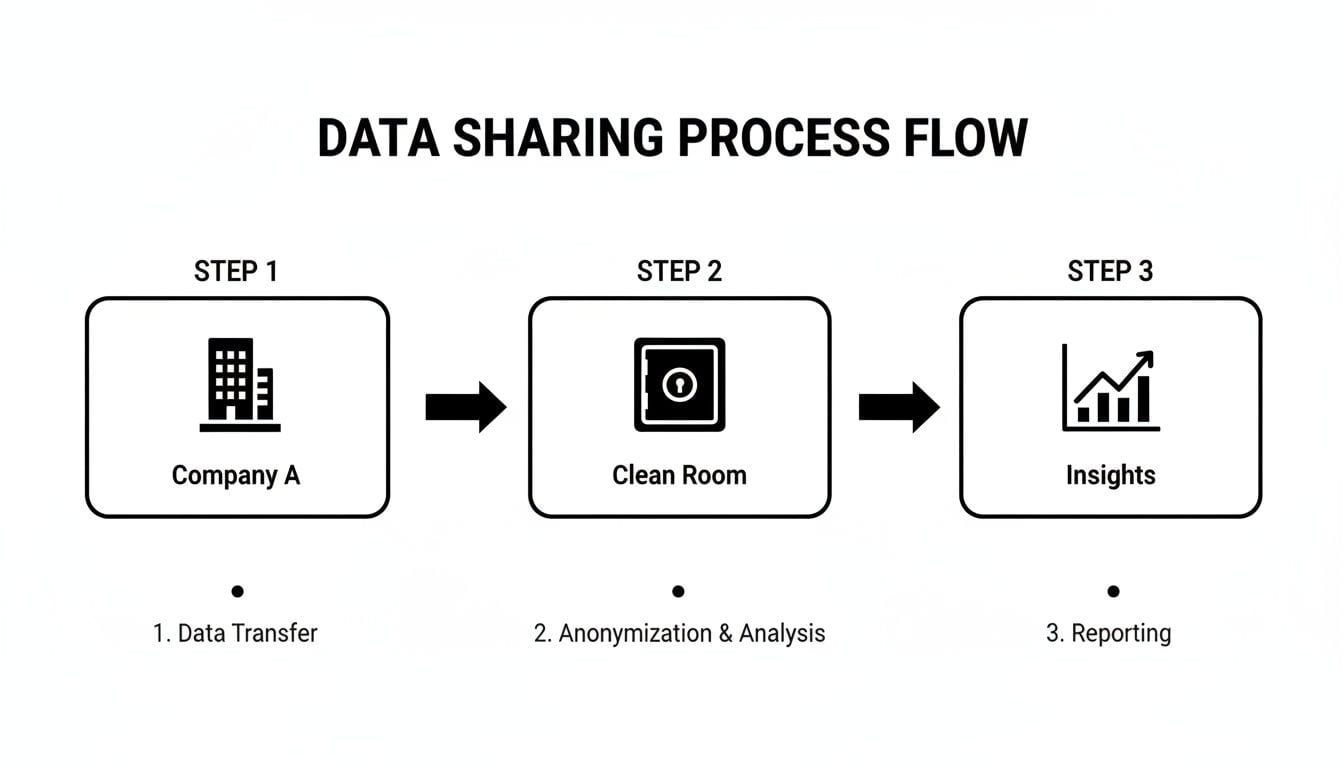
1. Each party prepares and loads its data
Personal identifiers such as emails or phone numbers are normalized and hashed before or during ingestion. A hash turns jane.doe@email.com into a fixed string that cannot be reversed, but the same input always produces the same string.
Each dataset stays separate and under its owner's control inside the environment. How easily this happens depends on your marketing data integration: if customer data lives in five systems with five email formats, the match will be poor before the clean room does anything.
Hashing is pseudonymization, not anonymization. A hashed email is still personal data under GDPR, so the legal basis for using it does not disappear because it was hashed.
2. The platform matches records
The clean room joins the datasets on the hashed identifiers. If the same string appears in both, it counts as a shared customer, without anyone seeing who that person is.
Match rate is the first number to look at. A low match rate usually means inconsistent formatting or a thin first-party dataset, and it limits every analysis that follows.
3. Partners run approved queries
Queries are restricted to what both parties agreed: an overlap count, a conversion rate for exposed versus unexposed users, a sales lift. Some platforms only allow query templates; others allow SQL with an approval workflow.
4. Privacy controls filter the output
Before any result leaves, the platform applies controls so that individuals cannot be re-identified:
- Aggregation thresholds: a result based on too few people is suppressed. The minimum group size is set by policy, and you should ask each partner what theirs is.
- Differential privacy: a small amount of statistical noise is added to results, so repeated queries cannot isolate one person.
- Access controls and query logs: who ran what, when and against which data.
The output is reach, overlap, conversion rates or lift. You get the "what" without the "who".
The use cases that justify a clean room
Closed-loop measurement with a retailer or publisher
This is the use case that pays for most clean rooms. A brand uploads ad exposure data, the retailer uploads transactions, and the clean room reports sales among exposed and unexposed groups.
It matters most for brands that don't own the point of sale: consumer goods sold through retailers, cars sold through dealerships, travel sold through booking sites. Retail media networks are a large part of why clean rooms spread, because advertisers want proof that the spend drove sales.
A clean room gives you a cleaner comparison of exposed and unexposed buyers, but it is not an incrementality test by itself. Unless the partner can hold out a control group, the exposed group may simply be people who were going to buy anyway.
Audience insight and enrichment
A brand and a publisher overlay their customer bases to answer questions neither can answer alone:
- What share of my recent buyers also read this publisher?
- Which sections do my high-value customers read?
- What does the shared audience look like compared with my overall base?
The answer shapes media planning and messaging. It works only if both sides have enough first-party data to produce overlaps above the threshold.
Privacy-safe activation
Insights can turn into campaigns. After measuring a campaign, the brand can ask the retailer's media network to target shoppers with the characteristics of the buyers who converted, a lookalike audience built inside the partner's environment. The brand never receives the retailer's customer list.
Cross-platform attribution
Some advertisers bring conversion data into the clean rooms of large ad platforms to see how exposure on each platform relates to outcomes. Be realistic about the limit: each walled garden lets you join your data with its own, not with its competitors' data. Stitching a full cross-channel path across several clean rooms is hard, which is why many teams combine clean-room reporting with marketing attribution models and experiments rather than relying on one source.
How to choose a clean room provider
The options fall into three groups, and the right one depends mostly on where your data already lives and who your partners are:
- Walled-garden clean rooms offered by large ad platforms. The partner is the platform; you join your data with theirs.
- Clean rooms built into cloud data warehouses. Useful when you and your partners already run on the same cloud.
- Independent clean-room vendors that sit between parties on different infrastructures.
Security and privacy technology
A clean room is a security product first. Ask each vendor which privacy-enhancing technologies it supports and how:
- Trusted execution environments (TEEs) and confidential computing: computation happens inside isolated hardware, so the data stays encrypted even while processed and the operator cannot read it.
- Secure multiparty computation (SMPC): parties compute a joint result without revealing their inputs to each other.
- Differential privacy: noise added to outputs so no single person can be inferred.
- Encryption at rest and in transit, and independent certifications such as SOC 2 Type II or ISO 27001.
Governance
You need control over who sees what, which queries are allowed, and how results may be used. Look for column-level permissions, query approval workflows, configurable thresholds and a complete audit log. These are the features your legal team will ask about before signing any partnership, and they belong in your wider data governance model.
Integration and usability
Check for native connectors to your warehouse and to the partners you actually plan to work with. A clean room that needs custom engineering for every new partner will stall after the first project.
Then check who will use it. Analysts need SQL or Python access; marketers need templates for overlap and lift reports. The better platforms offer both.
The questions to put in your RFP
| Area | Questions |
|---|---|
| Security | Which PETs do you support? Which certifications do you hold? Can you, as the operator, see our data? |
| Governance | Can we set column-level permissions and approve queries? What is the default minimum group size, and can we change it? Is every query logged? |
| Integration | Do you have native connectors to our warehouse and to our target partners? How long does onboarding a new partner take? |
| Measurement | Which methods are supported: overlap, attribution, lift with control groups? Can we bring our own models? |
| Activation | Can audiences be activated from the clean room, and where? |
| Compliance | Where is data stored and processed? Can we set residency rules? |
| Commercials | Is pricing by data volume, compute, users or partners? What does the cost look like once we add more partners? |
A pilot price tells you little. Ask for the cost at the number of partners and query volume you expect in the second year.
Where clean room projects fail
Poor data in, poor matches out
If your customer data has inconsistent emails, duplicates and missing fields, the match rate will be low and the overlaps too small to pass the thresholds. Audit and standardize your first-party data before you connect it. A clean room makes the quality of your data more visible, not better. My guide to marketing data quality covers the checks.
No specific question
"Let's see what we find with the retailer's data" produces interesting charts and no decisions. Start with one question and the metric that answers it, for example: did the last campaign with this retailer increase purchases among new-to-brand customers compared with a holdout group?
Legal joins too late
A clean room project involves at least three teams, and each one owns a part:
- Marketing defines the business question and uses the output.
- Data and IT prepare the data, build the connections and test the flow end to end, including whether the privacy rules are actually enforced.
- Legal and privacy vet the partner, set the rules and sign off on the agreement.
When legal joins after the technical work is done, the project waits for weeks or gets redesigned.
Starting too big
Multi-partner, multi-touch attribution is not a first project. An overlap analysis or a single-campaign lift study with one partner proves value quickly and shows you which data you need to collect next.
Misaligned partner expectations
Agree with each partner on the question, the metric, the thresholds and what "success" means before any data is loaded. Most delays come from discovering a disagreement after the setup.
Questions people ask about clean rooms
Is a clean room the same as a CDP?
No. A customer data platform unifies your own first-party data into profiles for your own use. A clean room is where you analyze your data next to a partner's without either side seeing the other's records. The CDP often prepares the data that goes into the clean room.
Do I need a data science team?
Not for the standard reports. Many platforms offer templates for overlap, attribution and journey analysis that an analyst can run. You do need a data engineer for the setup and someone who can judge whether a lift result is causal or just correlation.
What if my first-party data is limited?
Start with one partner and one campaign. The match rate from that first project tells you how much your data supports, and which identifiers to collect more of.
Can a clean room guarantee privacy?
No technology guarantees it. Risk drops a lot when thresholds, query restrictions and privacy-enhancing technologies are configured well, and the agreement between partners is clear. A badly configured clean room with permissive queries can still leak information.
What to check this week
- Write down the one question you would ask a partner's data, and the metric that would answer it.
- Check your match readiness: how many of your customer records have a normalized email or phone number?
- Ask your largest retail or media partner whether they offer a clean room, what their minimum group size is, and whether they support holdout groups.