

TL;DR:
- Marketing mix modeling is a statistical tool that quantifies each channel’s contribution to revenue.
- It is best used for strategic long-term budget planning rather than tactical campaign adjustments.
- Success depends on data quality and organizational readiness to interpret and act on insights.
Most marketing analysts at large enterprises can pull dashboards in seconds, yet still struggle to answer the fundamental question: which investments actually drove revenue? The problem isn’t a lack of data. It’s a lack of the right model to interpret it. Marketing mix modeling (MMM) has quietly become one of the most powerful tools for solving exactly that problem, cutting through noise to reveal which channels, conditions, and decisions genuinely move the needle. This guide covers what MMM is, how it works, how it compares to attribution modeling, and how to make it actionable inside a complex enterprise organization.
Table of Contents
- What is marketing mix modeling?
- How does MMM work? Key concepts and process
- MMM versus attribution modeling: Which is right for you?
- Making MMM actionable: Success factors and pitfalls
- What most guides miss: The real power (and limits) of MMM
- Take your marketing measurement further
- Frequently asked questions
Key Takeaways
| Point | Details |
|---|---|
| MMM reveals true campaign impact | Marketing mix modeling uses historical data to measure how different channels drive results and ROI. |
| Quality data is critical | Success depends on clean, multi-year data and cross-team alignment, not just good modeling tools. |
| MMM and attribution complement each other | Use both approaches to get a complete picture of your marketing effectiveness. |
| Model insights need context | MMM reflects past performance and works best when paired with expert interpretation and business knowledge. |
What is marketing mix modeling?
Now that you see why marketers crave clarity, let’s explore exactly what marketing mix modeling is and why it matters.
MMM is a statistical technique that marketing mix modeling basics practitioners use to quantify the incremental contribution of each marketing channel to a business outcome, typically revenue or sales volume. It works by analyzing historical data across media spend, pricing, promotions, competitor behavior, and macroeconomic conditions to isolate the effect of each variable. Think of it as a regression-based lens that separates what marketing actually caused from what simply happened at the same time.
The technique isn’t new. Brands used early forms of MMM as far back as the 1960s to measure TV and print advertising impact. But it’s surging again for a specific reason: the collapse of reliable user-level tracking. With third-party cookie deprecation, consent requirements, and cross-device fragmentation, bottom-up digital attribution has become increasingly unreliable. MMM offers a privacy-safe, aggregate-level alternative that doesn’t depend on individual identifiers.
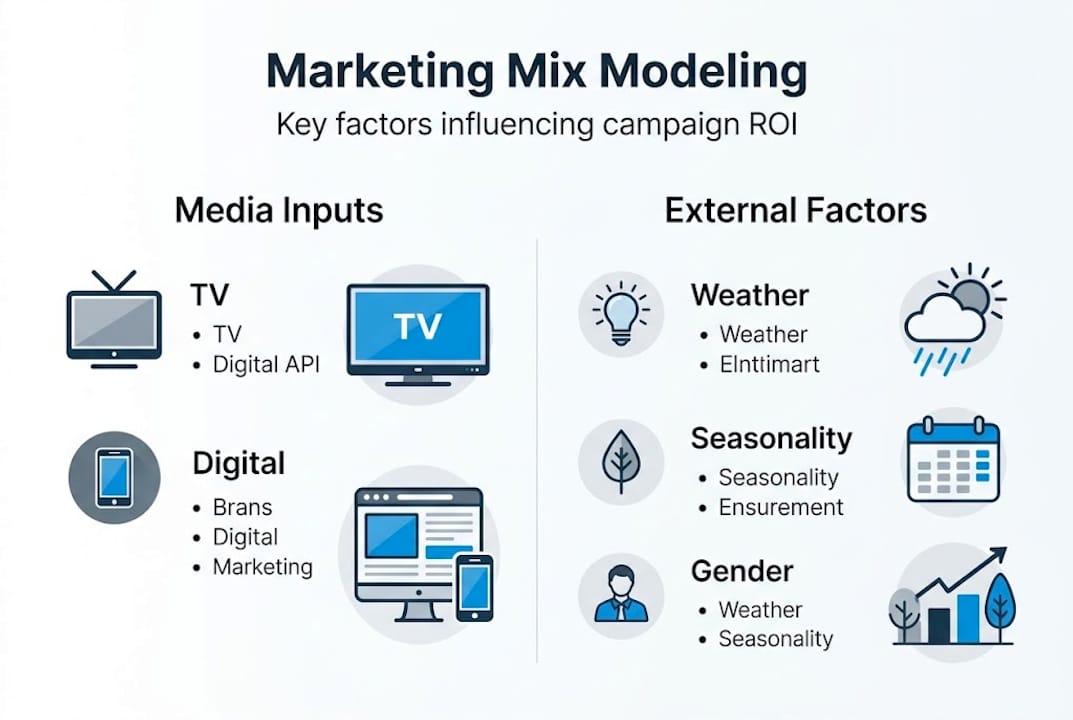
What makes MMM valuable isn’t just the channel-level attribution. It also incorporates:
- Media variables: TV, digital, paid social, out-of-home, radio spend and impressions
- Internal factors: pricing changes, promotions, product launches, distribution shifts
- External factors: seasonality, holidays, economic indicators, competitive activity
- Baseline sales: the volume you’d generate even without any marketing activity
One often-overlooked requirement is that clean, multi-year data and cross-functional buy-in are non-negotiable for MMM to produce reliable ROI estimates. Most experts recommend a minimum of two to three years of historical data. Without it, the model can’t distinguish genuine marketing effects from seasonal noise.
A critical nuance that separates experienced MMM practitioners from beginners: MMM reflects historical patterns, not future certainties. The model tells you what worked given past conditions. If those conditions change, the model’s recommendations must be reinterpreted accordingly. That’s not a flaw; it’s a design reality that demands contextual judgment from the analyst.
“A well-built MMM doesn’t just tell you what worked. It forces you to ask why it worked, and whether those conditions still hold today.”
Connecting MMM outputs to genuine improving marketing ROI decisions requires the model to be living documentation, updated regularly as new data arrives.
How does MMM work? Key concepts and process
Now that you understand what MMM is, let’s walk through how it actually works in practice.
At its core, MMM uses multivariate regression to estimate the relationship between marketing inputs and sales outputs while controlling for confounding variables. The process is iterative and collaborative, not a one-time technical exercise. Cross-functional collaboration and multi-year historical data are the structural requirements that make every subsequent step reliable.
Here is the standard process that enterprise teams follow:
- Data collection: Gather media spend, impressions, sales, pricing, promotional calendars, economic data, and competitive intelligence across 2-3 years minimum.
- Variable selection: Work with marketing, finance, and sales stakeholders to identify which factors likely influenced outcomes. Avoid throwing every variable into the model without business logic.
- Model estimation: Run regression analysis (often with adstock and diminishing returns transformations) to estimate coefficients for each variable.
- Validation: Check model fit, test against held-out data, and compare model-implied results against known business events.
- Reporting and scenario planning: Translate coefficients into ROI estimates, budget optimization curves, and what-if simulations.
Pro Tip: The biggest mistake analysts make at step three is treating a high R-squared as a success signal. A well-fitting model that lacks business logic is just a sophisticated way to be confidently wrong. Always validate outputs against real business knowledge before presenting to stakeholders.
Here’s a quick reference for the key inputs and outputs that define most MMM projects:
| Variable type | Examples | What it tells you |
|---|---|---|
| Paid media spend | TV, search, display, paid social | Incremental sales per dollar spent |
| Promotions | Discounts, coupons, bundles | Promotional lift vs. baseline |
| Seasonality | Holidays, weather, fiscal quarters | When demand peaks independently |
| Pricing | Price elasticity, competitor pricing | Volume impact of price changes |
| External conditions | GDP, consumer sentiment | Macro-level demand effects |
| Baseline sales | Organic demand | What you’d sell with zero marketing |
The output that matters most for marketing measurement accuracy isn’t a single number. It’s the marginal ROI curve for each channel, showing where additional investment yields returns and where it doesn’t. That’s the insight that drives smarter budget allocation.

MMM versus attribution modeling: Which is right for you?
With a grasp of MMM’s mechanics, it’s important to understand how it stacks up against other popular measurement methods.
MMM and attribution modeling explained are fundamentally different lenses, not competing replacements for each other. MMM is top-down: it analyzes aggregate business outcomes over long time horizons. Attribution models are bottom-up: they follow individual user journeys across touchpoints to assign conversion credit. Both answer different questions.
A misconception that MMM replaces attribution persists among teams that are new to measurement strategy, but experienced analysts know the two models serve distinct and complementary roles. Attribution gives you granular, real-time campaign optimization signals. MMM gives you strategic, long-term channel investment guidance.
| Dimension | MMM | Attribution modeling |
|---|---|---|
| Data level | Aggregate | User-level |
| Time horizon | Months to years | Days to weeks |
| Privacy requirements | No personal data needed | Depends on cookies/IDs |
| Best for | Budget allocation, channel mix | Campaign optimization, creative testing |
| Limitation | Can’t capture individual journeys | Can’t measure offline or brand effects |
You’re likely better served by MMM when:
- Your channel mix includes significant offline spend (TV, OOH, radio)
- Third-party cookie loss is degrading your attribution data quality
- You need long-term budget planning rather than real-time bidding signals
- Your organization makes quarterly or annual media investment decisions
You’re better served by digital attribution modeling when you need fast feedback loops on digital campaign performance, creative fatigue signals, or real-time audience optimization.
The most sophisticated enterprise teams combine both through a multi-touch attribution approach layered on top of MMM frameworks. MMM sets the strategic budget envelope, attribution optimizes within it. Relying on either model alone leaves significant insight on the table.
Making MMM actionable: Success factors and pitfalls
Comparing approaches is one thing. Making MMM drive better decisions in your organization is another. Here’s how to put insights into action.
The most important factor isn’t your modeling technique. It’s data quality. ROI gains from MMM depend on clean, consistent historical data and organizational alignment far more than on which software package you use. A sophisticated Bayesian model built on patchy data will underperform a simpler regression run on clean, well-governed inputs.
Successful enterprise MMM programs share three characteristics: a two to three year historical data window with consistent definitions across systems, active stakeholder participation from finance, sales, and media teams throughout model development, and a clear process for translating model outputs into budget decisions rather than treating MMM as a one-time audit.
Pitfalls that trip up even experienced teams:
- Spurious correlations: Two variables that move together historically don’t necessarily have a causal relationship. Ice cream sales and drowning incidents famously correlate in summer. Marketing data is full of similar traps.
- Ignoring business context: A model that doesn’t account for a major product recall, a supply chain disruption, or a competitor going bankrupt will misattribute outcomes to marketing that had nothing to do with them.
- Underestimating model refinement time: First-run models rarely deliver confident insights. Plan for multiple iterations across 8 to 12 weeks before results are stable enough for budget decisions.
- Treating the model as the answer: MMM outputs are inputs to human judgment, not replacements for it.
Pro Tip: Most MMM newcomers focus almost entirely on building the model and almost nothing on building organizational readiness to use it. The model is the easy part. Getting finance to trust it, getting media teams to act on it, and getting leadership to fund decisions based on it is where most programs stall. Invest in that work before you invest in modeling tools.
For a practical starting point, connect your MMM work to disciplined calculating marketing ROI frameworks so your outputs speak the language your CFO already understands. Pair that with data-driven ROI improvement practices to build momentum from early wins.
What most guides miss: The real power (and limits) of MMM
Here’s a perspective that most technical MMM guides skip entirely: the biggest failure mode isn’t a modeling error. It’s a cultural one.
We’ve seen major brands invest heavily in MMM, receive outputs that clearly showed TV was underperforming digital by a meaningful margin, and then… continue with the same TV-heavy budget because the relationship with the media agency was too entrenched to change. The model worked perfectly. The organization didn’t use it.
MMM’s real power is strategic, not tactical. It’s best suited to answering “where should we fundamentally shift our investment mix over the next two years?” not “should we pause this Facebook campaign on Thursday?” Treating MMM as a tactical optimization engine misuses it and leads to disappointment.
The other hard truth: models reflect past patterns and require context-driven interpretation, not mechanical application. One brand we’ve studied learned more from the variables their model couldn’t explain than from the ones it could. Those unexplained residuals pointed to a customer segment that wasn’t captured in any of their data systems, which became their next major growth opportunity.
If you’re building toward learning MMM fundamentals or scaling toward analytics-driven decision making, start by making sure your organization is structurally ready to act on what the model reveals.
Take your marketing measurement further
Ready to go from theory to practice? Effective MMM starts with trustworthy data, and that requires continuous monitoring of the marketing data layer underneath your models.
At Data Driven Marketer, we publish practical frameworks for building measurement programs that hold up under scrutiny. Explore our deep dives on data quality metrics to ensure your MMM inputs are reliable, or learn how marketing observability can help your team catch tracking gaps before they distort your model outputs. If you’re ready to move from raw data to analytics-driven insights, our resource library is the right next step.
Frequently asked questions
What type of data do I need for effective marketing mix modeling?
You need at least 2-3 years of clean historical marketing, sales, and external data for reliable MMM results. Inconsistent definitions across data sources will undermine even the most sophisticated model.
Can MMM predict future marketing performance?
MMM is best at explaining past patterns. Models reflect historical patterns and give directional insight, but they don’t guarantee future results if market conditions shift significantly.
How is MMM different from digital attribution models?
MMM analyzes overall marketing impact at an aggregate level over long periods, while attribution models focus on assigning credit within individual user journeys. MMM and attribution serve complementary, not competing, roles in a mature measurement stack.
What are the main pitfalls to avoid with MMM?
Beware of spurious correlations, unrealistic expectations around model speed, and insufficient cross-functional buy-in. The technical work is rarely what causes MMM programs to fail.