

TL;DR:
- Multi-touch attribution distributes credit across all customer interactions, providing a complete journey view.
- Different models like linear, time decay, and algorithmic vary in accuracy and applicability.
- Data quality is crucial; reliable tracking underpins effective attribution and campaign decisions.
Most marketing teams celebrate a successful campaign based on who closed the deal. That instinct makes sense at a human level, but it creates a dangerous blind spot in your analytics. When you credit only the last click or the first touch, you erase every interaction that actually built the buyer’s intent. Multi-touch attribution assigns revenue or conversion credit to multiple interactions in a customer’s journey, rather than a single touchpoint. The shift from single-touch to multi-touch thinking is not just a modeling upgrade. It is a fundamental change in how you understand what your marketing actually does.
Table of Contents
- What is multi-touch attribution?
- Popular models: Linear, time decay, and algorithmic
- How multi-touch attribution improves campaign optimization
- Choosing the right model for your marketing strategy
- Why most marketers misunderstand attribution—what you should really focus on
- Next steps: Unlock your marketing data’s full potential
- Frequently asked questions
Key Takeaways
| Point | Details |
|---|---|
| More than first or last touch | Multi-touch attribution reveals how all campaign interactions contribute to conversion. |
| Model choice shapes insights | Selecting the right attribution model determines the accuracy and usefulness of performance data. |
| Driving campaign success | Multi-touch attribution leads to smarter budget allocation and improved marketing ROI. |
| Data-driven approaches | Algorithmic models use advanced analytics to fairly assign credit along the customer journey. |
What is multi-touch attribution?
Multi-touch attribution is a measurement framework that distributes conversion credit across every touchpoint a customer encounters before converting. Instead of handing all the glory to one channel, it recognizes that a buyer might see a display ad on Monday, read a blog post on Wednesday, click a retargeting ad on Friday, and finally convert through a branded search on Saturday. Each of those moments played a role.
This approach matters enormously for cross-channel attribution because modern customer journeys rarely follow a straight line. A prospect might interact with six or more touchpoints before making a decision, and those interactions span paid search, organic content, email, social media, and direct visits. Crediting only one of those channels distorts your understanding of what is working.
Common misunderstandings about multi-touch attribution include:
- Thinking it requires perfect data from day one
- Assuming one model fits every campaign type or business goal
- Believing more touchpoints always means more accurate results
- Confusing attribution modeling with marketing mix modeling, which operates at a different level of analysis
Understanding how attribution modeling works is the first step toward choosing the right framework. The goal is not to collect more data. It is to ask better questions about which interactions actually influence your buyers.
For teams just getting started, algorithmic attribution explained by Adobe offers a useful technical foundation, especially if you are working inside enterprise analytics platforms.
Pro Tip: Before selecting any attribution model, write down your top three business questions. If your model cannot answer those questions clearly, it is the wrong model regardless of its technical sophistication.
Multi-touch attribution is not a silver bullet. It is a lens. And like any lens, its value depends entirely on what you are trying to see.
Popular models: Linear, time decay, and algorithmic
With the definition established, let’s explore the main models that power multi-touch attribution. Each one distributes credit differently, and that difference has real consequences for how you read campaign performance.
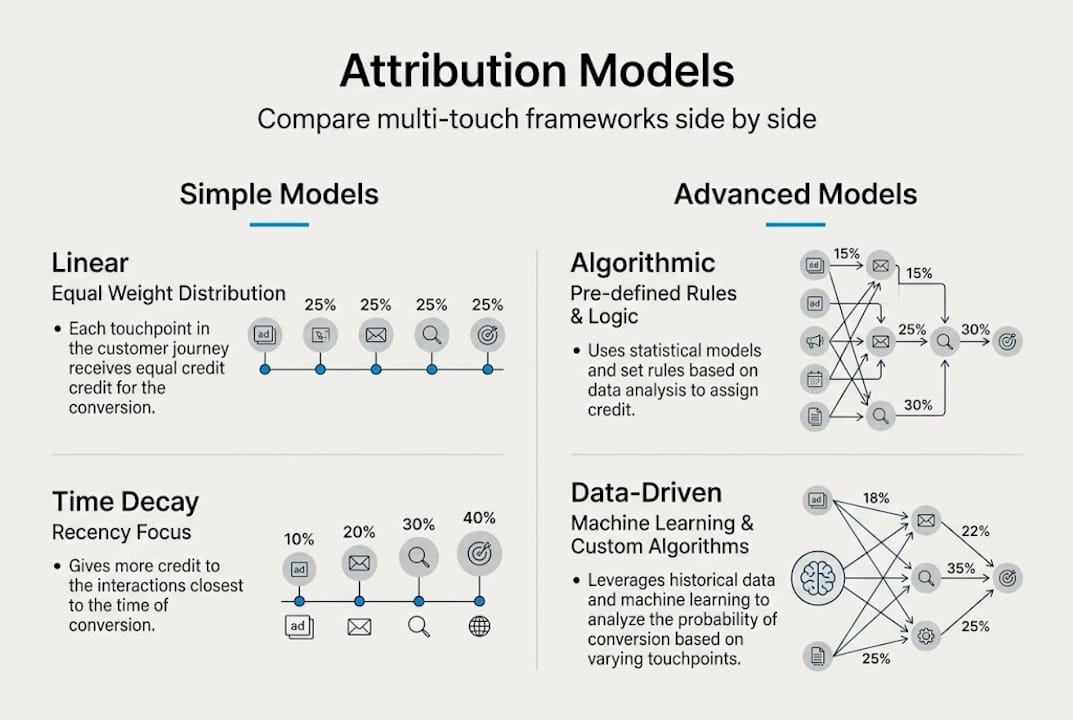
Linear attribution gives equal credit to every touchpoint in the journey. If a customer touched five channels before converting, each gets 20% of the credit. This model is transparent and easy to explain to stakeholders, but it treats a brand awareness display ad the same as a high-intent search click, which can mislead budget decisions.

Time decay attribution gives more credit to touchpoints that occurred closer to the conversion. The logic is that recent interactions had more influence on the final decision. This model works well for short sales cycles where recency genuinely matters, but it systematically undervalues top-of-funnel efforts like content marketing and brand campaigns.
Algorithmic attribution is where things get genuinely powerful. Algorithmic models use techniques like Markov chains and Shapley values for advanced data-driven attribution, calculating the actual contribution of each touchpoint based on historical conversion patterns. This approach removes human assumptions from the equation.
| Model | Credit distribution | Best for | Key limitation |
|---|---|---|---|
| Linear | Equal across all touches | Brand awareness campaigns | Ignores touchpoint influence |
| Time decay | More credit near conversion | Short sales cycles | Undervalues upper funnel |
| Algorithmic | Data-driven, dynamic | Complex, multi-channel journeys | Requires large data volumes |
Here is a practical sequence for evaluating which model fits your situation:
- Map your average customer journey length and channel count
- Identify whether your goal is awareness, consideration, or conversion optimization
- Assess your data volume and whether you have enough conversions for algorithmic models to be statistically reliable
- Run two models in parallel for 30 days and compare the channel rankings they produce
- Choose the model whose output aligns with what you can actually act on
Exploring Adobe Analytics attribution models in depth can help you understand how enterprise platforms implement these frameworks. And if you want to understand attribution modeling ROI, the data on switching from last-click to multi-touch models is compelling.
How multi-touch attribution improves campaign optimization
Understanding the models sets the stage for seeing how multi-touch attribution truly benefits campaign performance. The practical impact shows up fast once you start making budget decisions based on full-journey data instead of last-click shortcuts.
Multi-touch attribution empowers marketers to make data-driven decisions based on the full customer journey, not just the last click. That shift changes everything from channel investment to creative strategy.
Consider what happens when you discover that paid social drives 40% of first touches but gets zero credit in a last-click model. You might have been cutting that budget for months, wondering why pipeline was shrinking. Multi-touch attribution surfaces that hidden contribution and gives you the evidence to defend the spend.
Here is how campaign metrics typically shift after implementing multi-touch attribution:
| Metric | Pre-attribution (last-click) | Post-attribution (multi-touch) | Change |
|---|---|---|---|
| Paid social ROAS | 1.2x | 3.1x | +158% |
| Email attributed revenue | 38% of total | 22% of total | Recalibrated |
| Display ad budget share | 5% | 18% | Increased |
| Cost per acquisition | $142 | $98 | -31% |
The numbers shift because you are finally measuring what is actually happening, not what a simplified model assumed was happening.
Key ways multi-touch attribution improves campaign decisions:
- Reveals which channels initiate high-value journeys versus which ones close them
- Prevents over-investment in last-click channels that benefit from other channels’ work
- Identifies content types that consistently appear in converting journeys
- Surfaces budget waste in channels that appear in journeys but do not contribute to progression
Following marketing analytics best practices means treating attribution as an ongoing process, not a one-time setup. And measuring marketing impact accurately requires that your underlying tracking data is clean and complete, which is where many teams hit a wall.
Pro Tip: Focus on three to five actionable metrics rather than tracking every data point your attribution platform surfaces. More data does not mean better decisions. Clarity does.
Choosing the right model for your marketing strategy
Having seen the impact of attribution on campaigns, marketers should know how to pick the right model for their goals. The choice is less about which model is theoretically best and more about which one your team can implement, trust, and act on.
Here is a step-by-step approach to model selection:
- Audit your data infrastructure before choosing any model. If your tracking has gaps, every model will produce unreliable outputs.
- Define your conversion window based on your actual sales cycle. A 7-day window makes no sense for a product with a 90-day consideration phase.
- Start simpler than you think you need to. A well-implemented linear model beats a poorly configured algorithmic one every time.
- Test incrementally. Run your chosen model alongside your current approach for at least one full campaign cycle before making budget decisions based on it.
- Revisit quarterly. Customer journeys evolve, and your model should too.
Common pitfalls to avoid include selecting a model because it is the most sophisticated option available, ignoring data quality issues before model implementation, and treating attribution outputs as ground truth rather than directional guidance.
“The best attribution model is the one your team actually uses to make decisions. Complexity without adoption is just expensive noise.” This captures what experienced analytics leaders consistently find when rolling out algorithmic attribution adoption at scale.
Algorithmic attribution models are increasingly adopted by enterprise marketers using tools like Google GA4 and Adobe Analytics. But adoption without data quality is a trap.
For teams building out their process, following proven attribution modeling steps gives you a structured path. And using an attribution platforms evaluation framework helps you compare vendors without getting lost in feature lists.
Pro Tip: Involve your media buyers and campaign managers in model selection. If they do not trust the outputs, they will not change their behavior based on them, and that defeats the entire purpose.
Why most marketers misunderstand attribution—what you should really focus on
Here is the uncomfortable truth we have seen play out repeatedly: teams spend months selecting and configuring the perfect attribution model, then use the outputs to justify decisions they had already made. That is not attribution. That is confirmation bias with better charts.
The real value of multi-touch attribution is not the model itself. It is the discipline of asking what actually caused this outcome and being willing to act on an answer that challenges your assumptions. Most teams are not ready for that. They want attribution to validate their channel preferences, not question them.
Data quantity is not the same as data quality. An algorithmic model fed dirty tracking data will produce confident-looking numbers that are completely wrong. We have seen brands cut their best-performing acquisition channel because a misconfigured pixel made it look underperforming.
Our insider attribution guide makes this point clearly: the foundation of any attribution model is the reliability of the data feeding it. Before you debate Shapley values versus Markov chains, ask whether your events are firing correctly, whether your consent setup is capturing the right signals, and whether your channel tagging is consistent. Fix the foundation first. The model choice matters far less than you think.
Next steps: Unlock your marketing data’s full potential
If this article has shifted how you think about attribution, the next move is making sure your data is actually ready to support it. Attribution models are only as trustworthy as the tracking data beneath them.
At Data Driven Marketer, we cover the full stack of what makes attribution work in practice, from marketing data quality solutions that keep your measurement foundation solid, to guides on how to implement campaign observability so you catch tracking issues before they corrupt your reports. We also explore data observability tools that help teams monitor their entire marketing data layer continuously. Start there, and your attribution model will finally have something solid to stand on.
Frequently asked questions
Why is multi-touch attribution better than single-touch models?
Multi-touch attribution assigns credit across multiple interactions, providing a holistic view of the customer journey that single-touch models simply cannot deliver. This fuller picture enables smarter budget allocation and more accurate campaign optimization.
What is algorithmic attribution and how does it work?
Algorithmic models use ML and statistics such as Markov chains and Shapley values to assign credit based on historical data patterns and how touchpoints interact with each other. The result is a data-driven credit distribution that removes human assumptions from the equation.
How do I pick the best attribution model for my campaign?
Model selection should match your business goals, available data volume, and campaign complexity. Test two or three models in parallel and choose the one that produces outputs your team can actually act on.
Is multi-touch attribution only for large enterprises?
No, businesses of all sizes can use multi-touch attribution, though algorithmic models are increasingly adopted by enterprise marketers with access to tools like Google GA4 and Adobe Analytics. Simpler models like linear or time decay work well for smaller teams with less data volume.