Multi-touch attribution: how it works and when to trust it

Updated: October 2026. This post now merges five older guides on attribution modeling into one, with the current state of Google's attribution models, unsourced statistics removed, and a corrected section on cookies and signal loss.
Multi-touch attribution (MTA) splits the credit for a conversion across the touchpoints that came before it, instead of giving all of it to the last click. It is a better description of the customer path than last click, but it is still a description: it shows correlation, not cause, and it is only as accurate as the tracking that feeds it.
This guide is for the person who decides which model the team reports on and how much budget moves because of it. It covers what attribution is, how the models differ, what the data has to look like, how to validate the output, and where MTA stops being useful.
Attribution answers "what contributed", not "what caused"
Attribution modeling is the set of rules, or the algorithm, that decides how much credit each touchpoint gets for a conversion. A customer might see a LinkedIn ad, download a whitepaper, open two emails and then come back through branded search to request a demo. Every model looks at the same path and assigns the credit differently.
Last-click attribution gives everything to the final touch. It became the default in digital marketing because it was easy to implement and easy to explain. Its cost is a feedback loop: channels that close, such as branded search and retargeting, look better than they are, and channels that create demand look worse. Budgets drift toward the bottom of the funnel until the top stops filling it.
Multi-touch attribution spreads the credit across the path. It answers a different question, "how do my channels work together?", rather than "which channel gets the credit?".
It does not answer whether a conversion would have happened anyway. That is incrementality, and it needs experiments, not attribution. A mature measurement program uses attribution to understand the path and incrementality tests to prove which channels create new demand. More on that below.
The models, and the question each one assumes
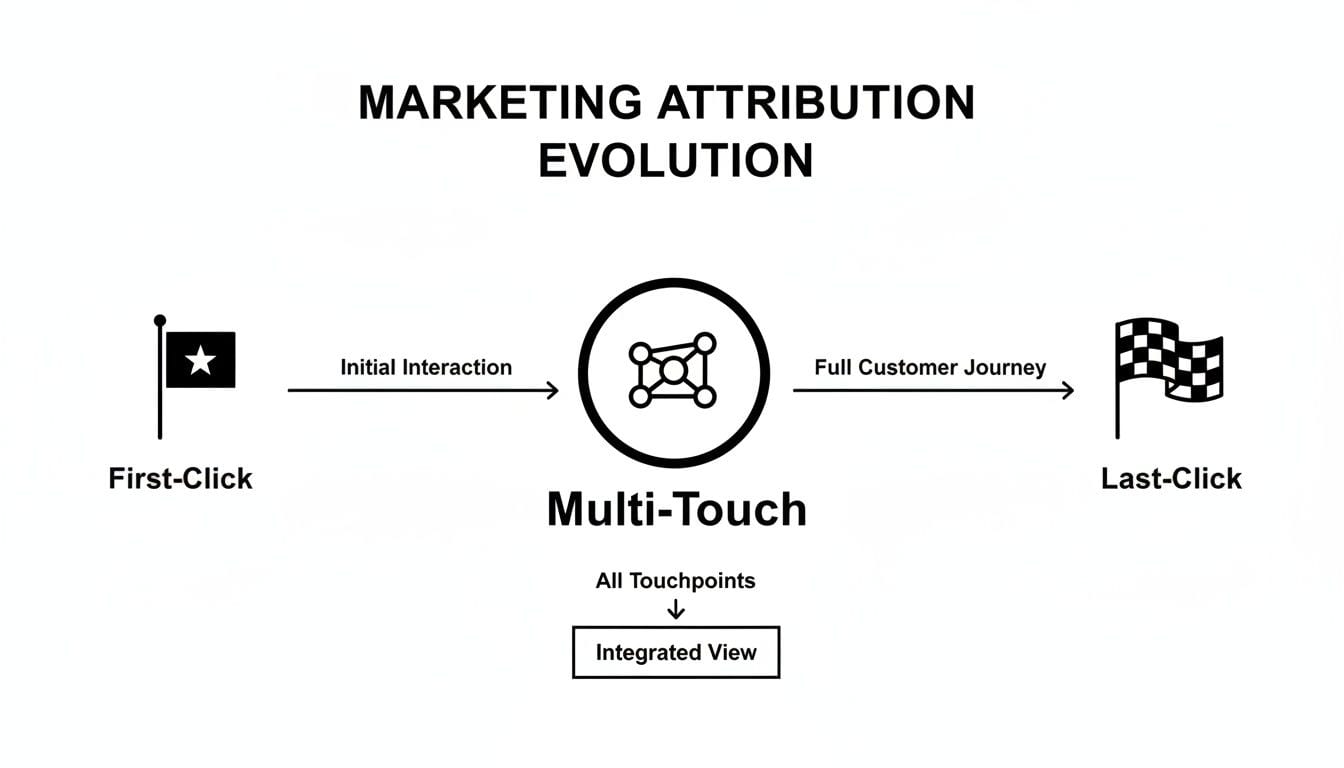
Models fall into two groups: rules-based (also called heuristic), where you set the split, and data-driven (algorithmic), where a model learns it from converting and non-converting paths.
| Model | How credit is split | Fits | Blind spot |
|---|---|---|---|
| Last click | 100% to the final touch | Short, single-session purchases | Ignores everything that created the demand |
| First click | 100% to the first touch | Understanding what opens journeys | Ignores everything that closed them |
| Linear | Equal shares to every touch | A neutral baseline for long journeys | A blog view counts the same as a demo request |
| Time decay | More credit the closer a touch is to conversion | Promotions and short decision windows | Undervalues early awareness work |
| U-shaped (position-based) | 40% first, 40% last, 20% shared by the middle | Lead generation, where opening and closing both matter | Mid-funnel nurturing gets little credit |
| W-shaped | 30% first, 30% lead creation, 30% conversion, 10% the rest | B2B funnels with a clear lead stage | Needs a reliable lead-creation event |
| Data-driven | Learned from your own paths, often with Shapley values or Markov chains | High conversion volume and clean tracking | Hard to explain, and needs a lot of data |
The splits in the rules-based models are conventions, not findings. A 40/40/20 split encodes the belief that the first and last touch matter most. If that belief is wrong for your business, the model will be confidently wrong.
Google has reduced the choice in its own tools. Google Ads no longer supports the first click, linear, time decay and position-based models; conversion actions that used them were moved to data-driven attribution, and last click is the only rules-based option left. GA4 made the same change in 2023. If you want to compare rules-based models today, you do it in a warehouse, in an attribution platform or in a tool like Adobe Analytics, which still offers them (see my post on Adobe Analytics attribution models).
How to choose a model without overthinking it
Write down the three business questions the model has to answer before you pick one. If a model can't answer them, it is the wrong model, however advanced it is.
Then match the model to the journey:
- Short, simple journeys. Last click, or linear as a neutral comparison, is usually enough.
- Lead generation. U-shaped or W-shaped, because the first touch and the lead-creation moment are decisions marketing owns.
- Long, multi-stakeholder B2B journeys. Data-driven if you have the volume, with the CRM's opportunity and closed-won data as the conversion, not the form fill.
- Low volume. Stay with rules-based models. A data-driven model trained on too few conversions produces unstable credit that changes month to month for no business reason.
Two practical rules help more than the choice itself. First, run two models side by side and look at where they disagree; the disagreement shows which channels are sensitive to your assumptions. Second, keep the model stable for at least a few quarters, so trends reflect the market and not the methodology.
What the data has to look like first
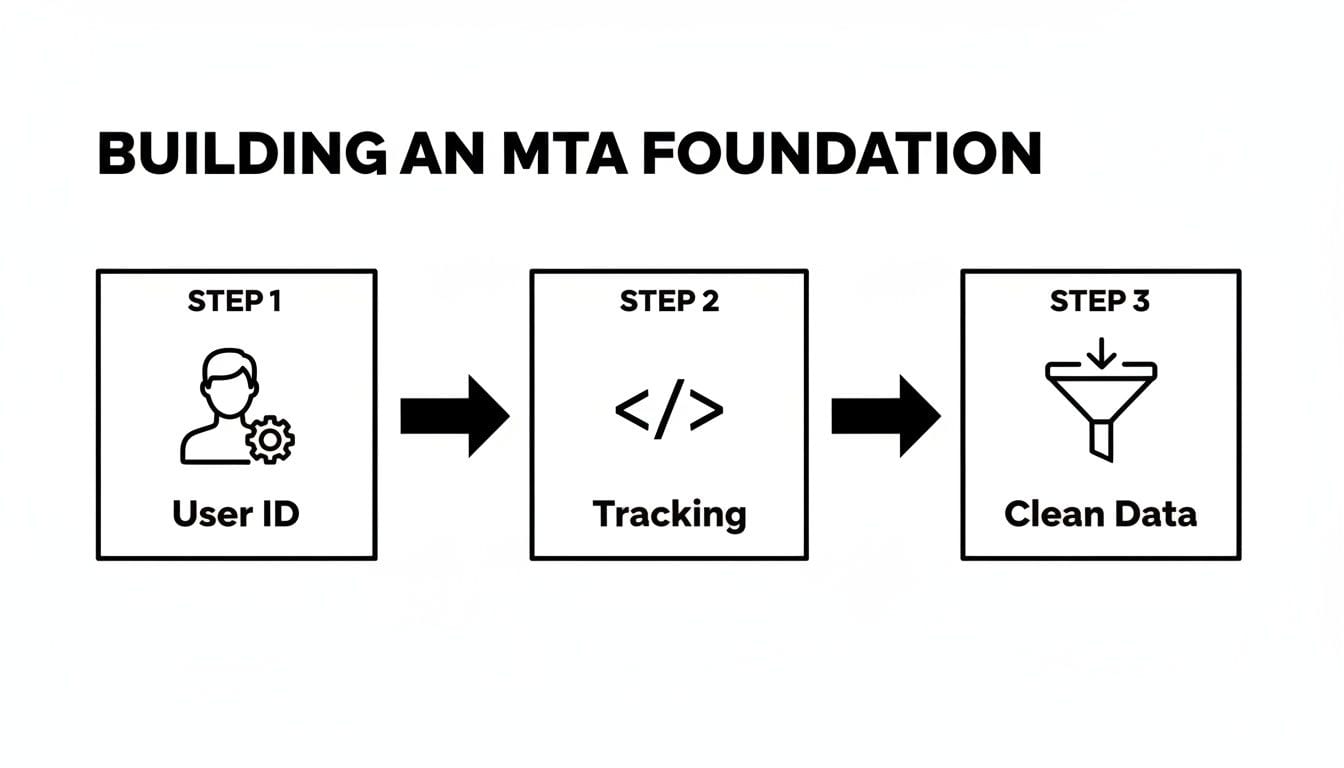
Every attribution model is built on the same inputs, and most failed attribution projects fail here, not in the model.
Identity. The model has to know that the mobile visit, the email click and the desktop conversion belong to the same person. Without a user ID strategy, usually built on logins and first-party identifiers, one customer looks like three short journeys, and early touches lose credit they deserve.
Coverage. Every channel that matters has to be tracked: paid media, organic, email, social, and offline touches such as sales calls or events if you can join them through a CRM ID.
Consistency. Campaign and UTM naming has to follow one convention. If one team tags linkedin and another LinkedIn-Ads, the model sees two channels. The same goes for cpc versus CPC.
Collection that survives the browser. Consent choices, Safari's Intelligent Tracking Prevention, ad blockers and Apple's App Tracking Transparency all remove signal from browser-side tracking. Note that Google did not remove third-party cookies from Chrome as it had planned, so the problem is not a single deadline; it is steady signal loss from several sources. Server-side tagging and first-party data collection reduce that loss. My post on what server-side tracking is covers the trade-offs.
A central store. Touchpoints, conversions and revenue have to meet in one place, a warehouse or a CDP, keyed to the same customer. If paid media data doesn't reach the CRM, attribution can't connect spend to pipeline.
Validate the model before anyone moves budget
An attribution model needs a QA process like any other production system. Run these checks before you present results, and again after every significant tracking change:
- Tags fire everywhere. Check key pages and actions on web and app. A missing tag on one template silently removes a channel from the paths.
- Channel grouping is right. Review a sample of conversions by hand. Paid search filed as organic, or email filed as direct, shifts credit between teams.
- Known journeys come out whole. Trace a few journeys you know, including cross-device ones, and confirm every touch appears.
- Platforms roughly agree. Compare conversions in Google Ads and Meta with your attributed conversions for the same period. They will differ because of windows and definitions, but they should move in the same direction.
- The CRM agrees. In B2B, reconcile attributed conversions with qualified leads and closed-won deals. This is how you show the model measures revenue, not clicks.
- Internal and bot traffic is excluded. Otherwise your own QA shows up as a campaign spike.
- Edge cases behave. Check how the model credits a one-touch path and a path with ten or more touches.
The goal is not perfect agreement between systems. It is understanding why they differ and knowing the model is close enough to act on. My guide to marketing data quality covers the tracking side in more depth.
Check attribution against incrementality
Attribution assigns credit; it does not prove that the credited channel caused the sale. Every ad platform also claims the conversions it touched, so the same sale can be claimed several times over.
Two methods give you a causal check:
- Holdout tests. Withhold a campaign from a random part of the audience and compare conversion rates. The difference is the lift the campaign created.
- Geo or time-based experiments. Turn spend up or off in comparable regions or periods and measure the change against a baseline.
When an incrementality test and your attribution model disagree about a channel, trust the test and adjust how you read the model.
Where MTA stops, and MMM takes over
MTA works on individual digital paths. It does not see TV, radio, out-of-home, a podcast ad someone mentions on a sales call, or an ad that was seen but never clicked. It also loses visibility inside walled gardens, which share aggregated results rather than user-level paths.
Marketing mix modeling (MMM) works the other way round. It uses aggregated spend and sales data over time, needs no user-level tracking, and covers offline and brand channels. It is slower and less granular, but it is not affected by signal loss.
Most mature teams now run both. MMM sets the budget split between channels, MTA guides optimization within the digital channels, and incrementality tests calibrate both. For an expert view on where MMM is going, see my summary of Jim Gianoglio on marketing mix modeling. If the analysis needs data shared with a media partner, data clean rooms are how that is done without exchanging user-level data.
Build or buy: what to ask an attribution vendor
Building on your own warehouse gives you full control over the model and the data, but it needs data engineering time and ongoing maintenance. Buying gets you models, dashboards and connectors faster, with less flexibility.
If you evaluate vendors, ask the same questions of each:
- Data ownership. Who owns the raw touchpoint data, and can you export it at user level at any time?
- Model transparency. Can you see how the data-driven model assigns credit, and can you compare it with rules-based models?
- Identity resolution. How do they stitch users across devices and channels, and what match rates do they see, by what method?
- Privacy and consent. How do they handle consent, and do they work with first-party and server-side data?
- Integrations. Which connectors exist for your CRM, ad platforms and warehouse, and how much custom work is left?
- Total cost. Licence, implementation, data processing and support, over three years.
My evaluation framework for attribution platforms goes through each criterion in detail.
What to report once it works
Attribution earns its cost when it changes decisions. Three outputs tend to do that:
- Cost per acquisition by path, not one blended number, so you can see which journeys bring customers more cheaply.
- Assist ratio by channel: how often a channel appears in converting paths without being the last touch. A high ratio marks a channel that last click undervalues.
- Path length and time lag: how many touches and how many days a conversion takes, which sets realistic expectations for campaign reporting.
The common failure is using attribution to confirm decisions already made. If the model never changes a budget conversation, either the model or the process around it isn't working.
What to check this week
- Name the questions. Write down the three decisions attribution is supposed to inform, and check whether your current model answers them.
- Audit one campaign's tags. Pick your largest campaign and check that its UTM values match your naming convention in every channel.
- Plan one holdout. Choose the channel your attribution model credits most and design a holdout test to confirm its lift.