
Marketing decisions based on gut feelings often miss critical opportunities and waste resources. When you rely solely on intuition, you overlook patterns in customer behavior, misjudge campaign performance, and struggle to justify budget allocations. Data driven marketing transforms this approach by grounding every choice in verifiable insights. This guide walks you through preparing your environment, executing decisions systematically, and verifying outcomes to optimize your marketing ROI. You’ll learn how to balance data with human judgment, avoid common pitfalls, and build a repeatable process that delivers measurable results.
Table of Contents
- Understanding The Problem: Why Intuition Alone No Longer Works
- Preparing Your Data Driven Decision Making Environment
- Step-By-Step Execution Of The Data Driven Decision Making Process
- Verifying And Optimizing Your Data Driven Decisions
- Enhance Your Data Driven Marketing With The Right Tools
Key takeaways
| Point | Details |
|---|---|
| Data improves targeting | Analytics-based decisions enhance campaign precision and resource allocation compared to intuition alone. |
| Quality data is essential | Poor data quality leads to flawed insights, making validation and monitoring critical for reliable outcomes. |
| Human judgment matters | Data guides decisions but expert interpretation prevents blind reliance on numbers that miss context. |
| Stepwise implementation works | Following preparation, execution, and verification stages ensures systematic adoption of data driven practices. |
| Continuous verification required | Regular monitoring detects bias, tracks performance, and enables iterative refinement of decision processes. |
Understanding the problem: why intuition alone no longer works
Traditional marketing relied heavily on experience and instinct. While veteran marketers developed strong intuition over years, today’s digital landscape moves too fast and generates too much complexity for gut feelings alone. Customer journeys span multiple touchpoints, campaigns run across dozens of channels, and audience segments shift rapidly based on trends you can’t observe without data.
Data driven marketing shifts from intuition-based decisions to decisions informed by data insights. You gain visibility into which channels drive conversions, what messaging resonates with specific segments, and how budget adjustments impact ROI. This approach improves targeting accuracy and campaign performance by revealing patterns invisible to human observation.
However, data misuse creates its own risks. Over-reliance on data without considering qualitative factors can lead to missed opportunities and strategic errors. Numbers don’t capture brand sentiment, creative impact, or emerging market shifts that require human interpretation. You might optimize for short-term metrics while damaging long-term brand equity, or chase statistical significance in A/B tests that ignore practical business value.
The balanced approach combines data with expert judgment. Use analytics to identify what’s happening and why, then apply your marketing expertise to determine the best response. Data tells you that mobile conversion rates dropped 15% last month. Your experience helps you investigate whether it’s a technical issue, seasonal pattern, or competitive pressure.
Key limitations of intuition-based marketing:
- Confirmation bias leads you to notice only evidence supporting existing beliefs
- Sample size errors cause overreaction to isolated incidents or outliers
- Recency bias weights recent events too heavily compared to long-term trends
- Attribution confusion makes it hard to credit the right channels for conversions
Recognizing these limitations is the first step toward building a robust data driven decision making process. You’re not abandoning expertise, you’re augmenting it with systematic evidence. Harnessing data science for marketing analytics provides the foundation for this transformation.
“The goal isn’t to replace human judgment with algorithms, but to give marketers the insights they need to make better-informed strategic choices.”
Preparing your data driven decision making environment
Before you can make reliable data driven decisions, you need infrastructure that delivers accurate, accessible, and timely information. Poor data architecture undermines even the best analytical skills, creating bottlenecks that slow decision making and introducing errors that corrupt insights.

A secure, scalable data environment is essential for compliance and speed. Modern Data Architecture Accelerator accelerates the implementation of a secure and compliant data environment by providing pre-built templates and automated infrastructure deployment. This approach reduces setup time from months to weeks while ensuring your data foundation meets regulatory requirements.
Your data architecture should support three core capabilities:
- Centralized data collection from all marketing channels and customer touchpoints
- Standardized data models that harmonize formats across different sources
- Real-time or near-real-time data processing to enable timely decisions
The Aera Decision Data Model drastically reduces time spent on data wrangling and integrates decision context by creating a unified schema that tracks not just outcomes but the reasoning and inputs behind each choice. This context becomes invaluable when you need to understand why a particular decision was made or replicate successful approaches.
Data quality determines the reliability of your insights. Garbage in, garbage out remains the fundamental rule of analytics. You must establish validation processes that catch errors at ingestion, monitor data completeness across sources, and flag anomalies that indicate tracking issues or integration problems.
Pro Tip: Create a data quality scorecard that tracks metrics like completeness, accuracy, consistency, and timeliness across all your marketing data sources. Review it weekly to catch degradation before it impacts decisions.
| Data Quality Dimension | What to Monitor | Target Threshold |
|---|---|---|
| Completeness | Percentage of required fields populated | >95% |
| Accuracy | Error rate in validation checks | <2% |
| Consistency | Cross-source data alignment | >98% match rate |
| Timeliness | Lag between event and availability | <1 hour |
| Uniqueness | Duplicate record rate | <1% |
Your tools and standards must ensure data accessibility for the teams making decisions. Data management for analytics covers governance frameworks that balance access with security, enabling marketers to self-serve insights while protecting sensitive information.
Invest in digital marketing tools that integrate seamlessly with your data architecture. Disconnected point solutions create data silos that fragment your view of customer behavior and force manual reconciliation that introduces errors and delays.
Step-by-step execution of the data driven decision making process
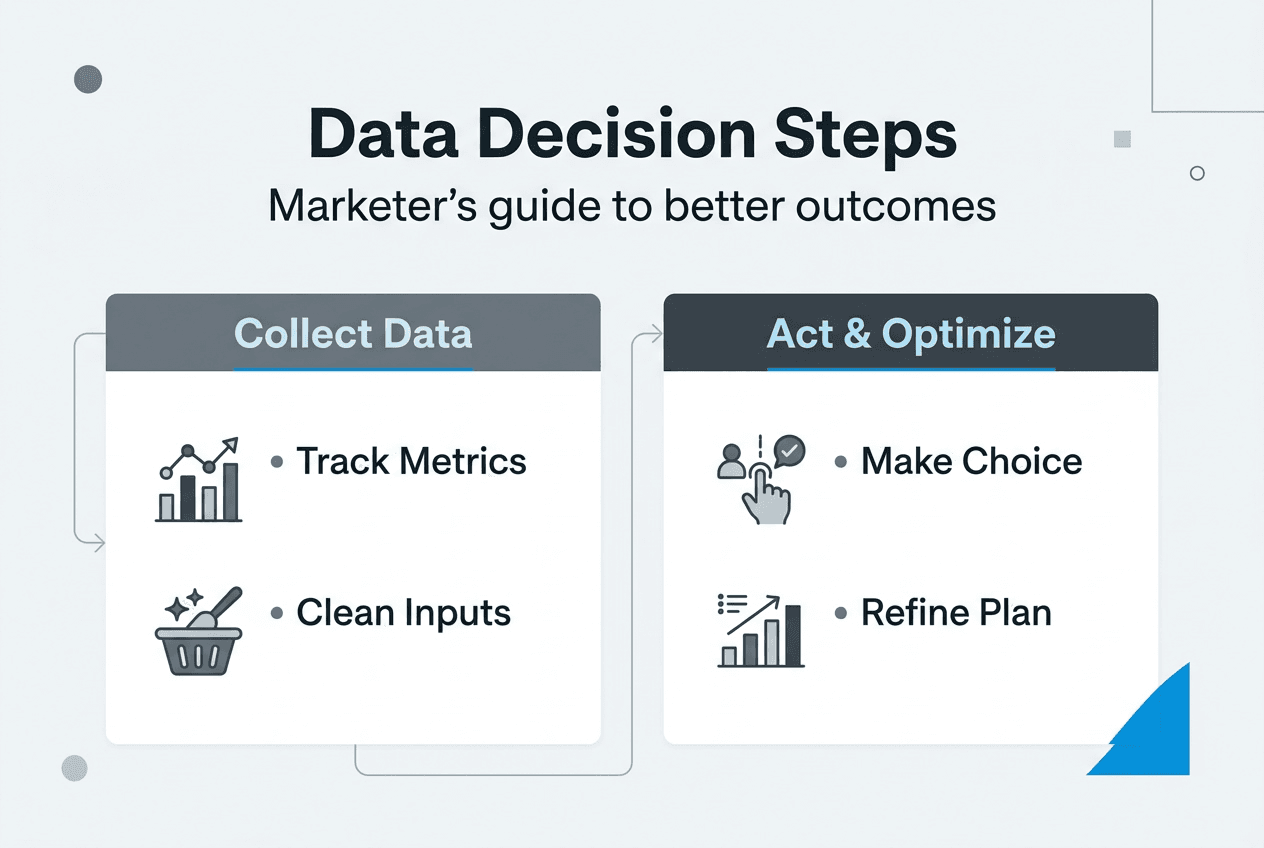
With your data environment prepared, you can implement a systematic process for making and executing data driven marketing decisions. This framework ensures consistency while remaining flexible enough to adapt to different decision types.
-
Define clear objectives aligned with business goals. Start by articulating what you’re trying to achieve and how you’ll measure success. Vague goals like “improve engagement” don’t provide direction. Specific objectives like “increase email click-through rate by 20% among enterprise segment” give you measurable targets and guide data collection.
-
Collect relevant, unbiased data aligned with your objectives. Identify which metrics and dimensions matter for your specific decision. If you’re optimizing ad spend allocation, you need channel-level performance data, audience segment behavior, and attribution modeling. Avoid collecting everything just because you can. Focused data collection reduces noise and speeds analysis.
-
Analyze data to uncover trends and insights. Look for patterns in customer behavior, performance variations across segments, and correlations between actions and outcomes. Use visualization to spot trends that tables of numbers obscure. Segment your analysis to understand how different customer groups respond differently to your marketing.
-
Develop hypotheses and test them systematically. Based on your analysis, form specific predictions about what changes will improve performance. If data shows mobile users abandon checkout at higher rates, hypothesize that simplifying the mobile payment flow will reduce abandonment. Design experiments to test these hypotheses before full rollout.
-
Implement decisions and monitor results in real time. Deploy your changes while tracking the metrics that indicate success or failure. Data driven marketing improves ROI and resource allocation by insights into campaign performance and customer behavior, but only if you monitor actively and adjust quickly when results diverge from expectations.
-
Iterate based on feedback and new data. No decision is final. As you gather performance data, refine your approach. A/B test variations, adjust targeting parameters, and optimize creative elements based on what the data reveals about audience preferences.
Pro Tip: Document your decision process including the data you reviewed, alternatives you considered, and reasoning behind your choice. This audit trail helps you learn from both successes and failures.
| Approach | Decision Speed | Accuracy | Scalability | Resource Needs |
|---|---|---|---|---|
| Intuition-based | Fast | Variable | Limited | Low |
| Data driven | Moderate | High | High | Moderate |
| Hybrid | Fast | High | High | Moderate |
The hybrid approach combines the speed of experienced judgment with the accuracy of data validation. You use data to identify opportunities and risks, then apply marketing expertise to make nuanced decisions that account for factors data can’t capture. This balance delivers better outcomes than either pure intuition or blind algorithmic optimization.
Your marketing data strategy should define roles and responsibilities for decision making. Clarify who analyzes data, who makes final decisions, and how quickly you can move from insight to action. Bottlenecks in this process undermine the value of having good data.
Track your decisions and outcomes systematically. Marketing performance analytics provides frameworks for measuring what works and understanding why. Build feedback loops that surface lessons learned and distribute them across your team.
Verifying and optimizing your data driven decisions
Making a data driven decision is just the beginning. You must verify that your decision achieved the intended outcome, understand any unintended consequences, and continuously optimize based on new information. This verification stage separates organizations that truly benefit from data driven approaches from those that just go through the motions.
Establish KPIs that measure decision effectiveness. Define success metrics before implementing changes so you can objectively assess results. Track both leading indicators that signal early performance and lagging indicators that confirm long-term impact. If you reallocated budget from social to search, monitor immediate changes in traffic and conversions, but also track customer acquisition cost and lifetime value over subsequent months.
Use audit trails to understand decision context and impact. Every decision made in Aera Decision Cloud is recorded with context and outcome, enabling real-time monitoring of how choices perform and why certain approaches work better than others. This historical record becomes a knowledge base that improves future decisions.
Monitor for bias and data quality drift. Even well-designed systems can develop problems over time. Tracking implementations break, audience behavior shifts, and data sources change formats. Regular validation catches these issues before they corrupt your insights. Set up automated alerts that flag anomalies in data volume, distribution, or key metrics.
Pro Tip: Schedule monthly data quality reviews where you examine recent decisions and verify the data supporting them was accurate and complete. This practice catches systematic issues before they become ingrained.
Key verification practices:
- Compare predicted outcomes to actual results and investigate significant variances
- Segment performance analysis to identify which customer groups benefited most from changes
- Track unintended consequences like shifts in other metrics you weren’t optimizing
- Validate that correlation patterns you relied on remain stable over time
Iterate and refine decisions with timely data and human review. Data driven marketing improves decision-making by focusing on investment, targeting, messaging, and customer experience, but only when you actively use performance data to adjust your approach. Set review cadences appropriate to decision velocity. Daily optimization for paid search campaigns, weekly reviews for email programs, monthly assessments for content strategy.
Optimized decisions drive better ROI and customer satisfaction by aligning your marketing activities with what actually works for your audience. You stop wasting budget on underperforming channels, improve message relevance through better targeting, and deliver experiences that match customer preferences revealed in behavioral data.
Data observability tools help you maintain confidence in your data foundation. They automatically detect tracking issues, schema changes, and data quality problems that could undermine decision accuracy. This proactive monitoring prevents the scenario where you make decisions based on corrupted data and only discover the problem after poor results accumulate.
Build a culture of continuous improvement where teams expect to refine decisions based on evidence rather than defending initial choices. The best data driven organizations treat every decision as a hypothesis to be tested and every outcome as a learning opportunity.
Enhance your data driven marketing with the right tools
Mastering the data driven decision making process requires more than methodology. You need specialized tools that streamline data collection, ensure quality, and surface insights efficiently. The right technology stack transforms data driven decision making from a theoretical framework into daily practice.
Using digital marketing tools tailored for analytics and automation improves your team’s ability to act on data quickly. Modern platforms integrate data sources, apply machine learning to identify patterns, and automate routine optimization tasks so your team focuses on strategic decisions.
Tracking data quality is essential for maintaining trust in your insights. Data quality metrics provide objective measures of whether your data foundation supports reliable decision making. Regular monitoring catches degradation before it impacts business outcomes.
Implementing observability across your marketing technology stack enables proactive issue detection and faster troubleshooting. Observability in marketing campaigns helps you understand not just what’s happening but why, giving you the context needed to optimize performance and prevent future problems.
FAQ
What is the first step in the data driven decision making process?
Start by clearly defining your business objectives and decision goals, ensuring alignment with data collection efforts. Specify what success looks like with measurable metrics before you begin gathering data. This focus prevents analysis paralysis and ensures you collect relevant information rather than drowning in unnecessary data points.
How do I ensure the data used is reliable and unbiased?
Implement consistent data validation frameworks and monitor key quality metrics to detect bias and errors early. Establish automated checks that flag anomalies in data volume, distribution, or completeness. Combine these technical safeguards with regular human review to catch issues that automated systems might miss, particularly subtle bias in how data is collected or interpreted.
Can data driven decision making fully replace human judgment?
Human judgment remains essential to interpret insights and validate decisions beyond quantitative data. Expert-level nuance involves understanding limitations of data and incorporating human judgment to account for context, brand considerations, and qualitative factors that numbers can’t capture. Data guides decisions but should not blindly replace the experience and strategic thinking that seasoned marketers bring.
How often should I review and adjust data driven decisions?
Review frequency depends on decision velocity and data availability. Paid advertising campaigns benefit from daily optimization based on performance data, while content strategy decisions might warrant monthly reviews. Establish cadences that balance responsiveness with stability, avoiding both slow reaction to problems and constant changes that prevent meaningful measurement.
What are common mistakes in implementing data driven decision making?
Common pitfalls include collecting data without clear objectives, ignoring data quality issues, over-optimizing for short-term metrics at the expense of long-term value, and treating correlation as causation without testing hypotheses. Many teams also fail to document decisions and outcomes, missing opportunities to learn from both successes and failures. Avoid these mistakes by following a systematic process that emphasizes preparation, testing, and verification.