
A data governance framework template is your blueprint for taming the wild west of marketing data. It provides the structure you desperately need to manage everything effectively, making sure your data is accurate, compliant, and actually usable for making smart decisions.
For marketing teams drowning in a sea of disconnected platforms, this kind of framework is the critical first step toward clarity and control.
Why Your Marketing Data Is Crying Out for Governance

Let’s be real. Modern marketing runs on data. But for most of us, it feels less like a well-oiled machine and more like pure data chaos. You’ve got customer info siloed in your CRM, campaign stats living in a dozen ad platforms, and website analytics in a completely separate universe.
When you try to stitch it all together, what do you get? Messy reports, insights you can't really stand behind, and that constant, nagging feeling that you just can't trust the numbers. This isn't just a minor headache; it's a major business risk.
Recognizing the Symptoms of Data Chaos
When you don't have data governance, the warning signs are impossible to miss. Your team is spending way more time cleaning and second-guessing data than actually using it to drive strategy. Sound familiar? These pain points are clear signals that you need a more structured approach, and fast.
You're probably dealing with issues like:
- Duplicate Contacts: Your CRM is a mess, clogged with multiple records for the same person. This leads to broken customer journeys and torches your marketing budget.
- Inconsistent Campaign Reporting: Facebook Ads says one thing, Google Analytics says another, and your CRM is telling a completely different story. Trying to figure out your actual ROI feels like a guessing game.
- Compliance Worries: The constant low-level anxiety over GDPR, CCPA, and whatever new privacy regulation is next creates a cloud of uncertainty that slows down every new initiative.
- Lack of Trust in Reports: Leadership asks for a simple performance number, and it triggers a multi-day fire drill. In the end, everyone shows up with a different version of the "truth."
Without a formal framework, marketing teams are often stuck in a reactive cycle, constantly putting out data fires instead of building a foundation for growth. This is a common challenge, and as one marketing leader's perspective highlights, navigating this data crisis is a critical step toward maturity.
The Shift from Reactive Fixes to Proactive Strategy
Putting a data governance framework in place is about making a fundamental cultural shift. It’s about moving from a world where data is a liability to one where it becomes your most powerful asset. It means finally defining who owns what data, setting clear ground rules for how it's handled, and establishing a single source of truth everyone can rely on.
Think about something as simple as creating a mandatory naming convention for all your marketing campaigns. It's a small change, but suddenly, your reports are clean. Filtering is a breeze. You can instantly compare performance across every channel without pulling your hair out. That's not a complex technical project; that's a governance policy in action.
Ultimately, this structure isn't about adding red tape. It’s about building confidence. When your team trusts the data, they can make faster, smarter decisions that have a direct line to revenue and growth. You finally stop arguing about whose numbers are right and start having productive conversations about what the numbers mean for your next big move.
Your Downloadable Marketing Data Governance Template
Talking about data governance is one thing, but actually doing it is where you'll see the payoff. To help you jump straight into action, we've built a hands-on data governance framework template specifically for the messes marketing teams deal with every day.
This isn't some ridiculously complex, enterprise-grade tool that only a data scientist could love. It’s a simple Google Sheet or Excel file, built by marketers, for marketers, to bring some much-needed order to your operations.
Forget the high-level theory. This template gives you a real, tangible starting point. It's structured to tackle the exact data chaos we've been talking about—think inconsistent campaign tracking, messy CRM data, and conflicting reports—by giving you a clear, organized way forward.
What's Inside the Template?
Before you grab the download, let's pop the hood and see what you're getting. The template is broken down into a few dedicated tabs, each one serving a specific purpose in building out your framework. It’s designed to be a living document, not something you fill out once and forget.
We’ve organized it into sections that build on each other logically:
- Core Data Domains: This is where you map out your key data categories. To save you time, we’ve pre-filled it with common marketing domains like Customer Data (your CRM gold), Campaign Performance (from all those ad platforms), and Web Analytics (your Google Analytics data).
- Data Stewardship & Roles: Here’s where you assign clear owners to each data domain. This section is all about moving past the finger-pointing and establishing exactly who is on the hook for the quality of specific datasets.
- Data Policies & Standards: Think of this tab as your rulebook. It’s the spot to finally document your campaign naming conventions, UTM tagging rules, or lead status definitions so everyone is singing from the same hymn sheet.
A good template does more than just organize information; it becomes a powerful communication tool. It forces you to have the right conversations about data ownership and standards—and honestly, that's often the biggest hurdle.
How All the Pieces Fit Together
Now, let's talk about what's included and why each part is so critical for marketers trying to get their data house in order.
Key Components of Your Marketing Data Governance Template
| Template Section | Purpose and Benefit for Marketers |
|---|---|
| Data Governance Charter | Establishes the "why" behind your initiative. It outlines the vision, goals, and business case, which is crucial for getting buy-in from leadership. |
| Roles & Responsibilities (RACI) | Defines who is Responsible, Accountable, Consulted, and Informed for key data tasks. Finally, you can end the "I thought you were doing that" confusion. |
| Data Domains & Stewards | Maps out your core marketing data assets (e.g., Lead Data, Web Traffic) and assigns a "steward" to own the quality and integrity of each one. |
| Data Policies & Standards | Your rulebook for data creation and management. This is where you'll document things like UTM parameters, campaign naming conventions, and lead status definitions. |
| Data Catalog & Dictionary | A central inventory of your key marketing metrics and data sources. It answers questions like, "Where does our 'MQL' number come from?" and "What does it actually mean?" |
| Access Control Matrix | Documents who can view, create, or edit specific datasets in your marketing tools. Essential for both security and preventing accidental data mishaps. |
| Data Quality Workflows | Outlines the steps for identifying, reporting, and fixing data quality issues. Turns reactive fire-drills into a proactive process. |
Each part of this template is designed to connect, creating a single, unified strategy. For example, the pre-built RACI matrix links directly to the roles you define in the stewardship section, making it crystal clear who does what for key data processes.
The data cataloging sheet is also built with a marketer's workflow in mind. It focuses on the practical details that matter to you, like the data source (e.g., a HubSpot form), key metrics pulled from it, and how often it's updated. This makes it useful from day one.
It’s no surprise that more and more companies are getting serious about this. The global data governance market was valued at $3.4 billion in 2023 and is on track to hit $15.1 billion by 2030. That massive growth shows just how vital these frameworks have become. You can dig deeper into what’s driving this trend by checking out the full data governance business research.
Ultimately, this data governance framework template gives you the scaffolding you need to build a system that creates real confidence in your marketing data, turning it from a source of frustration into a reliable asset for growth.
Putting Your Data Governance Framework Into Action
A downloaded file is just that—a file. The real magic happens when you turn that data governance framework template from a static spreadsheet into a living, breathing part of your marketing operations. This is your playbook for turning theory into practice and finally setting the rules of the road for your team's most valuable asset: its data.
Getting started can feel like a massive project, but it doesn't have to be. The trick is to start small, zero in on the areas causing the most pain, and build momentum from there. You don't need to boil the ocean. Just start with one critical drop.
This visual shows the essential flow for getting your feet wet: defining data domains, assigning clear roles, and documenting your policies.
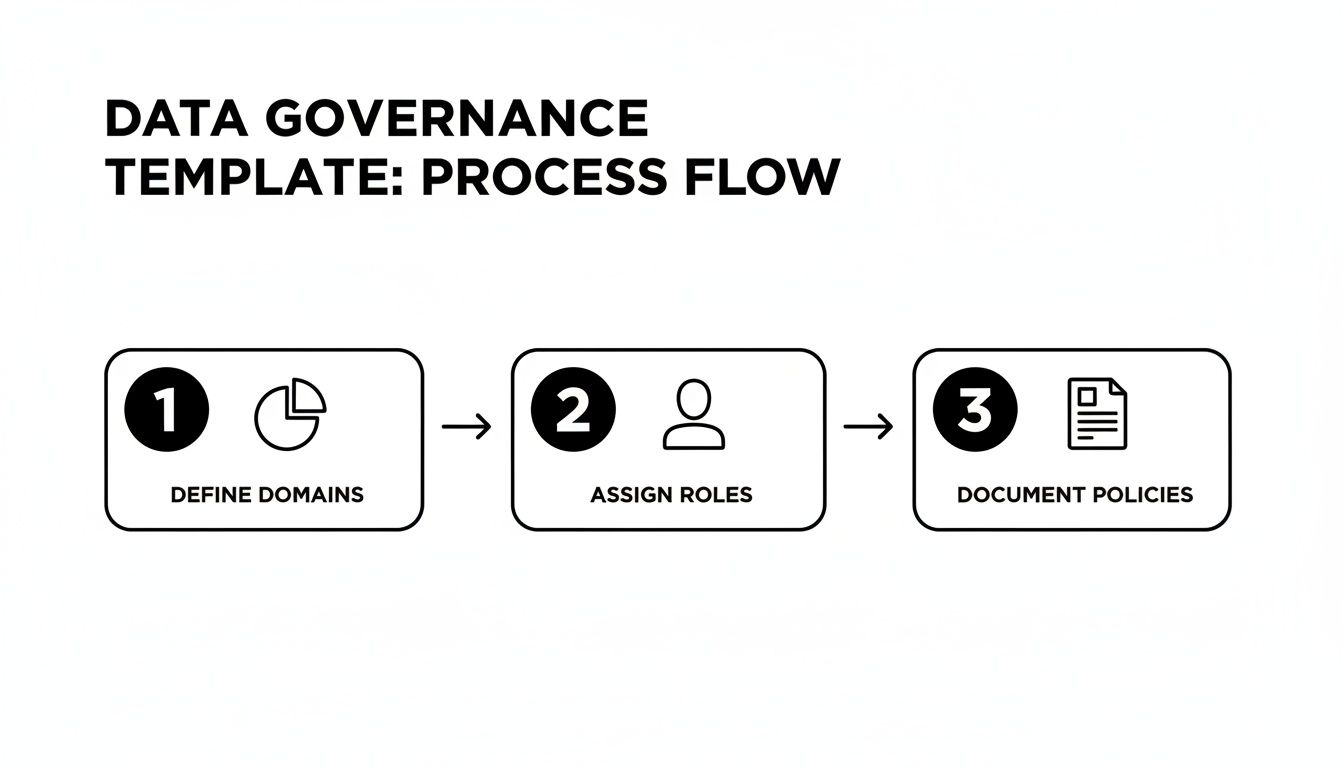
As you can see, the process starts with scoping your effort (defining domains) before you get bogged down in the people and process layers.
Identify Your Critical Data Domains
Before you can govern anything, you have to decide what to govern. Trying to wrangle every single data point across your MarTech stack is a surefire path to burnout. Instead, pinpoint your most critical data domains—the areas where bad data creates the most headaches or good data drives the most value.
For most marketing teams, the usual suspects are:
- Lead Source Data: This is the lifeblood of attribution. When it's a mess, you have no real clue which channels are working, making budget allocation a complete shot in the dark.
- Campaign Attribution Data: Going beyond just the first touch, this tracks the entire customer journey. Get this wrong, and you'll end up pouring money into the wrong places.
- Customer Contact Information: Bad emails, duplicate records, and incomplete profiles in your CRM (like HubSpot or Salesforce) kill campaign performance and create awful customer experiences.
- Website Analytics: Data from platforms like Google Analytics is the foundation for understanding user behavior. If events and conversions are tracked inconsistently, your whole digital strategy is built on quicksand.
Pick one. Just one. If your sales team constantly complains about lead quality, make CRM contact data your first project. If your CMO keeps questioning campaign ROI, focus on attribution data. Securing a quick win in a high-visibility area is the best way to build the credibility you need for a wider rollout.
Assign Roles and Define Responsibilities
Data governance falls apart without clear ownership. It's a team sport, and every team needs defined positions. This is where you move from abstract ideas to putting actual names next to specific responsibilities. Think of it like a pro kitchen: the Head Chef is accountable for the final dish, but the Sous Chef oversees operations, and a Chef de Partie is the expert for a specific station.
The same logic applies to data. Your template should include a RACI (Responsible, Accountable, Consulted, Informed) matrix to map this out clearly.
- Data Owners: These are senior leaders accountable for an entire data domain. Your Head of Demand Gen might own all campaign performance data. They aren't in the weeds every day, but the buck stops with them.
- Data Stewards: These are your hands-on heroes. A Marketing Ops Manager who lives in the CRM all day is the perfect Data Steward for customer contact data. They are responsible for defining standards, monitoring quality, and making sure policies are actually followed.
A common pitfall is just assuming everyone knows their role. Documenting these responsibilities in your framework kills ambiguity and prevents the classic "I thought you were handling that" conversation that lets data problems fester for months.
A global survey of 58 different data governance frameworks found a massive weakness: most offer suggestions without specifying the 'who, how, and when' for getting things done. This kills their operational impact. Success hinges on appointing high-level 'data champions' and establishing these clear roles to push the initiative forward.
Craft and Document Your Data Policies
With your domain chosen and roles assigned, it's time to write the rules. Policies are the simple, clear standards everyone on the team agrees to follow. This isn't about creating a 50-page bureaucratic manual no one will read; it's about documenting practical guidelines that solve real, everyday problems.
Your first policies should be direct and actionable. Here are a few examples that deliver value almost immediately:
| Policy Area | Example Policy | Business Impact |
|---|---|---|
| Campaign Naming Convention | All paid search campaigns must follow: Region_Objective_Platform_Date. Ex: NA_LeadGen_GoogleAds_2024Q4. |
Makes filtering and reporting in ad platforms and analytics instant and error-free. Ends the chaos of messy names. |
| UTM Tagging Standards | utm_source = platform name (e.g., 'linkedin'). utm_medium = channel type (e.g., 'cpc'). utm_campaign = campaign name. |
Ensures clean, reliable traffic data in Google Analytics, enabling accurate channel performance analysis. |
| Lead Status Definitions | A lead becomes an "MQL" only with a verified email, specific job title, and engagement with a high-intent asset. | Creates a clear handoff between marketing and sales, improving lead quality and alignment between teams. |
Document these policies right in your data governance framework template. Make it the single source of truth. The next time a new team member asks how to name a campaign, the answer should always be, "Check the governance framework." For more help on setting standards, check out our guide on data governance best practices for deeper insights.
Build a Simple Data Catalog
A data catalog doesn't have to be some fancy, expensive software—especially when you're just starting. At its core, it’s just an inventory of your most important data assets. Your template should have a dedicated tab for this.
For your chosen data domain, start cataloging the key assets. If you're tackling lead source data, your catalog might include:
- Data Asset: HubSpot Form Submission Data
- Description: Captures lead info from all website forms.
- Owner: Head of Marketing
- Steward: Marketing Operations Manager
- Location: HubSpot CRM,
Form Submissionsreport. - Key Metrics:
Original Source,Lead Status,Lifecycle Stage. - Refresh Rate: Real-time.
This simple act of documentation is incredibly powerful. It demystifies where data comes from and what it actually means, building trust across the entire team. The next time someone questions a number in a report, you can point them straight to the catalog entry that explains its origin and definition. This is a foundational step toward building a data-driven culture based on shared understanding, not assumptions.
Building Your Marketing Data Council
A solid data governance framework template is powered by people, not just a policy document saved on a shared drive. Real governance comes alive when a dedicated group champions the cause, turns rules into reality, and keeps the team on track. This is exactly where your Marketing Data Council fits in.

Forget the idea of some stuffy, bureaucratic committee. Think of the council as a small, agile task force laser-focused on making your marketing data better and more reliable. They are the human engine that makes your framework a living part of the team's culture, not just another forgotten initiative.
Defining Your Key Governance Roles
Before you start sending calendar invites, you have to get clear on the roles that make a data council work. In the world of data, ambiguity is the enemy. Clear responsibilities ensure nothing falls through the cracks, kind of like a kitchen brigade where everyone from the Head Chef to the line cook knows their exact purpose.
Here are the two fundamental roles you need to establish on your marketing team:
- Data Owner: This is a leadership position, usually a department head who is ultimately accountable for a major data domain. For instance, your Head of Demand Gen is the Data Owner for all lead acquisition and campaign performance data. They get the final say on policies and are on the hook for the business value that data provides.
- Data Steward: This is your hands-on expert, responsible for the day-to-day care of a specific dataset. Your Marketing Ops Manager, who lives and breathes CRM hygiene, is the perfect Data Steward for customer contact data. They are the ones defining the standards, monitoring quality, and answering all the detailed questions about data in their domain.
Just assigning these two roles clarifies who is accountable versus who is responsible—a massive first step in making your framework operational.
The secret to successful data governance isn't a fancier tool; it's having crystal-clear roles and responsibilities. This simple act brings clarity, reduces risk, and empowers the people who know the data best to actually manage it. Without this structure, even the most brilliant framework is just a collection of good intentions.
Assembling a Small and Mighty Council
For most marketing teams, a huge council is a recipe for disaster. It slows everything down. Your goal is a small, nimble group that can make decisions without endless debate. A great Marketing Data Council is a mix of strategic thinkers and tactical doers who bring different, valuable perspectives.
Your initial invite list should probably include:
- Key Data Stewards: Start with the people already deep in the data trenches, like your Marketing Ops guru and your lead digital analyst.
- A Data Owner: You need a director-level leader who can provide strategic guidance and bust through any organizational roadblocks.
- Reps from Key Functions: Bring in someone from the content team, the paid media squad, and maybe a liaison from sales or sales ops to bridge the gap.
Don't try to boil the ocean in your first meeting. Set a simple, focused agenda to build momentum. Start by formally assigning the Data Owner and Steward roles for your critical data domains, and then—this is key—pick just one pressing problem to solve first.
A Real-World Council Scenario
Let's say your team is wrestling with a classic marketing headache: lead source data in your CRM is a total mismatch with what you're seeing in Google Analytics. The reports are contradictory, and nobody trusts the attribution numbers.
Here’s how the new Data Council would jump on it:
The Demand Gen Manager (the Data Owner) flags this as a top priority. The Marketing Ops Manager (Steward for CRM data) and the Web Analyst (Steward for analytics data) are tasked with digging in. After a bit of investigation, they find the culprit: inconsistent UTM tagging on social media campaigns.
In the next council meeting, they present their findings. The group agrees on a mandatory UTM policy, which the Marketing Ops Manager promptly documents in the data governance framework template. The new standard is then rolled out to the entire marketing team, complete with a quick training session led by the stewards.
This is the council in action—not as a slow committee, but as a practical, problem-solving unit that drives real improvements in data quality.
Marketing Data Governance RACI Matrix Example
To make roles even clearer for specific, recurring processes, a RACI matrix is invaluable. It defines who is Responsible, Accountable, Consulted, and Informed for each step. This simple chart eliminates confusion and ensures everyone knows their part.
Below is a sample RACI for a common marketing process: 'New Lead Data Entry and Enrichment'.
| Task/Decision | Marketing Ops | Demand Gen Manager | Content Team | Sales Team |
|---|---|---|---|---|
| Define lead source values | R | A | C | I |
| Implement tracking in forms | R | A | I | I |
| Enrich lead data (e.g., Clearbit) | R | A | I | I |
| Create new lead routing rules | R | A | I | C |
| QA and verify new lead data | R | A | I | C |
| Report on lead quality | R | A | I | I |
This RACI makes it obvious that while Marketing Ops is responsible for the hands-on work, the Demand Gen Manager is ultimately accountable for the outcome. The Sales Team is consulted on routing and quality, ensuring their feedback is heard before changes go live. This level of clarity is what turns a good framework into a great one.
Getting Your Framework Off the Ground and Proving It Works
Building your data governance framework template is a major win, but let's be honest—the real work starts now. A framework is just a document until people actually start using it and the business starts seeing a difference. It's time to shift from planning to doing, launching your initiative and backing up its value with real numbers.
This is the part where your hard work becomes a living, breathing part of your marketing culture, not just another file forgotten on a shared drive. It’s all about making data governance stick and showing everyone the tangible results.
Don't Boil the Ocean—Start with a Pilot Project
I’ve seen it happen time and again: a team gets excited and tries to launch a massive, company-wide "big bang" rollout. It's a tempting idea, but it’s incredibly risky. A much smarter—and safer—approach is to kick things off with a focused pilot project. This gives you a chance to iron out the wrinkles, score some quick wins, and build the momentum you'll need for a broader rollout.
Pick a single, high-impact area to start. For instance, you could:
- Tackle a Single Channel: Apply your new rules exclusively to all your paid search campaigns. Standardize campaign naming and UTM tagging to prove you can finally clean up attribution data for one specific channel.
- Fix One Broken Report: Zero in on that monthly MQL report that everyone loves to argue about. Govern the underlying data in your CRM to finally create a single, trusted source of truth for that metric.
- Focus on One Platform: Roll out your governance policies just for your HubSpot or Marketo instance, concentrating on data hygiene and defining lead statuses once and for all.
Starting small creates a controlled environment to test-drive your framework. The success of this pilot becomes your best case study, making it infinitely easier to get other teams excited for a wider implementation.
Defining What Success Actually Looks Like
To prove your framework is more than just busywork, you need to track the right Key Performance Indicators (KPIs). These metrics should be a direct answer to the pain points you originally set out to solve. Vague goals like "improving data quality" won't cut it. You need concrete, measurable outcomes.
Here are a few practical KPIs I've seen work well for marketing data governance:
- Fewer Duplicate Contacts: Track the percentage drop in duplicate records created in your CRM each month. A 15% decrease is a clear signal that your new data entry policies are having an impact.
- Less Time on Manual Reporting: Just ask your analytics team. A great goal is to cut the time they spend manually cleaning and merging data for weekly reports from 5 hours down to 1 hour.
- Higher Confidence in Data: Run a simple quarterly survey asking stakeholders to rate their trust in marketing data on a scale of 1-10. Your mission is to see that score climb quarter after quarter.
- Quicker Campaign Launches: Measure the time it takes to set up and launch a new campaign from start to finish. As you remove ambiguity with standardized processes, this timeline should get shorter.
Defining these metrics isn't just an afterthought; it’s a critical part of building an effective measurement plan that directly connects your governance efforts to real business impact.
Your Practical Rollout Checklist
A smooth launch all comes down to clear communication and smart planning. This checklist covers the essentials for rolling out your framework so that everyone understands their part and knows exactly what’s expected of them.
- Start with the 'Why': Before you even mention a new rule, explain the problem this framework solves. Pull up those messy reports or share stories of costly errors to get everyone on the same page.
- Hold Real Training Sessions: Please, don't just send an email with a link. Host dedicated training workshops on new standards, like a hands-on session for proper UTM tagging or a walkthrough of the new campaign naming conventions.
- Update Your Onboarding Docs: Weave your data governance standards directly into the onboarding process for new hires. This helps build good habits from day one.
- Create a Feedback Loop: Set up a dedicated Slack channel or regular office hours for questions and ideas. Your framework isn't set in stone; it needs to evolve, and this feedback is gold.
- Celebrate the Small Wins: When your pilot project delivers good results, shout it from the rooftops. Publicly recognize the team members who are embracing the new processes.
Remember, policies are only as good as their adoption. Research from The Global Data Barometer found that while 74 countries have open data policies, only 30 are legally enforceable. That 40.5% enforcement rate highlights a massive "implementation gap." It’s a powerful lesson: policies without clear monitoring and measurable outcomes are destined to fail. You can find more insights on the global landscape of data governance on cigionline.org.
By focusing on a phased rollout, clear metrics, and consistent communication, you transform your data governance framework from a theoretical document into a practical, value-driving asset for your entire marketing organization.
Common Questions About Marketing Data Governance
As you start putting a data governance framework template into practice, questions are going to come up. That’s a good sign—it means your team is actually digging in and thinking critically about the process.
This section tackles some of the most common hurdles and confusion I've seen marketers run into. Think of it as your field guide for those nagging 'what if' scenarios and the practical roadblocks that pop up when the rubber meets the road.
My goal here is to demystify the process and give you the clear, straightforward answers you need to make this whole thing a success.
How Do I Get Buy-in From Leadership for This Project?
Getting your leadership team on board is rarely about the technical nitty-gritty. It’s all about the business impact. Executives want to know how this initiative helps the bottom line.
So, don't start the conversation with terms like "data stewardship" or "metadata management." That’s a surefire way to see their eyes glaze over. Instead, frame your pitch around the outcomes they lose sleep over.
Focus your business case on three core pillars:
- Slash Our Risk: Talk about the real financial and brand dangers of ignoring regulations like GDPR or CCPA. Frame governance not as a chore, but as an essential shield against six-figure fines and bad press.
- Boost Team Efficiency: Pull some real numbers. Explain how many hours your team wastes every single week cleaning up messy data or manually pulling reports that should be automated. Quantify it—those saved hours can be poured back into strategic work that actually grows the business.
- Supercharge Our ROI: Connect the dots between clean, trustworthy data and better marketing results. When you can actually rely on your attribution models, you make smarter budget decisions. It’s that simple. Better data means better personalization, which means more revenue.
My number one tip? Start small and prove it. Kick off a tiny pilot project—like cleaning up the lead source data for just one paid channel. When you can walk into a meeting and show how that small fix improved campaign reporting and ROI, you've got tangible proof. It makes getting a "yes" for a bigger rollout infinitely easier.
Can We Still Implement Data Governance with a Small Team?
Absolutely. In fact, small teams often have an edge because they can move faster and be more agile. Data governance isn’t some monolithic, all-or-nothing beast. It’s a practice that scales to fit your reality.
The key is to be brutally honest about your priorities. You can't boil the ocean.
For a smaller team, the game is all about simplicity and impact. Start by identifying the single biggest data-related headache your team complains about every day. Is it messy contacts in the CRM? Inconsistent UTM tracking? Pick one thing and make that your entire focus for the next 90 days.
You don't need a formal, multi-person data council. A single motivated person, maybe your Marketing Ops Manager, can step up as the first Data Steward to get the ball rolling. The most important thing is to just begin, document your simple processes in your framework template, and start building that culture of consistency.
What Is the Difference Between a Data Owner and a Data Steward?
This is a classic question, and getting it right is crucial for real accountability. The distinction is actually pretty simple if you think about a restaurant kitchen. The Head Chef is ultimately accountable for every single dish that goes out, while the line cook is responsible for perfectly executing the dishes at their specific station.
- A Data Owner is the "Head Chef." This is a senior leader—like your VP of Marketing—who is ultimately accountable for a big data domain (e.g., all customer marketing data). They own the strategic value of the data but aren't getting their hands dirty in the day-to-day.
- A Data Steward is the "Line Cook." This is a hands-on expert, like a Digital Analyst or your CRM Admin, who is responsible for the daily management, quality, and security of a specific dataset. They’re the ones defining the standards and making sure everyone follows the recipe.
Getting these roles clearly defined in your data governance framework template is one of the most powerful things you can do to kill confusion before it starts.
How Often Should We Review Our Data Governance Framework?
Your framework needs to be a living document, not some PDF you create once and file away to die in a forgotten folder. The data world moves incredibly fast, and your governance has to keep up.
Plan on conducting a formal review of your entire framework at least twice a year. If you're in a high-growth phase, quarterly might be even better.
But some events should trigger an immediate review, no matter where you are in your review cycle. These include:
- Onboarding a New MarTech Tool: A new platform always means new data flows, new definitions, and new potential quality issues.
- Expanding to New Regions: Launching in a new country or state often means navigating totally different privacy laws and data requirements.
- Major Team Shake-ups: When key people change roles or new members join, it’s the perfect time to revisit responsibilities and reinforce your data standards.
Regular check-ins ensure your framework stays relevant and actually helps your team hit its goals.
Ready to turn your marketing data from a source of chaos into your most valuable asset? At The data driven marketer, we provide the actionable guides and blueprints you need to build a data-driven culture with confidence. Explore our resources and start making smarter decisions today at https://datadrivenmarketer.me.
Article created using Outrank