
A marketing tech stack is the collection of software and technology marketers use to run, measure, and improve everything they do. But don't think of it as just a random pile of tools. It's a strategically integrated ecosystem designed to attract new customers, keep them engaged, and ultimately earn their loyalty. It’s the engine that powers modern marketing.
What Is a Marketing Tech Stack and Why It Matters
Imagine trying to build a house with only a hammer. You might get a basic frame up, but it would be a slow, messy process, and the final structure probably wouldn't be very stable. A modern marketing tech stack is the complete toolkit—the saws, drills, levels, and the blueprints—that lets you build a sophisticated and effective marketing program from the ground up.
Without an organized stack, marketing teams often work in silos. The social media team has its tools, the email team has another set, and the analytics team is off on its own island. This kind of fragmentation leads to a disjointed customer experience and data you can't really trust. A well-designed stack breaks down these walls, creating a central nervous system for all your marketing efforts.
The Foundation for Growth and Efficiency
A cohesive marketing tech stack does more than just organize your software; it lays the foundation for scalable growth. By integrating different platforms, you create a seamless flow of data that paints a single, unified picture of the customer journey. This is what allows your team to stop guessing and start making truly data-driven decisions.
This shift toward technology-powered marketing is why the market has grown so rapidly. The global marketing technology market was valued at an astonishing USD 660.91 billion in 2026, a massive jump from USD 551.96 billion the year before. Projections show it will soar past $1.2 trillion by 2031.
A well-architected stack gives you several major advantages:
- Operational Efficiency: It automates the repetitive, manual tasks that bog your team down, freeing them up to focus on strategy and creativity instead of data entry.
- Deeper Customer Insights: By connecting data from different touchpoints, you can build rich customer profiles and understand their behavior on a whole new level. Our guide on what marketing analytics are explains how this data becomes truly actionable.
- Enhanced Personalization: With a unified customer view, you can deliver highly relevant messages and experiences at scale, which is a game-changer for engagement and conversions.
To put it simply, your marketing tech stack is the operational core of your entire strategy. The table below breaks down the key jobs it needs to do.
| Core Functions of a Modern Marketing Tech Stack |
| :— | :— | :— |
| Core Function | Primary Goal | Example Tool Category |
| Data Collection | Gather customer data from all touchpoints | Web Analytics, Tag Management |
| Data Management | Unify, segment, and govern customer data | Customer Data Platform (CDP) |
| Analytics & Insights | Analyze data to uncover trends and opportunities | Business Intelligence (BI) Tools |
| Activation & Engagement | Deliver personalized campaigns and messages | Email Marketing, Ad Platforms |
| Experimentation | Test and optimize marketing initiatives | A/B Testing, Personalization Tools |
Each function builds on the last, creating a powerful loop where you collect data, understand it, act on it, and then measure the results to get even smarter next time.
A great marketing tech stack isn’t about having the most tools; it’s about having the right tools working together. It transforms raw data into meaningful customer interactions and measurable business impact.
Deconstructing the Core Components of Your Martech Stack
To build a martech stack that actually works, you first need to understand its essential building blocks. Think of it less like a neat pile of software and more like a sophisticated assembly line for your customer data. Each component has a very specific job, but they all have to work together perfectly to turn raw information into meaningful customer engagement and, most importantly, measurable results.
At its heart, a marketing tech stack runs on a simple principle: gather data, understand it, act on it, and then measure what happened. This flow is the engine of modern marketing, turning data into revenue.
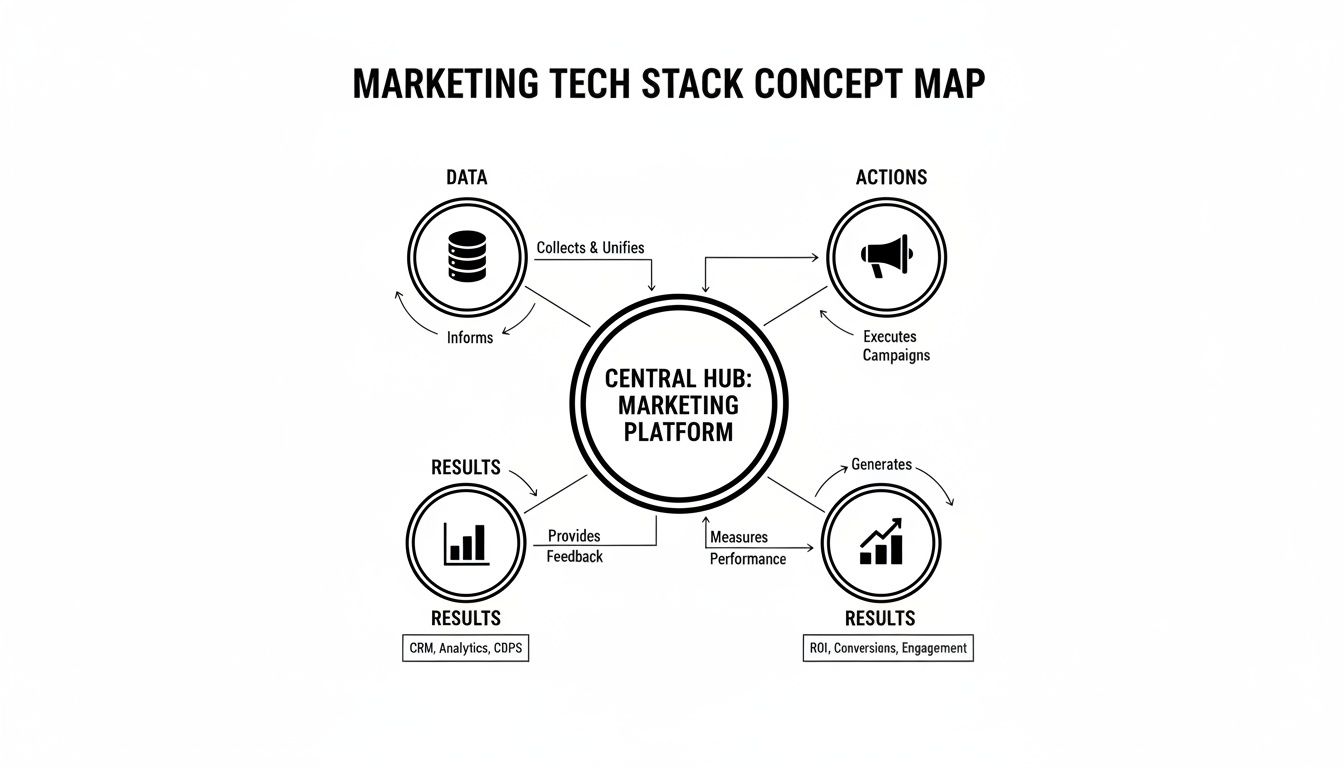
This diagram shows how every marketing activity really begins with data. That data fuels targeted actions, and those actions are ultimately justified by the results they produce. Let’s pull back the curtain on the five critical layers that make this whole process tick.
The Five Layers of a Modern Martech Stack
Each layer in the stack handles a specific part of the data's journey. Getting a handle on these individual functions is the key to designing an architecture that truly supports your business goals. A failure in one layer creates a bottleneck that gums up the entire system.
Here are the five essential layers you need to know:
- Data Collection: This is ground zero. It’s the layer responsible for scooping up raw behavioral data from every customer touchpoint—website visits, app usage, email opens, ad clicks, you name it.
- Data Management: Once collected, that raw data is a mess. This layer cleans it, unifies it, and organizes it into a single, reliable profile for each customer, making the information actually usable for your other tools.
- Analytics and Measurement: With clean, organized data, this is where you uncover the "why." You'll analyze trends, measure campaign performance, and finally understand what’s driving your key business metrics.
- Activation and Engagement: This is the action layer. It takes the insights from your data and uses them to power personalized messages and campaigns across channels like email, social media, and advertising networks.
- Governance and Observability: This final layer is the quality control system for your entire stack. It ensures the data flowing between tools is accurate, consistent, and reliable, catching errors before they can poison your analytics and campaigns.
These layers aren’t independent silos; they are deeply interconnected. Data flows from collection to management, is analyzed for insights, which then fuels activation—all while governance tools keep a watchful eye on the health of the entire process.
The Critical Role of Data Governance
While every layer is important, governance and observability is hands-down the most overlooked. Without it, you’re flying blind. You might have a hundred tools collecting data, but if that data is garbage, every single decision you make based on it will also be garbage. This isn't a rare problem; it's an epidemic.
The sheer number of marketing technology solutions has exploded, creating immense complexity. As of 2025, there were over 15,000 martech solutions on the market, and the average large company juggles over 100 different marketing tools every single day. This chaos creates data inconsistencies and workflow nightmares that directly sabotage marketing effectiveness, a problem detailed in industry research on how to turn your martech stack into a growth engine.
Data governance isn't just some boring technical task; it's a strategic necessity. It ensures the insights you generate and the campaigns you launch are built on a foundation of trustworthy data, protecting your investment and driving reliable outcomes.
Tools in the governance and observability layer act as automated auditors for your data pipeline. For example, platforms like Trackingplan.com offer solutions that automatically monitor your analytics and marketing tags to detect implementation errors, data inconsistencies, and schema changes. If a new website deployment breaks a critical analytics tag, these tools alert you immediately, preventing data loss and ensuring downstream platforms receive accurate information.
Without this layer, a broken tracking event could go unnoticed for weeks, leading to wildly inaccurate performance reports, poorly targeted campaigns, and a whole lot of wasted marketing spend. It’s the crucial safety net that makes the entire marketing tech stack something you can actually depend on.
Choosing Your Stack Architecture Blueprint
Picking the right structure for your marketing tech stack is one of the most critical decisions you'll make. There’s no magic "best" blueprint. The right architecture is completely tied to your company's size, maturity, technical muscle, and business goals. A startup’s lean toolkit would buckle under an enterprise's complexity, just as a global company would be suffocated by a startup's bare-bones setup.
The real goal is to build a system that crushes today's problems without painting you into a corner tomorrow. Think of it like buying a vehicle. A solo founder just needs a motorcycle—it's fast, agile, and cheap to run. A scaling business needs a versatile delivery van, while a massive corporation needs a whole fleet of semi-trucks, complete with its own logistics and maintenance department.

Let's walk through the three common blueprints that map to these different stages of business growth.
The Starter Stack for New Businesses
When you're just getting started, the name of the game is speed and simplicity. The main objective is to land those first customers and prove your business model works, not to architect a flawless data machine. The Starter Stack is all about ease of use and affordability.
This blueprint is usually just a handful of user-friendly tools, often with free or low-cost tiers, that cover the absolute essentials.
- Core Components: You'll typically see a simple CRM (like the free version of HubSpot), an email tool (like Mailchimp), web analytics (Google Analytics), and a social media scheduler (Buffer).
- Focus: The entire point is direct customer acquisition and basic engagement. There’s almost no thought given to deep data integration or complex automation just yet.
The biggest win here is the low barrier to entry. Your team can be up and running in days without needing to hire a data engineer. But the tradeoff is scalability. As the business grows, these disconnected tools quickly turn into frustrating data silos and operational nightmares.
The Growth Stack for Scaling Companies
Once a company hits product-market fit and starts to really scale, its needs get a lot more complicated. The Growth Stack is built to handle more data, automate more workflows, and create a much more unified view of the customer. This is usually when a Customer Data Platform (CDP) becomes the heart of the stack.
The focus shifts from simply acquiring customers to truly understanding and retaining them. This means you have to pull data from multiple sources to personalize messages and track a more complex customer journey. Tools for A/B testing, marketing automation, and more sophisticated analytics suddenly become non-negotiable.
The move to a Growth Stack is a huge turning point. It’s when marketing stops being about running a bunch of separate campaigns and starts becoming a data-driven system. You're building a repeatable engine for growth, not just pulling one-off levers.
This architecture can support a much more advanced marketing team, but it also requires more resources to manage and integrate properly. Making sure the data flowing into your CDP is clean and accurate is now a top priority, which is why governance tools start to enter the picture.
The Enterprise Stack for Complex Organizations
Large enterprises operate at a scale that demands a powerful, specialized, and highly governed tech stack. The Enterprise Stack is designed for massive complexity—managing multiple product lines, global regions, and petabytes of data. This blueprint almost always uses a "best-of-breed" or composable approach.
Instead of trying to find one platform that does everything, enterprises pick the absolute best tool for each specific job—a powerful data warehouse, an advanced attribution platform, a sophisticated personalization engine, you name it. The CDP is still central, but it's just one piece of a much larger, more intricate data ecosystem.
Here, data governance and observability are table stakes. With dozens or even hundreds of tools plugged in, one small data quality issue can create a massive ripple effect, costing millions in wasted ad spend or bad business intelligence. This is where platforms that offer data governance solutions like Trackingplan.com become critical infrastructure. They act as the quality control layer that ensures the entire system can be trusted.
Comparing Integrated Suites vs. Composable Stacks
As you move from a starter setup to a more mature architecture, a major decision is whether to buy into a single, all-in-one platform or build a "composable" stack by picking the best tool for each job. Each path has serious pros and cons, and the right choice depends on your team's skills, budget, and long-term goals. This table breaks down the key differences to help guide your decision.
| Factor | Integrated Suite (All-in-One) | Composable Stack (Best-of-Breed) |
|---|---|---|
| Flexibility | Lower. You're locked into the vendor's ecosystem and feature set. | Higher. You can swap tools in and out as needs change or better tech emerges. |
| Integration | Simpler. Tools are pre-integrated, reducing setup time and technical debt. | More Complex. Requires dedicated resources (engineers, a CDP) to connect tools. |
| Functionality | Often a "jack-of-all-trades, master-of-none." Good at many things, but rarely the best. | Best-in-class functionality for each specific task (e.g., email, analytics, personalization). |
| Cost | Can be cheaper upfront with bundled pricing, but may have hidden costs for premium features. | Potentially higher total cost of ownership due to multiple subscriptions and integration overhead. |
| Vendor Management | Simpler. One contract, one point of contact for support. | More Complex. Managing multiple contracts, renewals, and support relationships. |
| Ideal For | Teams with limited technical resources who value simplicity and convenience. | Mature teams with specific needs and the technical expertise to manage integrations. |
Ultimately, an integrated suite gets you to market faster and simplifies vendor management, which is perfect for many growing companies. A composable stack, on the other hand, offers unparalleled power and flexibility, making it the go-to choice for enterprises that need to maintain a competitive edge.
Integrating AI and Automation into Your Stack
Artificial intelligence isn't some far-off concept anymore; it's a real, practical tool that can supercharge every single part of your marketing tech stack. Instead of thinking of AI as just another platform to cram into an already crowded list, it’s better to see it as an intelligence layer. This layer makes the tools you already pay for smarter, faster, and way more effective.
We're moving past the hype and into real-world applications that deliver tangible business results. It’s all about embedding predictive and generative AI directly into your daily workflows, completely changing how you create content, understand your customers, and decide where to put your money. The end goal is to make every piece of your stack more insightful and autonomous.

This shift is happening right now. The latest data shows that 63% of marketers are already actively using generative AI tools. And this isn't just about making things easier—it's directly tied to the bottom line. Teams that bring AI into the fold are seeing better outcomes, with a whopping 83% of AI-powered sales teams hitting their revenue growth targets, compared to only 66% of their peers. You can discover more insights on AI's role in modern marketing and see the numbers for yourself.
How AI Supercharges Your Stack
Think of AI as a powerful amplifier, not a replacement for your core systems. It hooks into your existing data sources and activation channels, adding a layer of intelligence that was simply impossible to achieve at scale before.
Here are a few ways this comes to life in the real world:
- Generative AI for Content and Personalization: Imagine creating endless variations of ad copy, email subject lines, and landing page content without burning out your creative team. AI does just that, letting you run hyper-targeted campaigns and personalize experiences on the fly based on what a user is doing right now.
- Predictive AI for Lead and Churn Scoring: By digging through the historical data in your CRM and CDP, predictive models can pinpoint high-value leads who are most likely to convert. Even better, they can flag at-risk customers who are showing signs of leaving, giving you a chance to step in with a targeted retention campaign before it's too late.
- Machine Learning for Ad Spend Optimization: AI algorithms can analyze performance data from your ad platforms in real time. They automatically shift your budget to the channels, campaigns, and audiences that are actually working. This maximizes your return on ad spend without you needing to manually tweak bids and budgets all day.
AI's true power in a marketing tech stack isn't just automation; it's about uncovering hidden patterns in your data. It finds the opportunities and risks that human analysts would almost certainly miss, giving you a significant competitive advantage.
Making Your Analytics Smarter
One of the first places you'll see a huge benefit from AI is in your analytics. Your traditional BI tools are great for telling you what happened. But AI-powered analytics can finally tell you why it happened and what is likely to happen next.
This means your analytics platform evolves from a simple dashboard into a source of proactive insights. For instance, an AI tool might automatically notice that a specific customer segment is responding unusually well to a new campaign on a certain channel. It would then recommend you shift more budget there to capitalize on the trend. For a deeper dive, our article on integrating marketing automation takes a closer look at how to connect these systems for maximum impact.
Ultimately, bringing AI and automation into the mix is about building a marketing tech stack that learns and adapts on its own. It transforms your collection of tools from a passive system needing constant human guidance into a proactive engine that helps you make smarter decisions with far less effort.
A Practical Roadmap for Implementation and Vendor Selection
An idea for the perfect marketing tech stack is just that—an idea. It’s worthless without a solid plan to bring it to life. Moving from a blueprint on a whiteboard to a fully operational system requires a methodical approach, one that balances ambition with practicality.
This roadmap will give you a clear, step-by-step process for launching or upgrading your stack. The goal? Minimize risks and make sure you get value from day one.
The journey starts long before you ever sign a contract. The first, and most critical, phase is setting up a rigorous framework to evaluate potential vendors. Without clear criteria, it's all too easy for teams to get wowed by impressive demos and shiny features that don't actually solve their core business problems.
Building Your Vendor Evaluation Framework
Choosing the right technology partners is a high-stakes decision. The wrong tool can lead to wasted budget, frustrated teams, and a system that creates more headaches than it solves. A structured evaluation process is your best defense, helping you stay objective and focused on what truly matters.
Think of your framework as a scorecard. Every potential tool gets assessed against the same set of criteria, ensuring you’re comparing apples to apples and making a decision based on evidence, not just a gut feeling.
Your key evaluation criteria should absolutely include:
- Core Functionality: Does the tool actually excel at the specific job you need it to do? You have to go beyond the sales pitch and pressure-test the features most critical to your team's daily work.
- Integration Capabilities: How well does it play with the other tools in your stack? Look for robust APIs, native integrations, and—this is a big one—strong documentation. Poor integration just creates more data silos, defeating the whole purpose of a connected stack.
- Support and Partnership: What level of support can you realistically expect? Dig into their onboarding process, ongoing customer service, and the quality of their technical docs. A vendor should feel like a true partner invested in your success.
- Total Cost of Ownership (TCO): You have to look beyond the sticker price. Factor in implementation fees, training costs, the engineering resources you'll need, and any potential add-ons. A tool that seems cheap upfront can get very expensive, very fast.
A disciplined vendor selection process is your best defense against "shiny object syndrome." It forces you to prioritize your actual business needs over a vendor's marketing hype, leading to smarter, more sustainable technology investments.
A Phased Implementation Plan
Once you've picked your vendors, the real work begins. A phased rollout is almost always smarter than a "big bang" launch. It lets you manage risk, gather feedback, and show value incrementally, which is crucial for keeping momentum and stakeholder buy-in. An effective plan breaks the project into manageable stages.
1. Audit and Document Your Current State
Before you can build the future, you need to deeply understand the present. Map out your existing tools, data flows, and team workflows. This audit will uncover hidden dependencies and critical gaps your new stack absolutely must address.
2. Define Clear Business Requirements
What specific problems are you trying to solve? Translate your high-level goals into concrete, measurable requirements. For example, instead of a vague goal like "improve personalization," a much better requirement is "decrease cart abandonment by 15% using real-time behavioral triggers." Writing a detailed Request for Proposal (RFP) is a fantastic way to formalize these needs. You can learn more by checking out our guide on how to create a request for proposal for marketing services.
3. Run a Pilot Program
Never underestimate the power of a pilot. Select a small, controlled user group or a specific business unit to test the new technology. A pilot lets you work out the kinks in a low-risk environment, gather invaluable user feedback, and build a powerful business case for a full rollout.
4. Manage Data Migration and Training
This is where so many projects stumble and fall. You need a clear plan for migrating historical data and a comprehensive training program to get your team comfortable with the new tools. Adoption doesn't just happen by accident; it requires a deliberate, focused effort to drive change.
The Common Traps That Will Wreck Your Martech Stack
Building or overhauling your marketing tech stack is a massive undertaking. It’s also a journey filled with traps that can easily derail the entire project. I’ve seen it happen time and again: even the sharpest teams fall into predictable pitfalls, ending up with bloated budgets, frustrated marketers, and a stack that creates more chaos than it solves.
Want to de-risk your investment? The fastest way is to learn from the mistakes others have already made. By knowing what to look out for, you can navigate around these challenges and build a system that actually works. The funny thing is, the biggest failures are rarely about the technology itself. They’re about strategy, people, and process.
Chasing Shiny Objects Without a Strategy
This is the classic mistake. You see a flashy demo of the latest and greatest tool and get completely mesmerized. With over 15,000 martech solutions out there, it’s incredibly easy to get sucked into "shiny object syndrome." Teams buy impressive software based on a cool feature set, only to realize later that it doesn't solve a real business problem or, worse, won't even connect to their existing systems.
This is how you end up with a disconnected, bloated stack full of expensive shelfware. It's no wonder the average business is juggling 275 separate tools—many of which don't talk to each other. Before you even think about adding something new, you have to ask the hard questions: "What specific business problem are we trying to solve here, and how will we prove this tool solved it?"
Underestimating Data Quality and Governance
So many companies make this mistake. They'll spend a fortune on sophisticated analytics and activation platforms but completely ignore the quality of the data pumping through them. Think of it like building a Ferrari engine and then filling the tank with swamp water. The result is always the same: garbage in, garbage out.
When your data is a mess, your expensive insights are worthless and your personalization efforts fall flat. If you don't make data governance a priority from day one, you'll end up making critical business decisions based on flawed information.
Neglecting data governance is the silent killer of marketing tech stack ROI. It poisons your analytics, erodes trust in your reports, and ensures your expensive tools will never live up to their potential.
This is why tools that automate data monitoring, like the ones offered by Trackingplan.com, have become so essential. They're like an early-warning system for your data pipeline, catching errors before they have a chance to corrupt your entire decision-making process.
Creating New Data Silos
The whole point of a modern marketing stack is to build a single, unified view of the customer. But if you start bolting on new tools without a rock-solid integration plan, you achieve the exact opposite. You just end up creating new, isolated islands of data.
This typically happens when one department buys a tool to fix its own problem without thinking about the bigger picture. The email team has its data, the paid media team has its data, and the analytics team has its own version of the truth. None of them can be easily combined to see the full customer journey. A strong integration strategy, usually built around a CDP, is completely non-negotiable if you want to avoid this costly mistake and build a truly connected system.
Got Questions About Your Martech Stack?
As you start piecing together your marketing tech stack—or trying to make sense of the one you inherited—questions are going to pop up. It happens to everyone. Let's tackle some of the most common ones I hear from marketing leaders.
I'm Starting from Scratch. Where Do I Even Begin?
Don't boil the ocean. The biggest mistake is trying to buy everything at once. Instead, think about your customer's journey first.
Map out the basic stages—how people find you, how they decide to buy, and how you keep them coming back. Then, pick the one tool you absolutely need for each stage.
For most businesses, this simple "Starter Stack" is the way to go. It solves your most immediate problems without the complexity. It usually looks like this:
- Website Analytics: You need to see what people are actually doing on your site.
- A CRM: This is your command center for managing customer relationships and sales data.
- An Email Marketing Tool: The most direct line you have to your audience.
Once you’ve got these basics humming and you're seeing a return, you can then strategically add more specialized tools as you grow and face new challenges.
Realistically, How Much Should a Marketing Tech Stack Cost?
This is the classic "it depends" answer, and for good reason. The cost can swing from a couple of hundred dollars a month for a small team to millions a year for a global enterprise. A recent CMO Spend Survey found that marketing technology eats up nearly 22.4% of the total marketing budget.
But here’s the thing: focusing on a magic number is the wrong approach. You need to think in terms of Total Cost of Ownership (TCO). That's not just the subscription fees. It’s the implementation costs, the training, and the salaries of the people who have to run the tools. The goal isn't to be cheap; it's to get a positive return on your investment.
A common mistake is focusing solely on software license fees. The real cost of a marketing tech stack includes the people and processes required to make the technology deliver actual business value.
How Do I Make Sure My Data Is Actually Accurate?
You can’t just hope for clean data—you have to actively manage it. Trusting your numbers requires a serious commitment to data governance from day one. This means setting up clear processes to validate data as it’s collected and as it moves between your different platforms.
For many teams, this eventually means bringing in a dedicated data observability or governance platform. Think of these tools as an automated quality control layer for your entire stack. They constantly monitor your data pipelines for things that don't look right.
For example, a solution from a provider like Trackingplan.com can automatically spot broken analytics tags or inconsistent event data. It alerts you to problems before they poison your reports and throw your campaigns off track. This kind of proactive monitoring is non-negotiable if you want to maintain trust in your marketing data.
At The Data Driven Marketer, we build in-depth guides and frameworks to help you assemble a powerful, high-impact marketing tech stack. Explore our resources to learn more about turning data into your biggest competitive advantage.