

Over half of marketing teams struggle to unlock the full potential of their martech platforms due to integration complexity and unclear strategies. Yet these systems serve as the backbone of modern data-driven marketing, unifying fragmented tools and enabling real-time customer engagement. Understanding how to strategically leverage martech platforms transforms marketing performance from reactive guesswork into precision-driven growth.
Table of Contents
- Understanding Martech Platforms: Definition And Core Functions
- How Martech Platforms Enable Data-Driven Marketing
- Automating Customer Journey Orchestration With Martech
- Measuring Marketing Performance And Attribution Via Martech Platforms
- Common Misconceptions About Martech Platforms And Their Correction
- Framework For Evaluating And Optimizing Martech Platforms
- Practical Applications And Future Trends In Martech Platforms
- Enhance Your Martech Strategy With Our Expert Resources
- Frequently Asked Questions
Key takeaways
| Point | Details |
|---|---|
| Martech platforms function as marketing control planes | They unify diverse marketing systems into integrated hubs for centralized data and orchestration. |
| Real-time data-driven marketing becomes achievable | Automated insights and workflow orchestration enable personalized engagement at scale. |
| Strategic integration boosts attribution accuracy significantly | Proper platform integration reduces attribution errors by 40% through unified multi-channel data. |
| Regular auditing increases ROI and engagement | Systematic evaluation eliminates redundancies and aligns tools with evolving marketing goals. |
| Strategic operation matters more than tool collection | Misconceptions about automatic benefits hinder adoption; intentional use drives success. |
Understanding martech platforms: definition and core functions
Martech platforms are integrated technology suites that function as marketing control planes, orchestrating the complex ecosystem of tools modern marketers depend on daily. They aggregate data from disparate sources, automate repetitive processes, and generate actionable analytics that inform strategic decisions. Rather than operating as isolated tools, these platforms serve as the centralized hub that unifies your entire marketing technology infrastructure.
The core capabilities extend across four critical dimensions. Data ingestion pulls information from CRM systems, advertising platforms, email tools, and analytics services into a single repository. Automation workflows eliminate manual tasks by triggering actions based on predefined rules or behavioral signals. Analytics dashboards transform raw data into visual insights that reveal campaign performance and customer patterns. Journey orchestration coordinates touchpoints across channels to create seamless customer experiences.
These platforms enable building the perfect martech stack by providing the connective tissue between specialized tools. Without this integration layer, marketing teams face fragmented data, duplicated efforts, and blind spots in measurement.
Martech platforms transform disconnected marketing activities into synchronized operations where every touchpoint informs the next customer interaction.
Key functional components include:
- Customer data platforms that create unified profiles from fragmented identity data
- Marketing automation engines that execute multi-step campaigns without manual intervention
- Analytics modules that attribute revenue to specific marketing activities
- Integration frameworks that connect legacy systems with modern cloud applications
The distinction between a collection of marketing tools and a true martech platform lies in integration depth and operational cohesion. Platforms enable bi-directional data flow, ensuring customer actions in one channel immediately inform personalization in another.
How martech platforms enable data-driven marketing
Automated data connectivity forms the foundation of data-driven marketing by eliminating the manual processes that previously consumed hours of analyst time. Martech platforms reduce manual data handling by 60% through automated integration, freeing teams to focus on strategic interpretation rather than data wrangling. These systems continuously synchronize information across email platforms, advertising networks, website analytics, and customer databases to construct unified customer profiles.

Real-time analytics capabilities separate modern martech from legacy systems that relied on batch processing and delayed reporting. When a customer abandons a shopping cart or engages with specific content, platforms instantly update behavioral scores and trigger personalized responses. This immediacy enables marketing teams to capitalize on high-intent moments rather than discovering opportunities days later through backward-looking reports.
Artificial intelligence and machine learning integration elevate platforms from descriptive to predictive analytics. Advanced systems identify patterns humans miss, forecasting which customers will churn, which products appeal to specific segments, and which creative variations drive highest engagement. These data driven marketing insights transform gut-feel decisions into evidence-based strategies.
The practical workflow follows this progression:
- Data ingestion pulls customer interactions from all touchpoints into centralized storage
- Identity resolution matches anonymous visitors to known profiles using probabilistic and deterministic methods
- Behavioral scoring assigns values based on engagement signals and conversion likelihood
- Predictive modeling forecasts future actions using historical patterns and machine learning
- Automated orchestration triggers personalized messages through optimal channels at calculated moments
- Performance measurement feeds results back into models for continuous improvement
Pro Tip: Start with bi-directional integration between your CRM and advertising platforms to enable closed-loop attribution before expanding to additional systems.
The compounding effect of automation becomes apparent over time. Each customer interaction generates data that refines behavioral models, which improve personalization accuracy, driving higher engagement that produces richer behavioral signals. This virtuous cycle separates organizations that treat martech as passive repositories from those leveraging platforms as active intelligence engines.
Automating customer journey orchestration with martech
Dynamic adaptation represents the evolutionary leap from static campaign sequences to responsive customer journeys. Traditional email workflows followed predetermined paths regardless of real-time behavior, but modern martech platforms adjust messaging based on immediate actions. When a customer views pricing pages three times without converting, the system recognizes hesitation and automatically delivers social proof testimonials rather than generic product features.
Automation reduces the lag between customer signals and marketing responses from days to milliseconds. This compression of reaction time proves critical in competitive markets where delayed follow-up means lost opportunities. Platforms execute complex decision trees that would overwhelm human teams, evaluating hundreds of variables to determine optimal next actions for thousands of customers simultaneously.
Practical applications demonstrate the technology’s versatility:
- Triggered email sequences that adapt content based on browsing behavior and purchase history
- Retargeting campaigns that suppress ads for customers who already converted while intensifying exposure for high-intent prospects
- Personalized website experiences that display different content blocks based on traffic source and behavioral segment
- SMS notifications timed to individual timezone preferences and historical engagement patterns
- Social media advertising that automatically adjusts creative rotation based on performance metrics
Enhanced conversion rates emerge from removing friction points and delivering contextually relevant messages. When every touchpoint reflects awareness of the customer’s current position in their decision journey, the path to purchase shortens naturally. Seamless orchestration eliminates the jarring experience of receiving irrelevant messages that betray organizational silos.
Pro Tip: Map your customer journey visually before configuring automation rules to identify gaps where prospects currently fall through the cracks between marketing and sales handoffs.
The sophistication of orchestration scales with platform maturity. Entry-level implementations might automate welcome series and cart abandonment, while advanced deployments dynamically adjust entire campaign strategies based on predicted lifetime value and churn probability. The key lies in starting simple and layering complexity as teams develop operational competence.
Measuring marketing performance and attribution via martech platforms
Unified data consolidation eliminates the fractured visibility that plagued marketers when each channel reported performance in isolation. Platforms aggregate impressions, clicks, conversions, and revenue across paid search, social advertising, email, content marketing, and offline touchpoints into comprehensive dashboards. This holistic view reveals how channels interact rather than compete, exposing assist patterns that single-channel analytics miss entirely.
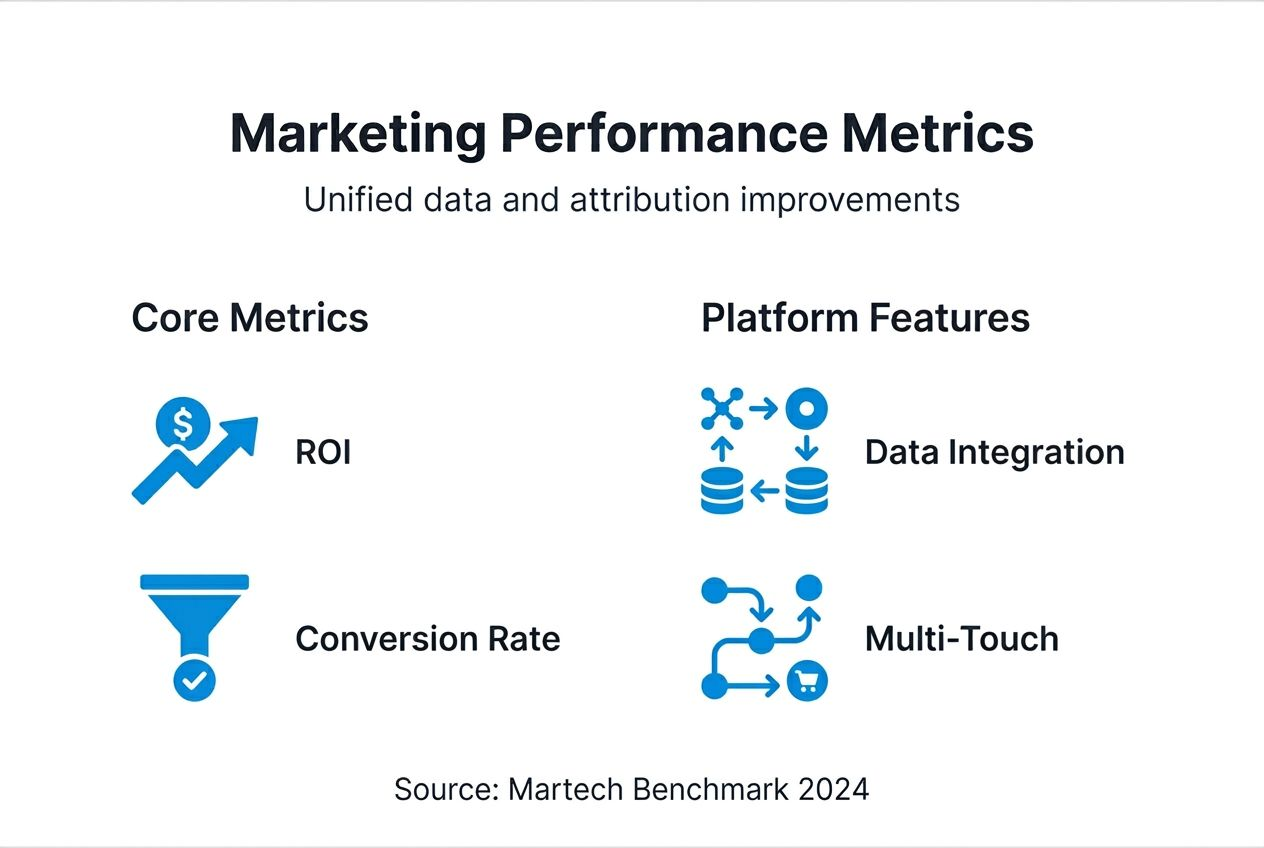
Measurement and attribution capabilities reduce attribution errors by 40% through multi-touchpoint data consolidation. By tracking the complete customer journey from initial awareness through final conversion, platforms assign appropriate credit to each contributing interaction. This precision enables confident budget allocation based on actual contribution rather than simplified last-click models that systematically undervalue upper-funnel activities.
Reduction of errors in multi-touch attribution transforms strategic planning from approximation to optimization. When you accurately understand which combination of touchpoints drives conversions, you shift spend toward high-performing sequences and away from ineffective tactics. The financial impact compounds quarter over quarter as budgets concentrate on proven approaches.
| Attribution Model | Accuracy Level | Best Use Case |
|---|---|---|
| Last Click | Low | Simple, short sales cycles |
| First Click | Low | Top-of-funnel focus only |
| Linear | Medium | Equal credit distribution |
| Time Decay | Medium | Recent touchpoints matter most |
| Data-Driven | High | Complex, multi-channel journeys |
Platform capabilities extend beyond attribution to comprehensive performance measurement:
- Customer acquisition cost tracking across all channels with precise per-customer calculations
- Lifetime value modeling that predicts long-term revenue based on early behavioral indicators
- Campaign ROI measurement linking marketing spend directly to revenue outcomes
- Cohort analysis revealing how customer behavior patterns shift over time
- Incrementality testing that isolates true marketing impact from organic baseline activity
The integration between measurement and optimization creates feedback loops that continuously improve results. Underperforming segments get automatically paused while high-performers receive increased budget allocation. This digital marketing measurement discipline separates organizations that grow predictably from those guessing their way through budget planning.
Accurate attribution transforms marketing from a cost center defending budgets into a growth engine demonstrating measurable return on every dollar invested.
Advanced practitioners extend measurement into predictive territory, using historical patterns to forecast future campaign performance before launching. This foresight enables proactive optimization rather than reactive correction, compressing the time required to achieve target metrics. Understanding how to calculate marketing roi and implementing robust marketing attribution frameworks become competitive advantages in saturated markets.
Common misconceptions about martech platforms and their correction
The belief that purchasing martech tools automatically improves marketing performance represents the most damaging misconception plaguing the industry. Technology alone delivers zero value without strategic deployment, skilled operation, and organizational alignment. 70% of marketers cite lack of strategy or integration as the main barrier to martech success, revealing that human factors outweigh technical capabilities in determining outcomes.
Complexity creates a secondary barrier that prevents teams from extracting available value from platforms already in their stack. When interfaces overwhelm users or capabilities remain undiscovered, organizations experience buyer’s remorse despite owning powerful systems. The solution requires dedicated training, phased rollouts that build competence incrementally, and executive commitment to operational excellence over shiny object syndrome.
Critical misconceptions marketers must overcome:
- Assuming data integration happens automatically rather than requiring deliberate configuration and maintenance
- Believing platforms operate effectively in isolation rather than requiring ecosystem-wide coordination
- Expecting immediate results rather than acknowledging the learning curve inherent in sophisticated systems
- Thinking more tools equal better performance rather than recognizing that focused capabilities outperform bloated stacks
- Viewing implementation as a project rather than an ongoing optimization process
Effective use demands operational integration where martech platforms connect to business processes, not just technical systems. Sales teams need visibility into marketing-qualified lead scores. Customer service requires access to campaign interaction history. Product teams benefit from behavioral insights that inform roadmap priorities. When platforms serve organizational needs holistically rather than existing as marketing department tools, their value multiplies.
The training investment separates successful deployments from expensive shelfware. Platforms offer extensive capabilities, but teams default to familiar basics without structured learning paths. Organizations that budget for ongoing education alongside licensing costs realize exponentially higher returns than those treating training as optional.
Ongoing optimization acknowledges that customer behavior, competitive dynamics, and platform capabilities evolve continuously. Static configurations that worked last quarter grow stale as markets shift. Regular audits identify new opportunities, eliminate outdated rules, and refresh strategies based on accumulated performance data.
Framework for evaluating and optimizing martech platforms
Auditing existing tools starts with comprehensive inventory of every marketing system currently in use, including forgotten trial accounts and shadow IT deployments. Document each platform’s primary function, monthly cost, user adoption rate, and integration status. This visibility exercise frequently reveals redundancies where three different tools perform overlapping functions, none optimally.
Identify underused platforms by comparing available capabilities against actual utilization. Many organizations pay for enterprise features while using only basic functionality. Consolidating onto fewer, fully-leveraged platforms typically outperforms maintaining sprawling collections of partially-adopted tools.
Prioritize integration by mapping data flows between systems and identifying gaps where manual processes persist. The highest-value integrations typically connect customer data platforms with advertising systems, enabling real-time audience synchronization. Secondary priorities include CRM-to-marketing automation links and analytics-to-optimization feedback loops.
| Evaluation Criterion | High Priority Signal | Low Priority Signal |
|---|---|---|
| Daily Active Users | >75% of licenses used | <25% adoption rate |
| Integration Depth | Bi-directional, automated | Manual CSV exports |
| Business Impact | Directly drives revenue | Unclear ROI connection |
| Vendor Viability | Growing market share | Declining user base |
| Cost Efficiency | <10% of marketing budget | >25% budget allocation |
Balance complexity with capability by establishing clear criteria for adding new tools. Each platform should solve specific problems existing systems cannot address, not duplicate current capabilities with marginal improvements. The perfect martech stack prioritizes depth over breadth.
Systematic optimization follows this workflow:
- Conduct quarterly audits documenting platform performance against defined KPIs
- Survey users to identify friction points and feature gaps impacting productivity
- Benchmark capabilities against evolving marketing goals and strategic priorities
- Test integration improvements in sandbox environments before production deployment
- Implement changes incrementally to isolate impact and enable rapid rollback if needed
- Document configuration decisions and maintain current architecture diagrams
- Review vendor roadmaps to anticipate upcoming capabilities and plan adoption
Pro Tip: Create a centralized documentation repository where all platform configurations, integration mappings, and optimization decisions get recorded for institutional knowledge preservation.
Regular performance reviews align tools with business evolution. A marketing tech stack that supported last year’s product launch might require reconfiguration for this year’s international expansion. Proactive realignment prevents the drift between platform capabilities and organizational needs.
Vendor relationships deserve active management rather than passive acceptance of standard service levels. Successful marketing technology companies recognize strategic customers and provide enhanced support, early access to features, and collaborative roadmap input when asked.
Practical applications and future trends in martech platforms
Stepwise optimization provides the roadmap for transforming theoretical understanding into operational excellence. Begin with comprehensive auditing that establishes baseline performance across all current platforms and identifies immediate improvement opportunities. Prioritize integration projects that eliminate the highest-impact data silos, typically between customer databases and activation channels.
Automate repetitive processes systematically, starting with high-volume, low-complexity workflows before tackling sophisticated orchestration. Welcome sequences and cart abandonment represent ideal starting points because they deliver measurable impact with straightforward logic. Measure results rigorously using the attribution frameworks discussed earlier, establishing clear benchmarks before and after each optimization.
Refinement never ends in dynamic markets. Quarterly reviews should reassess platform performance, user adoption, and strategic alignment. Customer expectations evolve, competitors launch innovations, and new technologies emerge constantly.
Leveraging AI advances positions forward-thinking marketers ahead of competitors still relying on rule-based automation. Predictive modeling now forecasts customer lifetime value with remarkable accuracy, enabling proactive retention strategies before churn signals appear. Natural language processing analyzes customer communications at scale, surfacing sentiment patterns and content preferences that inform creative strategy.
Automation scaling reduces manual intervention while improving responsiveness through machine learning that optimizes itself. Advanced platforms test message variations, adjust bid strategies, and refine audience targeting without human oversight. This autonomous optimization operates 24/7 across thousands of micro-segments simultaneously, achieving precision impossible through manual management.
Anticipate growing importance of unified data architectures as privacy regulations tighten and third-party cookies disappear. First-party data collection and activation become competitive differentiators. Platforms that enable real-time customer data platform functionality will command premium value as organizations race to build proprietary audience intelligence.
A B2B software company illustrates successful orchestration in practice. By integrating their martech platform across web analytics, advertising, email, and sales CRM, they created unified customer profiles tracking every interaction. Behavioral scoring identified high-intent prospects who received personalized nurture sequences while sales teams got real-time alerts about engagement spikes. Attribution modeling revealed that webinar attendance combined with case study downloads predicted conversion with 78% accuracy, enabling concentrated spend on those tactics. The result delivered 43% higher marketing-qualified lead volume and 31% improved sales conversion rates within six months.
Enhance your martech strategy with our expert resources
Navigating the complexity of modern martech requires more than understanding concepts; you need proven frameworks and actionable strategies. Whether you’re building your first integrated stack or optimizing an existing infrastructure, the right guidance accelerates results while avoiding costly mistakes.
Our comprehensive resources help you master the technical and strategic dimensions of martech success. Discover how attribution modeling transforms budget allocation from guesswork into precision targeting. Learn the frameworks for constructing a marketing tech stack that scales with your organization while maintaining operational simplicity. Access proven methodologies for measuring impact and demonstrating marketing’s contribution to revenue growth in 2026 and beyond.
Frequently asked questions
What is the main role of martech platforms in modern marketing?
Martech platforms serve as centralized control planes that unify data integration, workflow automation, real-time analytics, and customer journey orchestration across fragmented marketing systems. They enable marketing professionals to execute data-driven strategies efficiently while measuring impact with precision that was impossible when tools operated in isolation.
How do martech platforms improve marketing attribution accuracy?
They consolidate multi-channel data into unified customer profiles, reducing attribution errors by 40% through comprehensive touchpoint tracking. This visibility into complete customer journeys enables more confident budget allocation and strategic decisions based on actual contribution rather than simplified models.
What are common pitfalls when adopting martech platforms?
Deploying platforms without clear strategy leads to underutilization and wasted investment. Ignoring integration requirements creates persistent data silos that negate platform benefits. Overcomplicating technology stacks with redundant tools overwhelms teams and fragments customer data across incompatible systems.
How can marketers optimize their martech platforms for better ROI?
Regularly audit your technology stack to eliminate redundancies and identify underused capabilities worth expanding. Prioritize integration projects and automation workflows that align directly with revenue-generating business goals. Utilize data-driven insights to refine campaigns continuously rather than treating optimization as a one-time implementation project. Our martech stack optimization guide provides detailed frameworks for systematic improvement.