

TL;DR:
- Digital marketing maturity reflects an organization’s ability to strategically optimize technology, data, and processes.
- Different frameworks like Gartner and Forrester focus on process and culture, respectively, for assessing maturity.
- Advancing maturity requires focusing on measurement, cross-functional literacy, automation, and leadership alignment.
Most marketing teams assume that adding more tools or increasing ad spend will automatically produce better results. It rarely works that way. The real differentiator between organizations that consistently grow and those that plateau is digital marketing maturity, a concept that most strategy conversations skip entirely. This guide defines what digital marketing maturity actually means, walks through the most widely used frameworks, shows you how to assess where your organization stands today, and gives you concrete strategies to move up the curve. If you want sustainable, measurable marketing improvement, maturity is the lens you need.
Table of Contents
- Defining digital marketing maturity
- Popular digital marketing maturity models compared
- How to assess your organization’s digital marketing maturity
- Strategies to advance digital marketing maturity
- What most digital marketing maturity guides miss
- Advance your digital marketing maturity with expert tools
- Frequently asked questions
Key Takeaways
| Point | Details |
|---|---|
| Core concept | Digital marketing maturity measures how advanced your capabilities are across strategy, tools, and people. |
| Leading frameworks | Gartner and Forrester offer leading yet contrasting approaches for mapping and improving maturity. |
| Assessment tools | Use structured models to benchmark your current stage and identify realistic improvement areas. |
| Actionable strategies | Combine technology, data, process, and team development to climb the maturity curve. |
Defining digital marketing maturity
Digital marketing maturity describes how far an organization has evolved in its ability to plan, execute, measure, and optimize marketing across technology, processes, people, and data. It is not a measure of how many tools you use or how large your budget is. It is a measure of how effectively all those elements work together to produce reliable, repeatable outcomes.
Think of it this way: two companies can use the exact same marketing stack and get completely different results. The difference is almost always maturity. One team has clear processes, shared data definitions, cross-functional alignment, and a culture of testing. The other runs campaigns reactively, measures inconsistently, and treats analytics as an afterthought. Same tools, wildly different outputs.
It is also worth separating digital marketing maturity from digital transformation, a term that gets used interchangeably but means something broader. Digital transformation refers to organization-wide change across all business processes, from HR to supply chain to customer service. Digital marketing maturity is specifically about the sophistication of your marketing capabilities. You can be deep into a digital transformation program and still have immature marketing practices. They are related but not the same.
The core dimensions that most maturity models evaluate include:
- Technology: How well integrated and utilized your marketing tools are
- Data and analytics: The quality, accessibility, and use of digital marketing analytics across decisions
- Process: How standardized, documented, and repeatable your workflows are
- People and skills: The capabilities and training of your marketing team
- Culture: Whether data-driven thinking is embedded in how the team operates
“The distinction between process-focused and culture-centric models matters enormously when choosing a framework. Gartner-style models emphasize governance and structure, while Forrester-style models prioritize customer-centric culture.”
Understanding which of these dimensions is weakest in your organization is the first step toward targeted, meaningful improvement. Maturity is not about perfection across all dimensions simultaneously. It is about knowing where you are and making deliberate progress.
Popular digital marketing maturity models compared
A maturity model is a structured framework that describes stages of capability development, from basic and reactive to advanced and optimized. Different models exist because different organizations have different priorities, and no single framework fits every context.

The two most widely referenced are Gartner and Forrester. As noted in comparisons of major frameworks, Gartner-style models are process-focused, emphasizing governance, structure, and operational rigor. Forrester-style models are more culture and customer-centric, measuring how well an organization orients its marketing around customer experience and adaptability. A third well-known option is the Google/BCG Digital Maturity Model, which is specifically built for digital marketing and focuses on data connectivity, automation, and measurement.
| Model | Primary focus | Key dimensions | Best for |
|---|---|---|---|
| Gartner | Process and governance | Structure, operations, risk management | Large enterprises with complex governance needs |
| Forrester | Culture and customer centricity | Customer experience, adaptability, talent | Organizations prioritizing CX transformation |
| Google/BCG | Data and measurement | Audience, attribution, automation, organization | Digital marketing teams focused on performance |
Choosing a process-focused approach has real advantages: it creates accountability, reduces errors, and scales well. But it can also become bureaucratic and slow. A culture-focused approach drives innovation and agility but can lack the structure needed for consistent execution.
Pros of process-focused models:
- Clear accountability and governance
- Easier to audit and benchmark
- Scales across large teams
Cons:
- Can feel rigid and slow to adapt
- May underweight culture and talent
Pros of culture-focused models:
- Drives innovation and customer alignment
- Better at capturing organizational health
Cons:
- Harder to measure objectively
- Less prescriptive on execution
When building your optimization framework, consider borrowing structural elements from Gartner-style models while using Forrester’s customer-centric lens to evaluate outcomes. Pair that with analytics best practices to keep measurement honest.
Pro Tip: Do not pick a single model and apply it rigidly. Use one as your primary scaffold, then pull specific dimensions from others where your organization has unique gaps. Hybrid approaches almost always produce more useful assessments.
How to assess your organization’s digital marketing maturity
Once you have chosen or blended a model, the next step is to assess where your organization actually stands. Self-assessment tools are the most practical starting point. Google’s Digital Maturity Benchmark and Forrester’s Digital Maturity Assessment are both freely accessible and give structured scoring across key dimensions.
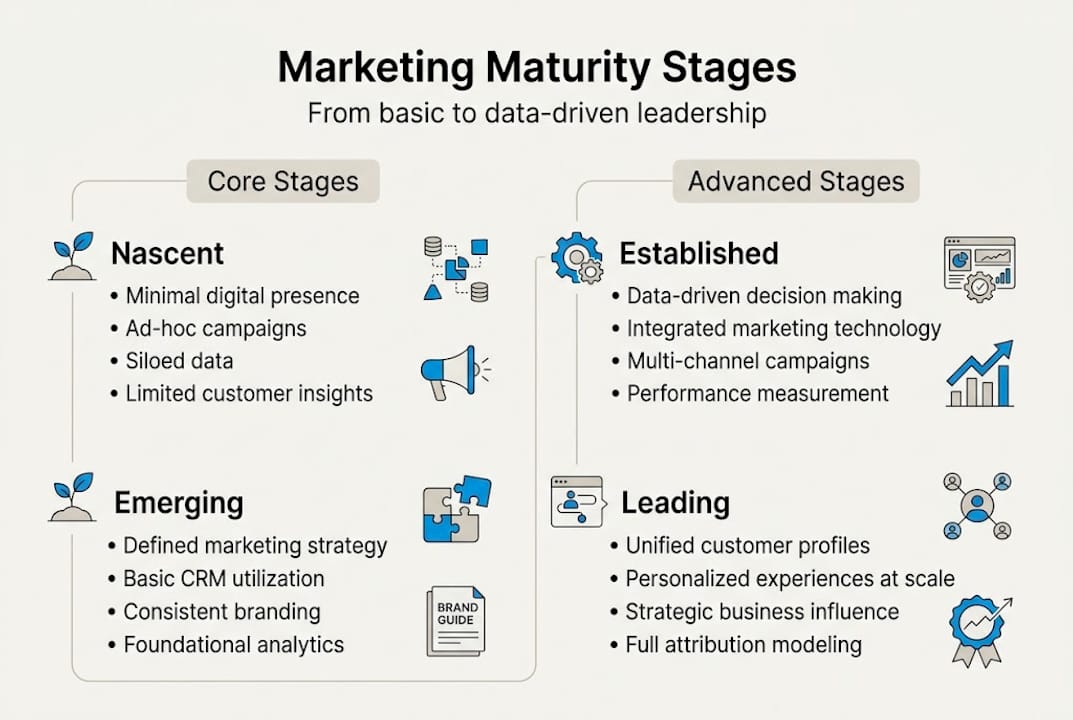
The maturity stages most models use follow a consistent progression:
| Stage | Label | Key characteristics |
|---|---|---|
| 1 | Nascent | Ad hoc campaigns, no standardized measurement, siloed teams |
| 2 | Emerging | Some repeatable processes, basic analytics in place, limited integration |
| 3 | Established | Standardized workflows, cross-channel data, regular performance reviews |
| 4 | Optimized | Fully integrated stack, predictive analytics, continuous testing culture |
Knowing which stage describes your organization gives you a clear starting point. Most mid-market companies sit between stages 2 and 3. Very few are genuinely at stage 4, even if their tools suggest otherwise.
Here is a practical process for running an internal maturity audit:
- Define scope: Decide whether you are assessing the full marketing function or a specific channel or capability area.
- Select your framework: Choose the model that best fits your industry and organizational size.
- Gather input across teams: Survey stakeholders in marketing, analytics, IT, and sales. Maturity is an organizational condition, not just a marketing one.
- Score each dimension: Use the model’s criteria to rate your current state honestly, not aspirationally.
- Identify gaps: Compare your scores against the next maturity stage to find the highest-priority gaps.
- Document findings: Create a shared report that leadership and cross-functional teams can act on.
Using the right digital marketing tools and analytics tools during this process helps surface data quality issues that often reveal maturity gaps you would not otherwise see. Teams adapting to new analytical tools frequently discover that their measurement infrastructure is less mature than their campaign execution.
Pro Tip: Include at least one person from finance and one from product or IT in your audit. Their perspective on how marketing data is used outside the marketing team will expose blind spots that internal marketing reviews consistently miss.
Strategies to advance digital marketing maturity
With your current maturity level defined, concrete improvement becomes possible. Advancing maturity is not about doing everything at once. It is about sequencing the right investments in the right order.
- Standardize your measurement foundation first. Before investing in new tools or campaigns, make sure your tracking, attribution, and reporting are reliable. Decisions built on bad data produce bad outcomes regardless of how sophisticated your strategy is.
- Build cross-functional data literacy. Maturity stalls when only the analytics team understands the data. Invest in training that helps marketers, product managers, and executives interpret and act on advanced marketing metrics.
- Automate repetitive processes strategically. Use marketing automation tools to free your team from manual reporting and campaign execution tasks, so they can focus on strategy and testing.
- Create a culture of structured experimentation. Move from intuition-based decisions to a regular cadence of A/B tests, incrementality studies, and post-campaign reviews.
- Align leadership on maturity goals. Maturity initiatives without executive sponsorship rarely survive past the first quarter. Make the business case using revenue impact and efficiency gains.
Common pitfalls that slow maturity progress:
- Buying new tools before fixing broken processes
- Treating maturity as a one-time project rather than an ongoing capability
- Skipping the people and culture dimensions entirely
- Measuring progress only by tool adoption, not by outcome improvement
- Letting process-focused vs. culture-centric debates stall decision-making
Pro Tip: Pick one quick win per quarter that demonstrates measurable improvement, whether that is reducing reporting lag, fixing a broken attribution model, or standardizing campaign naming conventions. Small, visible wins build the internal momentum that sustains longer-term maturity programs.
What most digital marketing maturity guides miss
Here is the uncomfortable reality: most organizations that fail to advance their digital marketing measurement maturity do not fail because of the wrong framework or the wrong tools. They fail because of people.
Stakeholder misalignment is the single biggest killer of maturity initiatives. When the CMO defines success differently than the analytics director, and both define it differently than the CFO, no framework in the world will produce alignment. Maturity is fundamentally a leadership and communication challenge dressed up as a technical one.
Most guides also underestimate the cultural shift required. Moving from reactive to data-driven marketing is not just a process change. It requires teams to admit uncertainty, test assumptions they previously treated as facts, and sometimes accept that their instincts were wrong. That is hard. It takes psychological safety, not just better dashboards.
The organizations that actually advance their maturity share one trait: they celebrate small wins loudly and invest in cross-team enablement consistently. They treat maturity as a cultural identity, not a project milestone. That mindset shift is what separates organizations that sustain progress from those that stall after the first assessment.
Advance your digital marketing maturity with expert tools
Understanding where your organization sits on the maturity curve is the first real step toward building marketing operations that consistently deliver. The next step is putting the right resources behind that understanding.
At Data Driven Marketer, we publish practical guides, frameworks, and tool comparisons designed specifically for teams working to improve their marketing measurement and operations. Whether you are evaluating digital marketing tool types, building a more reliable attribution model with our attribution modeling guide, or looking for ways to close specific maturity gaps, you will find resources built for the realities of modern marketing teams. Start with what you learned here and go deeper where it matters most.
Frequently asked questions
What are the main stages of digital marketing maturity?
The main stages typically progress from nascent (ad hoc) to emerging (repeatable) to established (standardized) and finally to optimized (fully integrated and data-driven), as reflected across major maturity frameworks.
How do I measure the digital marketing maturity of my company?
You can use established maturity models and assessment tools that rate your processes, technology, analytics, and organizational culture against defined benchmarks, with Gartner and Forrester models being the most widely referenced starting points.
What is the difference between digital marketing maturity and digital transformation?
Digital marketing maturity refers specifically to the sophistication of marketing practices, while digital transformation is broader, involving organization-wide change across all business processes from HR to supply chain.
Which popular models are used to assess digital marketing maturity?
Gartner and Forrester models are widely used, with Gartner focusing on process and structure and Forrester emphasizing customer-centric culture, while Google’s Digital Maturity Benchmark is a strong option for performance-focused teams.