
TL;DR:
- Analytics surpass intuition by offering scale, granularity, and reliability in complex marketing environments.
- Effective analytics use involves descriptive, predictive, and prescriptive models, applied in sequence.
- Success depends on data quality, governance, blending human judgment with machine insights, and ongoing organizational culture.
Seasoned marketers often trust their gut, and for good reason: experience builds pattern recognition that feels almost predictive. But that instinct has a ceiling. At scale, across dozens of channels, audiences, and campaign variables, intuition simply cannot process what analytics can. Analytics-driven decisions outperform intuition-based choices in scale, granularity, and reliability, and that gap widens as marketing stacks grow more complex. This guide walks through why analytics is now a core decision-making infrastructure, how to apply the right type of analytics to the right problem, and how to avoid the pitfalls that quietly undermine even the most data-rich teams.
Table of Contents
- Why analytics matter in modern decision making
- Types of analytics: Descriptive, predictive, and prescriptive
- Navigating common analytics pitfalls: Data quality, silos, and bias
- Blending intuition with analytics: The human-AI collaboration model
- What most marketers miss about analytics-driven decisions
- Take your analytics-driven decision making further
- Frequently asked questions
Key Takeaways
| Point | Details |
|---|---|
| Analytics outperforms intuition | Data-driven strategies consistently make marketing decisions more reliable and scalable. |
| Three types of analytics | Descriptive, predictive, and prescriptive analytics each play a unique role in guiding choices. |
| Quality and governance matter | High-quality data and strong governance frameworks are essential for trust and accuracy. |
| Human-AI synergy | Blending intuition with analytics delivers the best marketing outcomes. |
Why analytics matter in modern decision making
Marketing has always been a discipline of persuasion, but the competitive landscape now demands something more: precision at speed. You can run a campaign on six platforms simultaneously, target 40 audience segments, and test 12 creative variants, all in a single week. No human brain tracks that volume of interaction without help.
This is where analytics earns its place. It converts raw behavioral signals into structured insight, revealing which channel is pulling weight, which segment converts at a lower cost, and where budget is quietly leaking. The difference between a team that grows and one that stagnates often comes down to how well they read and act on that data.
“Analytics enables deduction, granularity, and scalable forecasts in ways human intuition cannot.”
Yet many organizations still rely on surface-level metrics: clicks, impressions, open rates. These numbers describe activity, not causality. They tell you something happened, not why it happened or what to do next. The teams winning right now are the ones building a data-driven decision process that goes several layers deeper.
Analytics transforms four core areas of marketing operations:
- Campaign optimization: Real-time performance data lets you shift budget mid-flight, not after the campaign ends.
- Audience segmentation: Behavioral and demographic signals reveal micro-segments that broad personas miss entirely.
- Budget allocation: Attribution models show which touchpoints actually drive conversion, not just which ones get credit.
- Forecasting: Historical trend data powers projections that make planning less of a guessing game.
The organizations that treat analytics as a reporting function rather than a decision engine are leaving serious performance on the table. Analytics is not a dashboard you check on Fridays. It is the operating system for how your marketing team thinks.
Types of analytics: Descriptive, predictive, and prescriptive
Not all analytics serve the same purpose, and using the wrong type for a given decision is a common source of frustration. Understanding the taxonomy helps you ask better questions and get more useful answers.
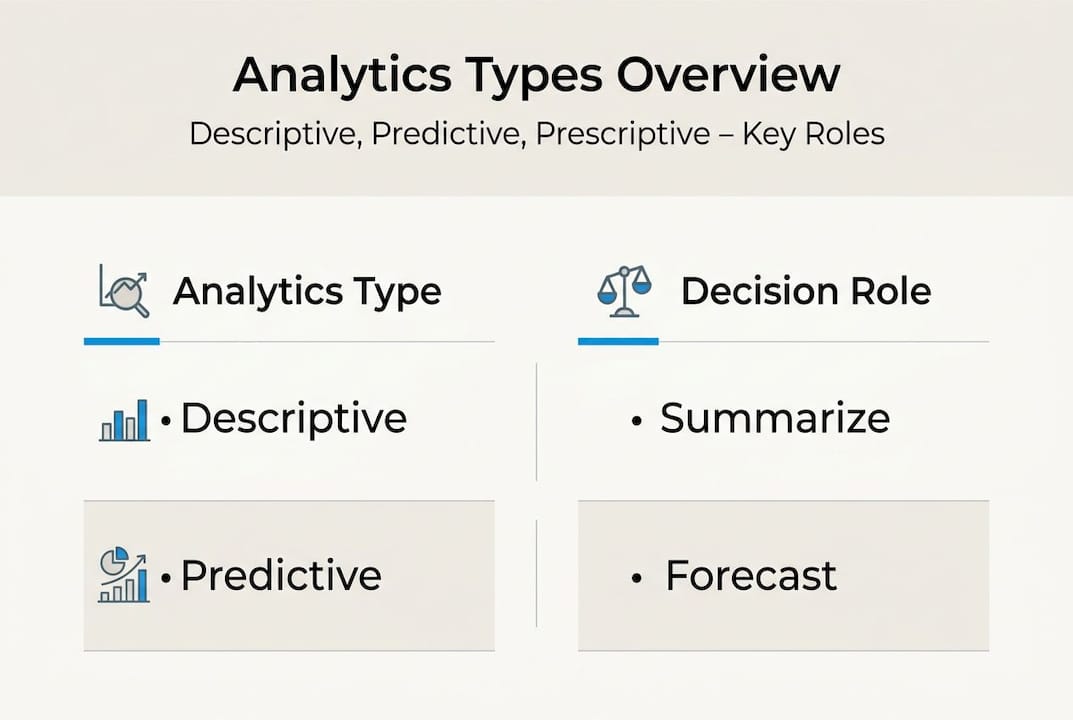
| Analytics type | Primary question | Decision role | Human vs. machine |
|---|---|---|---|
| Descriptive | What happened? | Reporting, benchmarking | Human-led |
| Predictive | What will happen? | Forecasting, targeting | Hybrid |
| Prescriptive | What should we do? | Optimization, automation | Machine-led |
Descriptive analytics is where most teams start. It covers dashboards, performance reports, and historical summaries. It is essential for understanding baseline performance, but it is backward-looking by nature. You learn what worked last quarter, not what will work next quarter.

Predictive analytics moves the lens forward. Using statistical models and machine learning, it identifies patterns in historical data and extrapolates likely outcomes. Think churn prediction, lead scoring, or forecasting seasonal demand. This is where predictive analytics for campaigns starts delivering real competitive advantage.
Prescriptive analytics goes one step further: it recommends specific actions. Bid optimization algorithms, dynamic creative selection, and automated budget reallocation tools all operate at this level. The machine is not just predicting; it is deciding.
Here is the practical sequencing most effective teams follow:
- Build reliable descriptive reporting first. Garbage in, garbage out applies at every level.
- Layer predictive models once your data pipelines are clean and consistent.
- Introduce prescriptive automation only after you trust the predictions driving it.
Pro Tip: Balance descriptive, predictive, and prescriptive analytics across your stack rather than defaulting to whichever tool your vendor pushes hardest. Each type serves a distinct function, and over-indexing on automation before your data foundation is solid creates compounding errors.
Navigating common analytics pitfalls: Data quality, silos, and bias
Understanding analytics types is only half the journey. You must also recognize and fix the structural problems that quietly corrupt your data before it ever reaches a dashboard.
The most damaging pitfall is poor data quality. Broken tracking implementations, misconfigured pixels, and inconsistent event naming conventions produce data that looks clean but leads to bad decisions. Improving data quality is not a one-time project. It requires continuous monitoring, especially as your marketing stack evolves.
| Pitfall | Impact on decisions | Mitigation approach |
|---|---|---|
| Poor data quality | Misleading KPIs, wrong attribution | Automated tracking validation, data audits |
| Data silos | Fragmented view of customer journey | Unified data layer, cross-team access |
| Algorithmic bias | Skewed targeting, unfair outcomes | Diverse training data, human review cycles |
| Privacy gaps | Consent failures, compliance risk | Governance frameworks, consent monitoring |
Data silos are the second major obstacle. When your CRM, ad platforms, email tool, and web analytics operate in isolation, you get a fragmented picture of the customer journey. A lead that converts after six touchpoints looks like a single-touch conversion if your systems do not talk to each other. Data governance for ROI starts with breaking those silos down.
Edge cases like data silos, poor quality, and bias demand governance frameworks and human-AI collaboration, not just better tooling.
Algorithmic bias is subtler but equally dangerous. When models train on historical data that reflects past biases, those biases get amplified at scale. A targeting algorithm trained on a narrow customer base will systematically underserve segments it was never trained to recognize.
Solutions worth implementing:
- Establish data governance best practices with clear ownership, documentation standards, and audit schedules.
- Require cross-functional sign-off before deploying predictive models in high-stakes campaigns.
- Build human review checkpoints into automated workflows, not just at setup but on an ongoing basis.
Pro Tip: Treat your tracking implementation as a living system. Every new tool you add, every pixel you install, and every consent configuration you update is a potential source of data corruption. Automated observability tools that flag anomalies in real time are worth their weight in avoided bad decisions.
Blending intuition with analytics: The human-AI collaboration model
With key pitfalls in mind, the next question is how human expertise and analytics output actually work together in practice. The answer is not that one replaces the other. It is that each handles what the other cannot.
Ambiguity and creative judgment remain human strengths, while analytic engines excel in granularity and scale. A machine can tell you that a particular audience segment has a 34% higher conversion rate on Thursday evenings. It cannot tell you whether a new brand positioning will resonate emotionally with that segment six months from now.
The most effective teams build their workflow around this division:
- Analytics answers the “what” and “how much” questions: which channel, which segment, which budget split.
- Human judgment answers the “why” and “what next” questions: what does this mean for our brand, and where should we place our creative bets?
- Both inputs are required before major decisions get made.
“The goal is not to replace human judgment with data. It is to give human judgment a much better foundation to stand on.”
In practice, this looks like a campaign strategist who uses integrating human and analytics frameworks to set hypotheses before pulling reports, not after. It looks like a media buyer who trusts the algorithm to optimize bids but sets the guardrails and audience parameters based on strategic context the algorithm cannot access.
AI’s role in marketing is expanding fast, but the teams getting the most out of it are not the ones automating everything. They are the ones being intentional about where human context adds irreplaceable value. Reviewing analytics best practices regularly keeps that balance calibrated as tools evolve.
Align on business goals before interpreting data outputs. Analytics without strategic context produces answers to questions nobody asked.
What most marketers miss about analytics-driven decisions
Here is the uncomfortable truth: most organizations have more data than they know what to do with, and that abundance is creating a false sense of capability. A well-designed dashboard feels like insight. It is not. It is a starting point.
The teams that actually move the needle treat analytics as a hypothesis-testing engine, not a reporting tool. They come to the data with a specific question, not a vague hope that the numbers will tell them something interesting. Off-the-shelf dashboards cannot replace that kind of structured inquiry.
Automation accelerates whatever is already in the system, including errors. If your tracking is broken and your model is biased, automation just scales those problems faster. Decision-making improves only when analytics is paired with governance and discernment.
The deeper issue is cultural. Analytics capability is not just a technology investment. It requires ongoing education, cross-functional trust, and a shared commitment to questioning what the data actually says versus what you want it to say. Building a strong marketing data culture is the infrastructure underneath the infrastructure. Without it, even the best tools produce shelf-ware.
Take your analytics-driven decision making further
Ready to put these frameworks to work? The gap between teams that talk about data-driven marketing and teams that actually practice it comes down to execution: clean pipelines, validated tracking, and the right tools for each layer of the analytics stack.
Start by auditing your current setup. Are your digital marketing tools actually feeding reliable data into your decisions, or are they creating noise? From there, invest in marketing data quality as a continuous practice, not a quarterly cleanup. And if you are not yet monitoring your data layer in real time, exploring data observability tools is the logical next step toward a measurement infrastructure you can actually trust.
Frequently asked questions
What is the primary benefit of using analytics in marketing decision making?
Analytics gives marketers the ability to make precise, data-backed decisions that scale far beyond what intuition alone can support. Analytics increases deduction, granularity, and scalability across marketing strategies in ways no human process can replicate.
How do you avoid bias in marketing analytics?
Bias prevention requires robust data quality controls, diverse training data, and cross-functional oversight built into your governance model. Bias and poor data quality remain major obstacles that no single tool eliminates on its own.
When should marketers trust intuition over analytics?
Intuition is most valuable for ambiguous, creative, or brand-level decisions where context and emotional resonance matter more than optimization. Humans excel at ambiguity while machines handle granularity, and the best decisions draw on both.
What is the biggest mistake in analytics-driven marketing?
Relying on dashboards without applying critical thinking or maintaining regular data governance is the most common and costly mistake. Analytics require thoughtful governance and human oversight to translate into real business impact.
Recommended
- Data analytics best practices for marketing success in 2026 – The data driven marketer
- What Are Marketing Analytics and How Do They Drive Growth – The data driven marketer
- Marketing Data Visualization: Driving Smarter Decisions – The data driven marketer
- Optimize LinkedIn marketing with analytics: B2B success – Kawaak