

Think of customer experience measurement as the art of turning feelings into facts. It’s the discipline of translating every customer interaction—every click, every purchase, every support ticket—into hard data you can actually use. This isn't just about satisfaction scores; it's about digging into the why behind customer behavior and connecting it directly to business growth.
Why Customer Experience Measurement Is Your New Growth Engine
In a market flooded with options, how customers feel about your brand has graduated from a "nice-to-have" to a non-negotiable business metric. Guessing what your customers want or running on a few anecdotes is like trying to navigate a new city without a map. A solid customer experience measurement strategy is that map, turning vague sentiment into a clear, predictable model for growth.
This data-first approach empowers marketers and data leaders to fine-tune every single touchpoint. You stop playing defense, reacting to problems as they arise, and start proactively designing incredible experiences. The result? Every dollar you invest in marketing and product development delivers a return you can actually measure.

Connecting Feelings to Financials
The real magic of measurement is its power to draw a straight line from customer sentiment to the numbers that matter: revenue, retention, and loyalty. When you systematically track how people perceive their journey with your brand, you can pinpoint the exact friction points causing churn and identify the moments of delight that create your biggest fans.
This isn't just a theory; the data backs it up. A major global study uncovered a powerful link between customer satisfaction and loyalty. For every one-star bump in a customer's satisfaction rating, their likelihood to recommend the company shot up by an average of 20%. At the same time, trust levels climbed by 17% and their intent to buy again grew by 15%. With that kind of ROI on the table, a proper measurement framework is essential. You can dive deeper by reading the full research on the ROI of CX to see the full impact.
The goal is to create a closed-loop system where customer feedback continuously informs business strategy, turning your data stack into a powerful engine for sustainable growth.
Building a Foundation for Success
Ultimately, putting a customer experience measurement program in place is about building a resilient, future-proof data foundation. It gives you the signals you need to:
- Optimize Marketing Spend: Figure out which touchpoints create the best experiences and put your budget where it will have the most impact.
- Improve Product Development: Get direct feedback to prioritize features and fixes that users actually care about.
- Enhance Customer Retention: Spot at-risk customers early on, allowing you to step in and prevent churn before it happens.
- Boost Brand Loyalty: Consistently deliver positive experiences that turn happy customers into vocal advocates for your brand.
Without a formal measurement strategy, you’re flying blind. By committing to this discipline, you give your entire organization the insights needed to make smarter decisions, build stronger customer relationships, and lock in a serious competitive edge.
Turning Customer Feedback into Action with Key CX Metrics
Knowing customer experience is important is the easy part. Actually measuring it in a way that gives you something to work with? That's a different game entirely. To translate those fuzzy customer feelings into hard data you can act on, you need a solid toolkit of well-defined metrics. Think of them as your compass, showing you exactly where your customer journey shines and where it's letting people down.
This isn't about chasing scores just to fill up a dashboard. It’s about strategically deploying the right measurement at the right moment to get feedback that's both relevant and immediate. When you get this right, you create a powerful feedback loop that fuels constant improvement across the board.
The Big Three Quantitative Metrics
Most CX measurement programs are built on the foundation of three core quantitative scores. They might seem similar at first glance, but each one answers a very different, very specific question about your relationship with your customers. For a really deep dive, check out our complete guide on key customer experience metrics.
-
Net Promoter Score (NPS): This classic metric gets straight to the point: "How likely are you to recommend our brand to a friend or colleague?" NPS is all about measuring long-term loyalty and overall brand health, not just satisfaction with one specific interaction. It's best used periodically—think quarterly or annually—to keep a pulse on your customer relationships.
-
Customer Satisfaction (CSAT): CSAT is your in-the-moment reality check, asking, "How satisfied were you with [a specific interaction]?" You should send a CSAT survey immediately after a key touchpoint, like right after a customer completes a purchase, a support ticket is closed, or they use a new feature for the first time.
-
Customer Effort Score (CES): This score is all about measuring friction. By asking, "How easy was it to get your issue resolved?" CES helps you pinpoint and eliminate frustrating roadblocks. It’s perfect for digging into the efficiency of specific processes, like finding information on your site, getting through checkout, or contacting customer service.
When you start combining these metrics, you build a much richer, multi-layered understanding of your CX. For instance, an improving NPS tells you the big-picture strategy is working. But a sudden dip in CSAT right after a website update gives you a very specific, actionable problem you can solve today.
Choosing the Right CX Metric for the Job
Deciding between survey scores and behavioral data isn't an either/or choice; it's about using the right tool for the right context. Quantitative metrics tell you what happened, while qualitative behavioral data helps you understand why.
Here’s a quick breakdown to help you decide when to use each:
| Metric Type | Example | What It Measures | Best Used For |
|---|---|---|---|
| Quantitative Survey | NPS, CSAT, CES | Customer sentiment, loyalty, satisfaction, and effort levels. | Capturing direct feedback at key journey stages (post-purchase, support interaction). |
| Qualitative Behavioral | Session Recordings, Heatmaps | Actual user actions, points of friction, and engagement patterns. | Diagnosing the "why" behind low scores and identifying usability issues. |
Ultimately, the strongest insights come from layering both. A low CSAT score is a signal, but watching a session recording of that user’s frustrating experience is what gives you the full story.
Blending Scores with Behavioral Insights
Quantitative scores like NPS and CSAT are fantastic at telling you what your customers are feeling. But they often leave out the most important part of the story: why. To get the full picture, you have to pair this survey data with qualitative, behavioral insights. This is where you connect what people say with what they actually do.
This means getting your hands dirty and looking at what users are doing on your site or in your app.
- Session Recordings and Heatmaps: These tools are like having a superpower. You can watch anonymized recordings of real user sessions and see exactly where people get stuck, hesitate before clicking, or even "rage-click" in frustration. This often gives you the smoking gun behind a low CES score.
- Feature Adoption Rates: It's one thing to launch a new feature; it's another to see if people actually use it. Tracking adoption rates gives you hard data on a feature's real-world value. If adoption is low and the early CSAT scores are negative, that's a clear sign you need to go back to the drawing board.
- User Journey Analysis: By mapping out the common paths users take, you can spot where they're dropping off in droves. When you correlate these drop-off points with low satisfaction scores, you can pinpoint the exact step in a critical flow—like onboarding—that’s causing all the friction.
This blend of "what" and "why" is where CX measurement truly comes to life. It’s no longer just about numbers on a report; it’s about understanding the complete, human story of your customer's journey. At a massive scale, orchestrating this data has become a huge undertaking. For example, some companies now manage over 12.3 billion customer journey interactions a year, with personalized engagements jumping by 15.6% in just one year. This shows just how deeply data platforms and CX are connected. You can learn more about how data drives CX at scale in the full report.
Building Your Data Foundation for Accurate Measurement
Reliable customer experience measurement doesn't start with the first survey you send. It begins much earlier, with a rock-solid data architecture. This is the technical blueprint that ensures every piece of customer feedback and every user action gets captured accurately and consistently. Without it, your metrics are built on shaky ground, and you'll end up with insights you just can't trust.
Think of your data foundation like the plumbing in a house. You don't see it, but if it's a mess, nothing else works right. A well-instrumented system makes sure data from your website, app, and other tools flows cleanly into one place, giving you a single, unified view of the customer.
For MarTech managers and data engineers, getting this blueprint right is non-negotiable. It means designing a smart event tracking strategy, using a data layer to keep collection standardized, and connecting your tools to build out rich customer profiles.
Designing Your Event Tracking Strategy
First things first: you need a clear plan for what user actions to track. This isn't about capturing every single click—that’s just noise. It’s about zeroing in on the specific events that signal progress, friction, or success in the customer journey. A thoughtful event strategy is what makes your data meaningful.
This plan should live in a central document, often called a tracking plan. It defines every event, its properties, and, most importantly, why it matters. So, instead of a generic "button_click" event, you'd define something specific like "add_to_cart_click" or "demo_request_submitted."
The goal is to connect these discrete actions and scores to a bigger strategic picture.
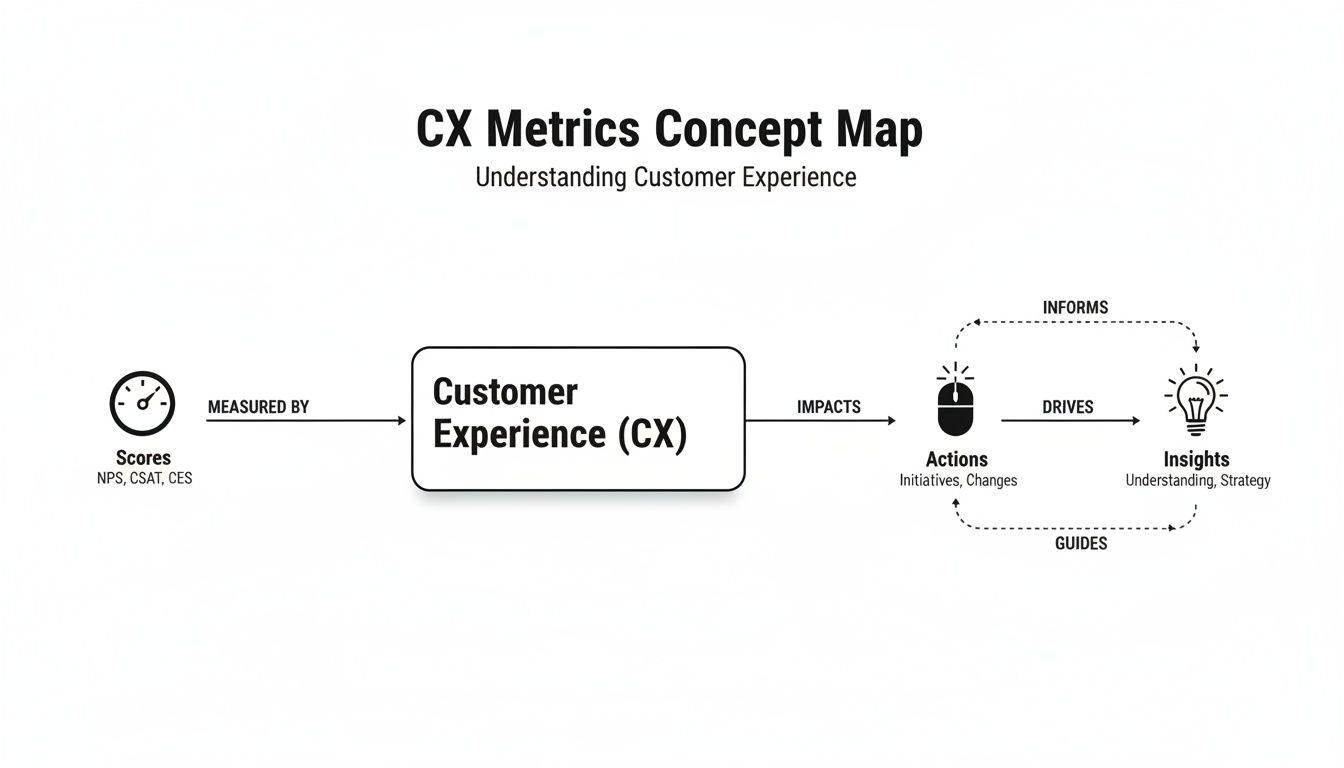
As you can see, raw scores and user behaviors are just the starting point. The real value is unlocked when you can synthesize them into actionable business insights.
Unifying Data with a Data Layer and Tag Management
Once you know what to track, you need a standardized way to collect it. This is where a data layer comes into play. A data layer is a simple JavaScript object that acts as a middleman between your website and your analytics tools, like Google Analytics or your CRM. It organizes key info—like a user ID, purchase details, or page category—into a consistent format.
From there, Google Tag Manager (GTM) reads that structured information and sends it off to all your connected platforms. This setup is a game-changer for a few reasons:
- Consistency: Every tool gets the exact same data, which kills off frustrating discrepancies.
- Scalability: You can add or remove marketing tools through GTM without begging developers to write new code each time.
- Governance: It centralizes all your tracking logic, making it far easier to manage and QA.
This kind of rigorous governance is more critical than ever. A recent KPMG report, analyzing over 81,000 customer interviews, found a troubling global decline in CX performance. Key metrics like problem resolution actually dropped by 3% year-over-year. This slide underscores just how vital precise tracking is for spotting issues and making improvements. You can dig into the full 2024 Customer Experience Excellence report to see the trends for yourself.
The Role of CDPs and Modern Analytics Platforms
While GTM is the traffic cop for your data, modern tools like Customer Data Platforms (CDPs) and Google Analytics 4 (GA4) are where everything comes together to form unified customer profiles.
A CDP acts as the central brain for all your customer data. It pulls in event data from your website, mobile app, and even offline sources, then stitches it all together into a single profile for each user. This unified view is the holy grail for personalization and accurate measurement. Getting this right is a core part of any serious marketing data integration strategy.
A CDP doesn’t just store data; it makes it actionable. By unifying event streams, it allows you to build sophisticated audience segments, trigger personalized messages, and sync consistent data across your entire tech stack.
GA4, with its event-based data model, fits perfectly into this modern architecture. Unlike older analytics platforms that were built around pageviews, GA4 treats every single interaction as an event. This lines up perfectly with the event-driven approach of a good tracking plan and a CDP, making it an incredibly powerful tool for analyzing the complete customer journey.
By combining these tools, you build a resilient and powerful foundation for your entire customer experience measurement program.
Connecting CX Data to Business Outcomes and ROI
Collecting customer feedback is just the first step. The real work—and where the money is—is tying those scores and signals directly to business performance. A high NPS score is nice, but a high NPS that correlates with a 15% lift in repeat purchases? That's a story every executive wants to hear.
Proving the ROI of your customer experience measurement program is all about turning abstract feedback into a clear narrative of financial impact. It means moving past surface-level dashboards and getting your hands dirty with attribution.
For example, can you prove that a sudden dip in your CSAT scores was caused by a specific product update or a new marketing campaign? Answering that question is how you hold teams accountable and make smarter decisions about where to invest. Without that connection, CX metrics are just vanity numbers, sitting in a dashboard without driving any real action.
The key is building a bridge between your sentiment data (what customers say) and your behavioral data (what customers do). That's how you transform a simple listening program into a strategic tool for growth.
Uncovering Hidden Patterns with Data Segmentation
Not all customers are created equal, so their feedback shouldn't be lumped together either. The most powerful insights are almost always hiding in the details, which you can find by segmenting your CX data. By slicing your feedback by different user groups, you can spot patterns that are completely invisible in the averages.
Think about breaking down your feedback by:
- User Cohorts: What's the NPS for customers who signed up in January versus those who joined in June? This can tell you if recent changes to your onboarding flow are actually working.
- Lifecycle Stage: A brand-new user is going to have a very different perspective than a long-time power user. One cares about the first-run experience, while the other is focused on feature depth and reliability. Separating their feedback reveals entirely different priorities.
- Customer Value Tiers: Are your biggest spenders also your happiest customers? If the answer is no, you have a massive retention risk on your hands. Correlating satisfaction with customer value is a fundamental step in proving ROI.
This kind of analysis helps you focus your efforts. Instead of trying to please everyone, you can zero in on improvements that will make the biggest difference for your most important customers.
Bridging Analytics and Action with SQL
To truly connect feelings to actions, your data needs to live in the same place. This usually means pulling survey responses from tools like Medallia or Qualtrics into your data warehouse, right alongside your product analytics and sales data. Once it's all there, a simple SQL query can unlock some incredible insights.
Imagine you want to see if customers who gave a low CSAT score after a support ticket are more likely to churn. A quick SQL join between your survey response table and your user activity table can show you their engagement levels post-interaction, which you can then compare to users who gave high scores.
This analytical process is what separates mature CX programs from the rest. It’s about moving past isolated metrics and building a unified data model that can directly answer critical business questions about retention, loyalty, and revenue.
Tying CX Metrics to Bottom-Line Results
Ultimately, the goal is to draw an undeniable line from your CX initiatives to the financial health of the business. The best way to do this is by connecting your key CX metrics directly to bottom-line outcomes like churn reduction and customer lifetime value (CLV).
- Churn Reduction: By analyzing the feedback and behavior of customers who left, you can start building predictive models. This lets you spot at-risk customers before they churn and step in with proactive support or a special offer.
- Increased Customer Lifetime Value: A consistently great experience builds loyalty and encourages customers to stick around and spend more. By tracking CLV across different NPS or CSAT segments, you can quantify exactly how much more a happy customer is worth over their entire relationship with you. To get this right, you need to understand the different models and methods; our guide on how to measure customer lifetime value offers a detailed framework for this analysis.
When you can walk into a leadership meeting and say, "Improving our CES score for the checkout process by one point reduces cart abandonment by 5%," you've successfully connected customer experience measurement to tangible ROI. This is how CX stops being seen as a cost center and starts being recognized as a powerful engine for growth.
Putting Your CX Measurement Program into Action
So, you’ve got a customer experience measurement strategy on paper. That's a great start, but the real work begins now. It's time to turn that plan into a living, breathing part of your company's day-to-day operations—the point where raw data finally starts driving real change.
This is all about making CX data accessible, understandable, and most importantly, trusted. When you get this right, you build a culture where the customer's voice informs every decision. You shift from putting out fires to proactively designing better experiences from the ground up.

Designing Dashboards for Different Audiences
Let’s be honest: a single, one-size-fits-all dashboard never works. Your CMO needs a completely different view than a product manager knee-deep in feature analytics. The key is to give everyone exactly what they need, and nothing they don’t.
- Executive Summaries: For the C-suite, dashboards in tools like Looker Studio or Tableau should be all about the big picture. They need to see high-level KPIs like NPS trends or changes in Customer Lifetime Value, linking CX directly to business goals like revenue and market share.
- Managerial Overviews: Department heads are focused on team performance. Their dashboards should connect CSAT scores to operational metrics. Think support ticket resolution times or the impact of a recent marketing campaign on customer sentiment.
- Diagnostic Views: This is where product managers and analysts live. They need the ability to drill down deep, filter by specific user segments, analyze the CES for a newly launched feature, and tie qualitative feedback directly to points in the user journey.
This layered approach ensures every stakeholder gets relevant, actionable information without drowning in a sea of irrelevant data.
Establishing Data Governance and Quality Assurance
Trust is the currency of any data program. If your stakeholders don’t believe the numbers, they will never use them to make decisions. That’s why a solid data governance framework and a practical Quality Assurance (QA) playbook aren't just nice-to-haves; they're non-negotiable.
A QA playbook is your organization’s commitment to data integrity. It's a living document that outlines the processes for validating tracking implementations, monitoring data pipelines, and certifying the accuracy of dashboards before they are shared.
This means running regular audits on your tracking setup, creating automated alerts for weird data spikes or dips, and having a clear process for fixing things when they break. Without this discipline, even the most sophisticated customer experience measurement system will lose credibility—fast.
Choosing the Right Tools with a Vendor Selection Checklist
Building a modern CX tech stack means picking vendors for everything from surveys and analytics to data warehousing. To avoid ending up with a collection of expensive, siloed tools, you need a structured evaluation process.
A good checklist helps you cut through the marketing fluff and focus on what actually matters for your business. Before you sign any contracts, make sure you're asking the right questions.
CX Platform Vendor Selection Checklist
| Evaluation Category | Key Questions to Ask | Ideal Outcome |
|---|---|---|
| Data Integration | How easily does this platform connect to our existing CDP, data warehouse, and marketing tools? Does it offer pre-built connectors or require custom API work? | The platform integrates with your core systems out of the box, minimizing engineering effort and creating a unified data flow. |
| Analytics Capabilities | Does the tool support advanced segmentation, journey analysis, and text analytics for open-ended feedback? | You can move beyond simple scores to uncover deep insights, understand the "why" behind the numbers, and identify root causes. |
| Scalability & Security | Can the platform handle our projected data volume? Does it meet our company's security and compliance requirements (e.g., GDPR, CCPA)? | The solution scales with your business growth and adheres to all necessary data privacy and security standards, protecting you and your customers. |
| Usability & Support | Is the interface intuitive for non-technical users? What level of training and ongoing support does the vendor provide? | Business users can self-serve to find answers, reducing reliance on the data team and accelerating the pace of insight-driven action. |
By systematically vetting vendors against these criteria, you can de-risk your technology investments. You'll build a powerful, interconnected stack that makes your CX measurement program a reliable engine for business decisions, not just a dashboard nobody looks at.
Got Questions About Measuring Customer Experience? We've Got Answers.
As you start to build out or fine-tune your customer experience measurement program, you're going to run into some real-world questions and roadblocks. It’s inevitable. This last section is designed to give you clear, straight-to-the-point answers for the most common challenges that pop up.
Think of this as your quick-reference guide. We're cutting through the theory to give you practical advice for turning customer feedback into a powerful engine for growth.
How Do We Choose Between NPS, CSAT, and CES?
This is a classic question, but it’s the wrong one to ask. It's not about which metric is "best," but which one is the right tool for the job. Each one answers a different, very specific question about your customer's journey. Honestly, a strong program uses a mix of all three.
Here’s how to think about it:
- Net Promoter Score (NPS): Use this for the big picture. NPS gives you a high-level read on long-term customer loyalty and overall brand health. It’s best used periodically—think quarterly or biannually—to check the pulse of your overall relationship with customers.
- Customer Satisfaction (CSAT): CSAT is all about the "right now." Deploy it for immediate feedback on a specific transaction or interaction. Did they like the product they just bought? Was their support ticket resolved to their satisfaction? That's CSAT's sweet spot.
- Customer Effort Score (CES): This one is your friction detector. Use CES to find out how easy or difficult you're making things for your customers. It’s perfect for moments like trying to find information on your site or resolving a billing issue.
When you use them together, you get a much richer, more complete picture of what's really happening. You see the forest and the trees.
What Is the Biggest Mistake Companies Make?
The single most common—and most expensive—mistake is collecting tons of data with no plan to actually do anything with it. So many organizations get obsessed with the metrics themselves. They build beautiful dashboards and track scores religiously, but they never "close the loop" by following up with customers or using the insights to fix the root problems.
A measurement program without a clear plan for action is just an expensive hobby. The entire point isn't just to measure; it's to listen, understand what you've heard, and then act on it to make the experience better.
Remember, data that doesn't lead to action is just noise. The value of your customer experience measurement program is directly tied to the improvements it inspires.
How Can We Prove the ROI of Our CX Program?
To prove the return on investment (ROI), you have to connect the dots between your CX metrics and cold, hard financial outcomes. This is how you shift the conversation from "making customers happy" to "driving business results."
Start by correlating your sentiment data (like NPS or CSAT) with the business metrics sitting in your data warehouse or CDP. For example, you can run an analysis to see if customers with higher satisfaction scores also have a higher customer lifetime value (LTV) or lower churn rates. The ultimate goal is to build a model that can answer questions like, "How much revenue do we gain for every one-point increase in our NPS score?"
Where Should We Start If We Have Nothing in Place?
If you're starting from a blank slate, the key is to think small and build momentum. Don't fall into the trap of trying to measure everything all at once. You'll just get overwhelmed.
Instead, pick the single most critical journey for your business. Maybe it’s the new user onboarding flow or the checkout process. Once you've identified that one journey, implement one simple, highly relevant metric at a key moment. That could be a CSAT survey right after the first purchase or a CES survey after a customer uses a new feature for the first time.
Focus on mastering that single feedback loop. Get the data collection right and set up a weekly process to actually review the insights. Once you've proven the value in that one small area, you'll have the credibility and confidence to strategically expand your program to other touchpoints.
At The data driven marketer, we provide the blueprints and playbooks to help you build a measurement strategy that connects directly to business growth. https://datadrivenmarketer.me