
Let's be honest, marketing measurement used to be simple. Way too simple. For a long time, we all leaned on models like first-click and last-click attribution. In that world, either the very first ad a customer saw or the absolute last one they clicked before buying got 100% of the credit.
This is like giving the game ball to the player who kicked off or the one who scored the winning goal, completely ignoring the midfielders, defenders, and every other player who moved the ball down the field. It’s a fundamentally broken way to see the game.
Why Simplistic Attribution Models Are Broken
Relying on single-touch models paints a dangerously distorted picture of what’s actually working. It systematically overvalues the channels that are great at opening a conversation or closing the deal, while completely ignoring the critical "middle" touches that do the hard work of building trust and nurturing leads.
When you only measure the very beginning or the absolute end of the journey, you’re flying blind. You miss the context, the nuance, and the reality of how modern customers actually behave. This leads to bad decisions and, frankly, wasted money.
The Problem with Giving 100% Credit
Giving all the glory to one touchpoint means you’re overlooking the real story.
Here’s what gets completely missed:
- The Nurturing Process: All those content downloads, email sequences, and retargeting ads that educate and engage your prospects? They get zero credit, making them look like a waste of budget.
- Brand Building Efforts: Top-of-funnel campaigns on social media or display that build awareness are seen as failures if they don't lead directly to a sale.
- How Channels Work Together: You can't see the synergy. Maybe that paid search ad only converted because a series of blog posts had already built up your brand's credibility.
By focusing only on the final touchpoint, marketers risk cutting budgets for the very channels that made that final touchpoint effective in the first place.
This is exactly why we need to move beyond last-click. Multi-touch attribution isn't just a new buzzword—it's a fundamental shift in how you view the entire customer journey. It gives credit where credit is due, assigning value to the multiple marketing touchpoints that influence a conversion over time.
Adopting this approach gives you a complete picture. It leads to smarter budget allocation, uncovers hidden opportunities in your funnel, and finally proves marketing’s true impact on the bottom line. For any modern team serious about growth, it’s no longer optional.
Comparing the Most Common Attribution Models
Once you ditch the limitations of single-touch thinking, the world of multi touch attribution really opens up. But with several models on the table, which one is right for you? Honestly, it’s less about finding one "perfect" model and more about picking the one that actually reflects how your customers behave and what your business is trying to achieve.
Think of each model as a different lens for viewing your marketing performance. Some are simple and rules-based, which makes them clear and easy to get running. Others are far more complex, using algorithms to paint a more nuanced picture of how your channels actually work together to get that final conversion.
To keep things practical, let's use a classic B2B software buyer's journey. Imagine a prospect first sees a LinkedIn ad (Touchpoint 1), then downloads a whitepaper (Touchpoint 2), engages with a follow-up email (Touchpoint 3), and finally requests a demo after a direct website visit (Touchpoint 4). We'll use this path to see how each model assigns credit.
The Linear Model
The Linear attribution model is the most democratic of the bunch. It simply splits the credit equally across every single touchpoint that led to the conversion. The core assumption? Every interaction played an equal part in the final decision. No drama, just equal shares.
For our B2B software example, the credit is a clean split:
- LinkedIn Ad: 25%
- Whitepaper Download: 25%
- Email Engagement: 25%
- Direct Visit & Demo: 25%
This is a great starting point because it forces you to acknowledge every channel’s contribution. It’s a good safeguard against accidentally cutting the budget for a channel that’s quietly doing heavy lifting in the middle of the funnel.
The Time-Decay Model
The Time-Decay model brings a sense of urgency into the mix. It gives more credit to the touchpoints that happened closer to the conversion. The logic here is that the most recent interactions had the biggest influence on the customer’s final decision to act.
In our scenario, the credit would be weighted toward the end:
- Direct Visit & Demo: 45% (most credit)
- Email Engagement: 30%
- Whitepaper Download: 15%
- LinkedIn Ad: 10% (least credit)
This model is especially useful for businesses with shorter sales cycles. It's also great for evaluating promotional campaigns where the final touches—like a "last chance" email—are specifically designed to push someone over the finish line.
The entire evolution of marketing attribution is a story of moving from overly simple answers to more sophisticated, realistic views of the customer path.
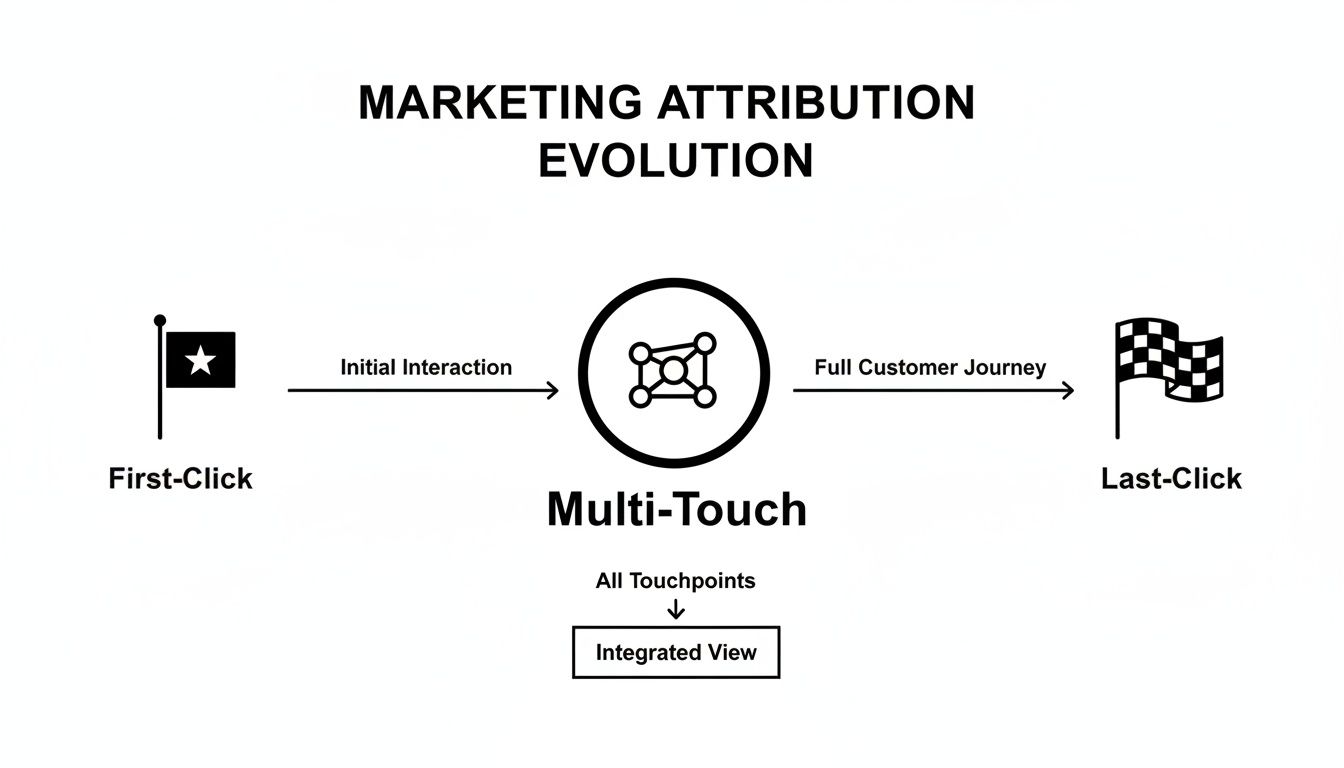
This visual really captures that progression away from the blunt instruments of First-Click and Last-Click toward a Multi-Touch approach that respects the whole journey.
Position-Based and W-Shaped Models
Position-based models are all about giving extra weight to specific, key moments in the journey. The two you'll run into most often are the U-Shaped and W-Shaped models.
The U-Shaped model (also called Position-Based) champions the beginning and the end of the journey. It typically gives 40% of the credit to the very first touch (the introduction) and 40% to the last touch (the closer). The remaining 20% gets distributed evenly among all the interactions in the middle.
For our example journey, it looks like this:
- LinkedIn Ad (First Touch): 40%
- Whitepaper Download (Middle): 10%
- Email Engagement (Middle): 10%
- Direct Visit & Demo (Last Touch): 40%
The W-Shaped model adds another hero moment to the story: lead creation. It assigns 30% credit to the first touch, 30% to the touch that created the lead, and 30% to the final conversion touch. The last 10% is split among any other interactions. This is a game-changer for B2B marketers who see the moment a prospect becomes a qualified lead as a major milestone.
Picking a model isn’t a one-and-done decision. The smart play is to start with a model that lines up with your current goals, then test it against others as your team and your data get more sophisticated.
Algorithmic or Data-Driven Models
This is where things get really interesting. Algorithmic attribution (often called data-driven attribution) is the most advanced approach. Instead of following pre-set rules, these models use machine learning to crunch the numbers on all your converting and non-converting paths. The algorithm figures out the actual influence of each touchpoint by finding patterns in your own data.
While this approach is incredibly accurate, it needs a lot of data to learn effectively. It’s also a bit of a "black box," meaning it can be tough to explain exactly how it decided on the credit distribution. But for companies with the right data volume, its predictive power is unmatched. For a truly panoramic view, you can explore how these models work alongside broader measurement techniques like marketing mix modeling.
Comparison of Multi Touch Attribution Models
To help you sort through these options, the table below breaks down the key features of each model we've covered. It’s a handy cheat sheet for matching a model to your business needs.
| Model Type | Credit Distribution Logic | Pros | Cons | Best For |
|---|---|---|---|---|
| Linear | Gives equal credit to every touchpoint. | Simple to implement and values every interaction. | Can undervalue more influential touchpoints. | Businesses with consistent, ongoing marketing efforts. |
| Time-Decay | Gives more credit to touchpoints closer to conversion. | Reflects the urgency often present before a purchase. | Devalues top-of-funnel awareness activities. | Short sales cycles and promotional campaigns. |
| U-Shaped | Credits the first and last touches most (e.g., 40% each). | Highlights both lead generation and conversion drivers. | Overlooks the importance of middle-funnel nurturing. | Lead-focused businesses where opening and closing are key. |
| W-Shaped | Credits first, lead creation, and last touches most (e.g., 30% each). | Aligns well with B2B funnels and sales milestones. | Complex and can still undervalue other middle interactions. | B2B companies with a clearly defined MQL/SQL process. |
| Algorithmic | Uses machine learning to assign credit based on historical data. | The most accurate and dynamic model available. | Requires large data sets and can be a "black box." | Mature organizations with high data volume. |
Ultimately, the goal isn't just to pick a model but to understand what it's telling you about your customers and how you can use that information to make smarter marketing decisions.
The Technology Powering Modern Attribution
Multi-touch attribution has evolved far beyond clunky spreadsheets and backward-looking reports. Today, it’s a predictive powerhouse, capable of untangling the most chaotic, non-linear customer journeys you can imagine. This leap forward is almost entirely fueled by artificial intelligence and machine learning, the twin engines driving modern measurement.

These advanced systems churn through massive datasets—far more than any human team could ever hope to analyze—to find the subtle patterns that signal a future conversion. Instead of just looking in the rearview mirror, they look ahead, predicting which combinations of touchpoints are most likely to drive results.
The Rise of AI and Machine Learning
Bringing AI and machine learning into the measurement stack isn't just an upgrade; it’s a complete shift in methodology. These algorithms are incredibly good at boosting the accuracy of attribution models by analyzing a dizzying number of touchpoint combinations that older statistical methods would simply miss. This allows for much sharper credit assignment, even across the most convoluted customer paths.
This move allows marketers to get out of reactive analysis mode and into proactive strategy. The technology doesn't just tell you what worked last quarter; it predicts what's likely to work next quarter for very specific audience segments. By constantly learning from new data, these models adapt to shifting customer behaviors and market dynamics, keeping your insights fresh and actionable.
The real job of AI in attribution is to find the signal in the noise. It sifts through thousands of converting and non-converting paths to figure out the true incremental lift of each marketing touch, getting us beyond simple correlation and closer to actual causation.
How AI Uncovers Hidden Conversion Paths
Think of a traditional, rules-based model like a map that only shows the major highways. It gets you the general idea, but it misses all the side streets, back alleys, and shortcuts that people actually use to get around.
AI and machine learning, on the other hand, map the entire city. They reveal every possible route a customer might take, which is crucial for a few key reasons:
- Handling Scale and Complexity: Modern customer journeys can have dozens of interactions across channels and devices. AI algorithms can process this high-dimensional data without breaking a sweat.
- Identifying Synergies: The tech can spot how different channels amplify each other. For instance, it might discover that a LinkedIn ad followed by a webinar is 3x more effective than either touchpoint on its own.
- Moving Beyond Bias: Unlike rules-based models that are built on human assumptions (like "the last click is most important"), data-driven models let the data tell the story. This removes our preconceived notions about channel performance.
Cloud Solutions Make Advanced Attribution Accessible
Not too long ago, this kind of analytical muscle was only available to massive enterprises with huge budgets and dedicated data science teams. Thankfully, the rise of cloud-based marketing platforms has completely changed the game.
Cloud-based and hybrid solutions now offer sophisticated multi-touch attribution capabilities as a service. This means businesses of all sizes can tap into powerful machine learning models without having to build and maintain the complex infrastructure themselves. These platforms do the heavy lifting—data collection, processing, and modeling—and serve up the insights in clean, intuitive dashboards.
For a deeper look into what to expect from these tools, check out our guide on the essential features of modern attribution platforms.
This accessibility is a game-changer. It empowers more marketing teams than ever to adopt a truly data-driven approach and gives MarTech leaders the tools needed to build an intelligent measurement system that keeps them ahead of the curve.
Your Blueprint for Implementing Attribution
Let’s get real. All the theory in the world won’t help you if your multi touch attribution project is built on a shaky foundation. Moving to a smarter measurement framework isn't as simple as flipping a switch. It takes careful planning, squeaky-clean data, and a clear architectural vision.
Think of this as the blueprint for building a reliable, high-performance engine for your marketing insights.
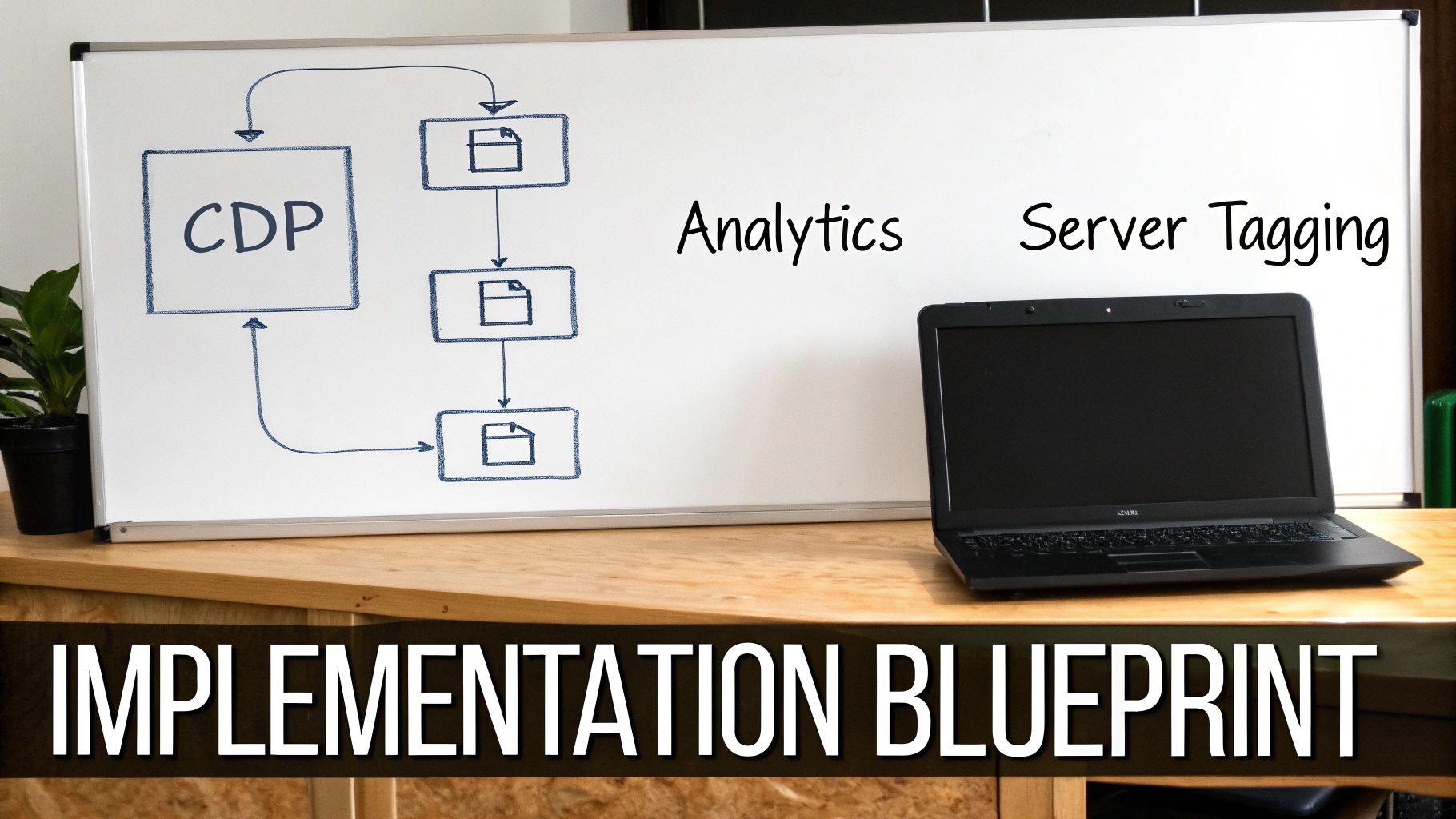
Before you even think about comparing models or digging into reports, you have to get your data house in order. Because without clean, consistent, and trustworthy data, even the most sophisticated algorithmic model will just give you garbage insights faster.
Laying the Groundwork with Data Governance
The absolute bedrock of any attribution project is data discipline. This all starts with ironclad tracking standards to make sure every single touchpoint gets captured accurately and can be tied back to a user journey. Messy data is the number one killer of attribution projects.
To stop that from happening, you need to establish some non-negotiable rules for your marketing and analytics teams. This is your first and most critical step.
Here are the key areas to lock down:
- Consistent UTM Parameters: You need a standardized, company-wide policy for UTM tagging. Every campaign, every link, every ad must follow the exact same structure for
utm_source,utm_medium,utm_campaign, etc. Any deviation here makes it impossible to group and analyze your channel performance correctly. - Unified User IDs: Piecing together a user's journey across their laptop, phone, and work computer is a classic attribution headache. Implementing a unified user ID strategy—whether through login info, email hashes, or a Customer Data Platform (CDP)—is the only way to build a true single customer view.
- Solid Event Tracking: Define a clear and concise event taxonomy for the key actions people take on your site and in your app. Events like "form_submission," "product_viewed," or "demo_requested" must be named and tracked identically everywhere. These are your conversion goalposts.
A multi-touch attribution system is only as good as the data you feed it. Time spent on data governance and cleanup at the beginning will save you months of troubleshooting and frustration down the line.
Architecting Your Attribution Stack
With a solid data foundation in place, it’s time to design the tech stack that will collect, unify, and analyze all that touchpoint data. A modern attribution setup isn’t about one magic tool; it's about integrating several key platforms that each play a distinct, complementary role.
This is about connecting the systems you already have into a cohesive data pipeline that powers your attribution model.
A common and effective architecture involves these core components:
- Data Collection Layer: This is where you capture raw interaction data. It includes your web analytics platform (like Google Analytics 4), a mobile measurement partner (MMP) for app data, and server-side tagging (like Google Tag Manager's server-side container) for more reliable, first-party data capture that isn't blocked by browsers.
- Data Unification Layer: This is where a Customer Data Platform (CDP) often becomes the heart of your stack. It pulls in data from all your collection points, resolves user identities, and builds that comprehensive single customer view. It’s the glue that connects an anonymous website visit to a known user profile in your CRM.
- Attribution and Modeling Layer: This could be a specialized attribution vendor, a feature within your CDP, or a custom model you build in a data warehouse like BigQuery or Snowflake. This is the "brain" that takes the unified journey data and applies your chosen model (Linear, U-Shaped, Algorithmic) to assign credit.
- Activation and Visualization Layer: This is where insights turn into action. The model's output gets piped into BI tools like Looker or Tableau for reporting and deep-dive analysis. Even better, these insights can be sent back to your marketing automation or ad platforms to optimize campaigns in near real-time.
Evaluating Potential Vendors
If you decide to go with an attribution vendor instead of building a completely custom solution, a thorough evaluation is absolutely critical. Not all platforms are created equal, and picking the wrong one can lock you into a rigid system that doesn’t fit your business or your tech stack.
Use this checklist to ask the hard questions and make sure you choose a partner that truly aligns with your goals.
Vendor Evaluation Checklist:
- Integration Capabilities: Does the platform have pre-built, reliable connectors for your existing tools (CRM, ad platforms, analytics)? How painful are custom integrations?
- Data Privacy and Compliance: How does the solution handle user privacy, especially with GDPR, CCPA, and the death of third-party cookies on the horizon? Does it empower a first-party data strategy?
- Modeling Flexibility: Are you stuck with their proprietary "black box" algorithm, or can you choose, customize, and compare multiple models (e.g., Linear, Time-Decay, U-Shaped)?
- Identity Resolution: Get specific. How exactly do they handle cross-device and cross-channel identity stitching? Ask for their typical match rates and the methodology behind them.
- Data Access and Ownership: Can you export raw, user-level journey data to analyze yourself, or are you trapped in their dashboards? Crucially, who actually owns the data?
- Scalability and Support: Can the platform handle your data volume today and as you scale? What kind of technical support and strategic guidance do they offer after the contract is signed?
By focusing on these foundational pieces—data governance, a clear architecture, and a diligent vendor evaluation—you set your multi touch attribution project up for success from day one.
How to Validate and Operationalize Your Data
Getting a multi touch attribution model up and running is a huge win, but let's be honest—it's only half the battle. Raw data from a shiny new model doesn’t magically lead to smarter decisions. The real work starts now: making that data trustworthy and, more importantly, genuinely actionable. We need to turn numbers on a dashboard into strategic insights that actually move the needle.
This all starts with rigorous validation. Before you even think about presenting findings or shifting a single dollar of your budget, you have to be confident the data is solid. Skip this, and you risk making terrible decisions on flawed inputs, which is the fastest way to kill trust in your entire measurement system. The goal is to get from "the model says this" to "we trust what this data is telling us."
A Playbook for Data Validation
Think of validation not as a one-and-done task, but as an ongoing discipline. It's about putting systematic checks and balances in place to protect the integrity of the data feeding your model. This is basically quality assurance for your marketing insights.
First, go back to basics and audit your foundational tracking. Are your pixels and event tags firing correctly on every key page and user action? You can use simple tools like your browser's developer console or tag validation extensions to spot missing or broken tags before they poison your dataset.
Once the foundation is solid, it's time for platform reconciliation.
- Ad Platform vs. Analytics: Pull conversion data straight from your ad platforms (like Google Ads or Meta Ads) and compare it to the attributed conversions in your analytics tool for the same timeframe. You'll always see some discrepancies—different attribution windows will do that—but the numbers should be pointing in the same general direction.
- CRM vs. Attribution Model: If you're in B2B, this is non-negotiable. Reconcile the qualified leads or closed-won deals in your CRM with the final conversion events in your attribution model. This is how you prove you're measuring real business impact, not just clicks and impressions.
- Cross-Device Journey Sanity Checks: Do a little manual detective work. Trace a few customer journeys you know about to see if the model pieces them together correctly. If someone engaged on their phone and later converted on a desktop, does your system show that unified path?
The point of validation isn't to hit 100% perfect data alignment—that's a fantasy. It's about understanding the why behind the variances and building enough confidence to know your model reflects reality with acceptable accuracy.
Turning Raw Data into Strategic Insights
With your data validated, it's time for the fun part: operationalizing it. This is where you pull the insights out of complex tables and transform them into clear, simple metrics that answer your team's biggest business questions. This is the moment where analysts and growth marketers translate attribution data directly into strategic decisions.
Dashboards are your best friend here. Stop just reporting on siloed channel metrics. Build visualizations that tell the story of how your marketing channels collaborate to create value.
Here are a few essential metrics and reports to get you started:
- True Channel ROI: Forget platform-reported ROAS. Use your model's fractional credit to calculate a far more accurate return on investment for each channel, accounting for its role across the entire funnel.
- Most Common Conversion Paths: Pinpoint the top 5-10 sequences of touchpoints that consistently lead to conversions. This will show you which channels are your best "openers," "influencers," and "closers."
- Time Lag & Path Length Reports: Dig into how long it takes for a user to convert after their first touch and how many interactions it usually takes. This insight is gold for understanding your sales cycle and setting realistic campaign expectations.
Sample Queries and Advanced Analysis
For teams with the keys to a data warehouse, SQL unlocks a much deeper level of questioning. With the right data management for analytics, you can blow past pre-built reports and start hunting for nuanced patterns.
For instance, you could write a query to find the "assist-to-conversion" ratio for each channel. This would calculate how often a channel shows up in a converting path without being the final touchpoint. A high ratio flags a channel as a powerful mid-funnel influencer, even if its last-click credit looks weak.
Another powerful move is to model the impact of budget shifts. You can use your attribution data to simulate what might happen if you bumped up spend on a top-performing "assisting" channel by 20%. When you start connecting insights to tangible business scenarios like this, you're not just reporting data—you're proving the value of your work and building a rock-solid case for the resources you need to grow.
Got Questions? We've Got Answers
Even with the best blueprint in hand, jumping into multi-touch attribution can feel a bit like you’re learning a new language. You’re bound to have questions as you move away from the simple models you know toward a much more honest view of performance. This is where we’ll tackle the most common roadblocks and sticking points marketers run into.
Think of this as your no-nonsense FAQ for getting attribution to work in the real world. We’ll clear up the confusing parts so you can focus on what really matters—using your data to make better, smarter decisions.
How Do I Choose the Right Model for My Business?
Let's get one thing straight: the perfect multi-touch attribution model doesn't exist. The right one for you is all about your business goals, how complicated your customer journey is, and how mature your data setup is. There's no single right answer, but there is a smart way to find yours.
Start by looking at your sales cycle.
- For shorter, simpler journeys: A basic, rules-based model like Linear or Time-Decay is a great place to start. They're transparent, easy to set up, and get the job done.
- For lead-focused funnels: If generating and closing leads is your bread and butter, a U-Shaped model is often very effective. It gives extra credit to that crucial first touch and the final closing touch.
- For long, complex journeys: If you've got enough data to work with, algorithmic models like Markov Chains will give you a far more accurate, data-driven picture of what’s really influencing sales.
The best approach is often to start simple and build from there. Kick things off with a Linear model to get a baseline and help your team get comfortable with the whole idea. Once your analytics game is stronger, you can test it against a more advanced algorithmic model and see what new insights you uncover.
What Are the Biggest Implementation Challenges?
Getting multi-touch attribution right is about more than just buying software. It's a battle fought on three fronts: data, systems, and people. And almost every team that struggles runs into the same three obstacles.
First up is data quality. I can't stress this enough. Messy UTM parameters, missing user IDs, and inconsistent data are the number one reason attribution projects die. If your data isn't clean, your model can't connect the dots in a user's journey. It's that simple.
Second is cross-device identity resolution. Piecing together a user's journey as they hop from your mobile app to their laptop and back again is a huge technical challenge. You need a solid identity strategy for this, usually built on first-party data from customer logins.
Finally, getting organizational alignment is absolutely critical. You can't just flip a switch and move off last-click. It requires educating everyone—marketing, sales, analytics—on why this new view matters. You have to set clear expectations and be patient as you show them the value of seeing the full picture.
How Does Cookie Deprecation Affect Attribution?
The slow death of third-party cookies is a game-changer for attribution, no doubt about it. It makes tracking users across different websites and sessions much, much harder. This hits top-of-funnel campaigns and efforts to reach new audiences the hardest. But it's not a deal-breaker.
To stay ahead, you have to get serious about your first-party data strategy. That means giving users a real reason to share their information with you directly.
Here’s how to build a more resilient foundation for attribution:
- Focus on authenticated events: Use logins, newsletter sign-ups, and other logged-in actions to create a reliable user ID that you own and control.
- Move to server-side tagging: This data collection method is far more dependable than browser-based cookies, giving you a much cleaner signal to work with.
- Look into privacy-enhancing tech: Newer MTA tools are using things like probabilistic modeling to fill in the gaps, but nothing beats a strong foundation of your own first-party data. That's your most durable solution.
At The Data Driven Marketer, we build practitioner-led guides to help you cut through the noise and build a measurement system that actually drives growth. Find more blueprints, frameworks, and actionable advice at https://datadrivenmarketer.me.