
Picture this: two companies are in a negotiation, but instead of laying all their cards on the table, they meet in a secure room. Here, they can compare notes and find common ground without revealing their entire playbook.
That's the basic idea behind a data clean room. It's a secure, neutral digital space where different companies can analyze their combined customer data without ever directly sharing or exposing sensitive information like names or email addresses.
What Are Data Clean Rooms and Why Do They Matter?
For years, digital advertising ran on third-party cookies. They were the engine that powered everything from ad targeting to campaign measurement. But that engine is sputtering out. Faced with new privacy laws and users who are tired of being tracked, the old model is collapsing.
This leaves marketers with a massive headache. How are you supposed to measure what's working, understand your audience, or team up with partners when the data connections you relied on are gone?
Data clean rooms were built to solve this exact problem. They create a controlled environment where collaboration can happen without ever compromising user privacy.
The Forces Driving the Shift
The move toward data clean rooms isn't just a fleeting trend—it's a direct answer to some huge shifts in the market. A few key things are pushing companies in this direction:
- The End of Third-Party Cookies: Big players like Google Chrome are pulling the plug on third-party cookies, which makes tracking users across different websites almost impossible. This puts the focus squarely back on the first-party data that brands collect themselves.
- Tougher Privacy Rules: Laws like GDPR in Europe and CCPA in California come with steep fines for messing up how you handle customer data. Secure data sharing isn't just a good idea anymore; it's a legal necessity.
- The Walled Gardens: Platforms like Google, Meta, and Amazon have mountains of user data, but they keep it locked up tight. Clean rooms give advertisers a safe way to match their own data against the insights hidden inside these giants.
Think of a data clean room as a neutral "data escrow" service. It lets two or more parties bring their data together for analysis under strict rules that prevent anyone from peeking at the other's raw, sensitive customer information.
Turning a Problem into an Advantage
Instead of seeing this new reality as a roadblock, smart brands are treating it as an opportunity.
Imagine a CPG company that wants to know if its latest ad campaign actually drove sales at a major retailer. Using a data clean room, the CPG brand can securely match its data on who saw the ads with the retailer’s sales data. The result? The CPG brand gets a crystal-clear picture of its campaign ROI, and neither company has to expose its valuable customer lists.
This isn't just a cool feature; it’s quickly becoming essential for any serious marketer. The market for data clean room software is expected to jump from $2 billion in 2025 to a massive $10 billion by 2033. That explosive growth shows just how vital these tools are, turning a major privacy challenge into a powerful way to collaborate and get better results.
How Data Clean Rooms Actually Work
So, how does a data clean room really work? Let's pull back the curtain and follow the data on its journey. It’s not some black-box magic; it’s a highly secure, step-by-step process designed to turn sensitive, raw information from different companies into privacy-compliant, aggregated insights.
The whole thing kicks off when two or more partners agree to collaborate. Each company brings its own first-party dataset to the table—think customer lists, transaction histories, or ad exposure logs. The most important rule here? The raw, identifiable data from one company never, ever gets seen by another.
This visual perfectly captures why we're even having this conversation. The death of the third-party cookie and the rise of privacy laws created a massive gap that clean rooms were built to fill.
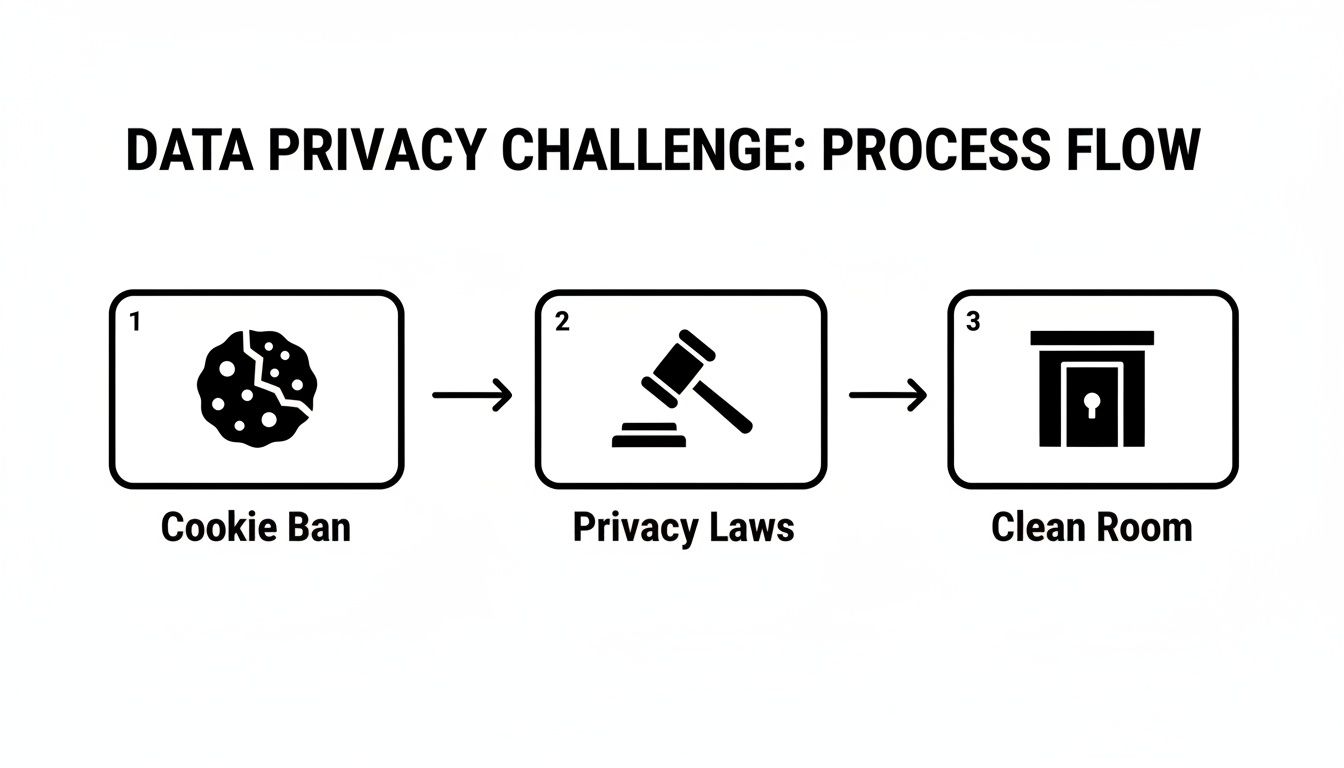
As the infographic shows, the market had to evolve. When old-school tracking methods became unreliable and illegal, a new technology was needed to let businesses analyze data together without breaking trust or the law.
The Core Mechanics: Anonymization and Matching
Before any data even touches the clean room, it goes through a critical transformation. All personally identifiable information (PII)—names, emails, phone numbers—gets anonymized. This is usually done through hashing, a process that scrambles the data into an irreversible, encrypted string of characters.
Once hashed and anonymized, these datasets are uploaded into the secure clean room environment. This is where the matching happens. The platform looks for overlaps between the datasets using those common, encrypted identifiers. For example, it can find where user_abc in a brand’s data is the same person as user_abc in a publisher’s data, all without anyone knowing who that person actually is.
This matching process is the heart of clean room analysis. It creates a shared audience segment that both partners can analyze together, but only at an aggregate level. This is where the true power of data clean rooms shines—it finally allows for collaboration on a unified customer view that was impossible before.
Privacy-Enhancing Technologies: The Safety Net
You might be wondering, what stops a clever analyst from running queries over and over until they can de-anonymize someone? That’s where Privacy-Enhancing Technologies (PETs) come in. Think of PETs as the clean room's built-in security guard, enforcing the rules.
One of the most important PETs is differential privacy. This technique adds a tiny amount of statistical "noise" to the results of a query. It's just enough to make it mathematically impossible to re-identify any single person from the output, but not so much that it messes with the accuracy of large-scale insights.
Another critical control is the audience threshold.
This is a rule that prevents the clean room from returning results for any query that includes too few people. For instance, if a query only matches 15 individuals, the system will block the result to stop analysts from isolating a small, identifiable group.
These safeguards ensure every output is aggregated and anonymous, protecting user privacy at every turn. It’s this disciplined, secure approach that’s driving the technology’s explosive growth. The global Data Clean Room Software market is projected to jump from USD 1.25 billion to USD 2.72 billion by 2032, with a strong CAGR of 13.6%. This isn't just hype; it reflects an urgent industry-wide shift toward privacy-first data collaboration.
If you're interested in the deeper technical side, it's worth learning about how server-side tracking complements these privacy-focused solutions. For more on market trends, check out the data clean room software market analysis from Intel Market Research.
Key Use Cases for Marketers and Media
The theory behind data clean rooms is great, but their real magic happens when you apply them to actual marketing problems. These aren't just abstract tech concepts; they're practical tools solving very real headaches for brands, publishers, and retailers. Let's get out of the weeds of the technical and see what they actually do.
Picture a major CPG brand that just dropped millions on a digital campaign for a new snack. For years, figuring out if those ads actually led to more in-store sales was a guessing game, full of estimates and crossed fingers. The brand knew who saw the ads, and their retail partners knew who bought the snacks, but those two worlds could never safely connect.

This is exactly where a data clean room steps in to build a secure bridge. The CPG brand uploads its anonymized ad exposure data, and the retailer uploads its anonymized sales data. Inside the clean room, the records are matched, spitting out an aggregated, privacy-safe report showing precisely how many people who saw an ad later bought the product.
Unlocking Closed-Loop Measurement
This process, often called closed-loop measurement, is one of the most powerful things you can do with a data clean room. It finally draws a straight line from digital ad spend to offline or third-party sales.
The results are game-changing. Instead of relying on proxy metrics like clicks or impressions, marketers can finally calculate a true return on ad spend (ROAS).
- CPG & Retail: Just like the example, brands can see how online campaigns directly drive purchases in physical stores.
- Auto & Dealerships: A car manufacturer can track whether a regional ad campaign is actually getting more people into local dealerships for test drives.
- Travel & Booking Sites: An airline could team up with a hotel chain to understand how many travelers book a flight and a hotel together, paving the way for smarter bundled offers.
The core benefit is crystal clear: data clean rooms provide an undeniable link between marketing actions and business outcomes, proving campaign value with hard sales data.
This is especially critical in the booming retail media space. With US retail media ad spending projected to hit nearly $70 billion in 2026, clean rooms are becoming the essential plumbing that connects purchase data with campaign performance. As cookies fade away, this secure method of matching first-party data is the new gold standard for accurate measurement. eMarketer has a great analysis on how retail media is driving clean room adoption.
Enhancing Audience Insights and Segmentation
Another massive win is getting a much deeper understanding of your own customers. Your CRM data is a goldmine, but it only tells part of the story. By working with a publisher or another data partner in a clean room, you can build a richer, more complete picture of your audience without ever exposing individual data.
Imagine a luxury fashion brand partnering with a high-end travel magazine.
- The brand brings its anonymized list of top-spending customers into the clean room.
- The magazine brings its anonymized data on subscribers who read articles about international travel.
- Inside the clean room, they run an overlap analysis. This reveals a segment of high-spending customers who are also passionate international travelers.
This new audience segment is incredibly valuable. The brand can now craft campaigns and content that speak directly to this group, knowing their interests go far beyond just fashion. It's a powerful insight that neither company could have found on its own.
Enabling Precise Cross-Channel Attribution
In a world without third-party cookies, tracking a customer's journey across different channels and devices is a huge challenge. How do you prove that a purchase on your website was influenced by an ad seen on a social media app and another on a connected TV?
Data clean rooms provide a neutral, central ground for attribution. Each media partner or "walled garden" (like Meta or Google) can bring its campaign data into the clean room. The advertiser then adds their own conversion data.
The clean room matches these different datasets using privacy-safe identifiers. This allows marketers to see the complete path to purchase and understand which touchpoints actually moved the needle. It brings back the ability to do sophisticated multi-touch attribution, which is absolutely essential for optimizing media budgets and making every dollar count.
How to Choose the Right Data Clean Room
Picking a data clean room isn't just about adding another tool to your martech stack; it's a major strategic decision. Get it right, and you unlock powerful collaboration and measurement that were impossible before. Get it wrong, and you're stuck with wasted resources, security headaches, and frustrating limitations.
The market is crowded, with everyone from major cloud providers to niche software vendors throwing their hats in the ring. To make a smart choice, you have to look past the sales pitches and really dig into the technology, usability, and commercial terms. It's about finding a true partner who aligns with where you are today and where you want to be tomorrow.
Start with Security and Compliance
Let's be clear: the entire point of a data clean room is built on a foundation of trust. If a platform can't guarantee data privacy, it has failed its most basic purpose. This is where your evaluation absolutely must begin.
First things first, check the vendor's security certifications and their compliance with major privacy laws.
- Certifications: Look for heavy hitters like SOC 2 Type II, ISO 27001, and HIPAA or GDPR compliance if that’s relevant for you. These aren't just logos on a website—they prove a vendor has passed rigorous, third-party security audits.
- Privacy-Enhancing Technologies (PETs): Don't be afraid to get technical. Ask vendors exactly which PETs they use. Are they using differential privacy to add statistical noise? What are their minimum audience thresholds to stop bad actors from identifying small groups? You need to understand these safeguards.
- Data Governance: How much control do you really have? You should be able to define, with surgical precision, who can access what data and what kinds of queries they can run. A great platform makes setting and enforcing these rules simple.
The gold standard for security is often confidential computing. This ensures data stays encrypted even while it's being processed. In simple terms, this means not even the clean room provider can peek at your raw data, offering the highest level of protection out there.
Evaluate Technical Capabilities and Integrations
A fortress is useless if you can't get in or out. A secure clean room that doesn’t fit into your existing workflow or support the analysis you need is just as unhelpful. Your next step is to pop the hood and assess the platform’s technical muscle.
Interoperability is one of the most critical factors. Your data is everywhere—in CDPs like Segment, CRMs like Salesforce, cloud warehouses like Snowflake, and ad platforms. The clean room has to connect to these sources without a ton of custom engineering work. Look for pre-built connectors to platforms like AWS, Google Cloud, and the big walled gardens.
Next up, think about who will actually be using this thing every day.
- For Business Users: If your marketing analysts are the main users, they need a clean, intuitive, no-code interface. They should be able to run common reports—like audience overlap or attribution—without having to call a data engineer for help.
- For Technical Teams: If your data scientists need to do more advanced work, the platform must support custom queries and modeling in languages like Python or R. The best solutions usually cater to both, offering a simple UI with a powerful, flexible engine underneath.
Scrutinize the Commercial Model
Finally, it's time to talk money. Hidden costs and restrictive contracts can turn a promising tool into a financial nightmare. You need to ask direct questions about how the vendor actually charges for their service.
Is the pricing based on data volume, the number of users, how many partners you connect with, or just a flat fee? You need to understand how costs will scale as your usage grows. A model that looks cheap for a small pilot can become wildly expensive once you start onboarding more partners and running complex analyses.
But don't stop at the price tag. Evaluate the vendor as a long-term partner. How good is their customer support? What does their onboarding process look like? A great partner does more than just sell you software—they provide strategic guidance, helping you map out use cases and nail your first few collaborations. That hands-on support can be the difference between a stalled project and a game-changing success.
Building Your Implementation Playbook
Let's be honest: a successful data clean room isn't just about cool technology. It’s built on a rock-solid strategic plan. Moving from picking a vendor to having a fully operational, value-driving asset requires a clear, step-by-step playbook. This is what keeps every team—from marketing to legal—aligned and ensures every move you make is intentional.
The journey starts long before you ingest a single byte of data. It begins with defining your business objectives with surgical precision. Vague goals like "getting better insights" just won't cut it.
You need to get specific and measurable. Are you aiming for a 15% lift in campaign ROAS by closing the measurement loop with a retail partner? Or is the goal to enrich 30% of your first-party profiles with partner data to sharpen your segmentation?

Think of these clear objectives as your north star. They guide every single decision that follows and, just as importantly, they're the bedrock for getting all your stakeholders on board, making sure everyone understands the "why" behind this project.
Assembling Your Core Team and Governance
Implementing a data clean room is a team sport, plain and simple. Success hinges on pulling together a cross-functional group of stakeholders right from day one. This team isn’t just a formality; they are the engine that will drive this entire initiative forward.
Your core implementation team should have a seat at the table for:
- Marketing: They're the primary business users who will dream up the use cases and dig into the outputs.
- Data and Analytics: These are your technical owners, responsible for prepping, integrating, and validating all the data sources.
- Legal and Compliance: Think of them as the guardians of privacy. They'll vet partners and set the rules of engagement.
- IT: This team makes sure the clean room plays nicely with your existing tech infrastructure.
Once the team is in place, your next move is to build a robust governance framework. This is the official rulebook for how the clean room operates. It defines who gets to see what data, what kinds of queries are allowed, and what the minimum audience thresholds for analysis will be. A strong governance plan is your best defense against privacy headaches and data misuse down the road. If you're curious, our guide on designing a customer data platform architecture shows how this fits into a bigger data picture.
The Technical Lift: Preparing Data and Integration
With a solid strategy and governance plan, it’s time to get your hands dirty with the technical setup. First up is data preparation. You know the old saying: "garbage in, garbage out." It's especially true for data clean rooms, where messy data leads to terrible match rates and insights that are basically useless. Your data teams have to make sure every dataset is clean, standardized, and properly formatted before it ever touches the clean room.
Next is the integration phase. This is where you connect the clean room to your various data sources—your CDP, cloud data warehouse, and key ad platforms. Many modern clean room solutions offer pre-built connectors that can make this a lot easier, but don't be surprised if some custom work is still on the table.
A critical part of this phase is creating a comprehensive testing and Quality Assurance (QA) plan. Before going live, you must rigorously test the entire data flow—from ingestion and anonymization to matching and querying—to validate both data accuracy and the enforcement of your privacy rules.
This structured approach is crucial, especially as the market explodes. Projections show the Data Cleanroom Software Market is expected to jump from USD 100 billion to USD 266 billion by 2031. This hyper-growth shows the technology is moving from a niche tool to a core piece of the modern marketing stack. You can discover more insights about these market trends from Verified Market Research.
Avoiding Common Pitfalls and Measuring Real Success
Getting a data clean room up and running is a huge milestone, but the real work starts after the technical setup. Even the most advanced technology will fall flat without a smart strategy. Honestly, avoiding the common tripwires is just as critical as picking the right vendor in the first place.
One of the fastest ways to kill a clean room project is by having fuzzy goals. If you don’t define specific, measurable outcomes that tie directly back to the business, you’ve just built a very expensive solution that's hunting for a problem. Vague ambitions just lead to confused stakeholders and analytics projects that go nowhere.
Another classic mistake? Bad data. It’s the old "garbage in, garbage out" problem. If your source data is a mess—incomplete, messy, or poorly formatted—you'll get terrible match rates. This means the overlap between your data and your partner's will be so small that you can't pull any meaningful insights. The whole effort becomes pointless.
Identifying Key Stumbling Blocks
Beyond strategy and data quality, a few other obstacles can sneak up on you. A big one is underestimating the need for legal and compliance to be on board from day one. Bringing them in late can cause massive delays or even get the project shut down. Likewise, if you don't plan for the human side of things—the skills and training your team needs—that shiny new tool will just sit there collecting dust.
Keep an eye out for these pitfalls:
- Misaligned Partner Expectations: Make sure every single collaborator is on the same page about goals, governance rules, and what "success" looks like before a single piece of data is shared.
- Starting Too Big: Don't try to boil the ocean. Kick things off with a simple, high-impact project, like a basic audience overlap analysis. This helps you prove value quickly and builds momentum before you tackle something complex like multi-touch attribution.
- Ignoring Data Governance: Without clear rules for data usage and access, you’re creating serious privacy risks. Strong data governance best practices aren't optional; they're essential.
Measuring the True Impact of Your Data Clean Room
To justify the investment and make the clean room a permanent part of your strategy, you absolutely have to track the right KPIs. Success isn't just about having the technology; it's about what you achieve with it.
The ultimate goal is to draw a straight line from your data clean room activities to business growth. Your measurement framework should prove how secure data collaboration is making your marketing smarter, more efficient, and more profitable.
Focus on metrics that tell a clear story of value. You need to show how attribution accuracy has improved by uncovering conversions that were previously missed. Measure the lift in campaign Return on Ad Spend (ROAS) now that you have a closed-loop view of performance. You can even quantify the faster time-to-insight for your analytics team or point to new partnerships that were only possible because of secure collaboration.
These are the concrete metrics that transform your data clean room from a cost center into a true competitive advantage.
Got Questions? We've Got Answers
Even after a deep dive, new technology always sparks a few questions. Let's tackle some of the most common ones that come up when marketers and data pros start exploring data clean rooms.
What’s the Difference Between a Data Clean Room and a CDP?
This is a great question, and the answer gets to the heart of what makes each tool unique.
A Customer Data Platform (CDP) is all about your own world. Its job is to collect, clean, and stitch together all the first-party data you have about your customers. The end goal is to build a single, unified profile for each person that you can use for your internal marketing, analytics, and personalization efforts. It's your single source of truth, for your eyes only.
A data clean room, on the other hand, is built for collaboration. It's a neutral, secure space where you and a partner can bring your datasets together for analysis without either side seeing the other's raw customer data.
Here's a simple analogy: Your CDP is like organizing your entire personal address book. A data clean room is the trusted third-party service that tells you how many of your contacts are also in a friend's address book, without you ever having to swap books.
Just How Secure Is the Data Inside a Clean Room?
Security isn't just a feature; it's the entire foundation of a data clean room. These platforms are architected from the ground up to prevent data leaks and protect consumer privacy, using several layers of protection.
First off, raw data almost never enters the environment. It’s typically hashed or anonymized before it's even uploaded. Once inside, strict access controls and pre-negotiated rules dictate exactly what each party can do.
Most importantly, you can't just pull out individual-level data. All outputs are aggregated. This is usually enforced by a minimum audience size (sometimes called a k-anonymity threshold), which stops anyone from running queries on just a handful of people. Many platforms also add advanced privacy-enhancing technologies like differential privacy, which mathematically guarantees that it's nearly impossible to re-identify any single person from the results.
Do I Need a Data Science Team to Use a Data Clean Room?
Not necessarily. While having data scientists on hand can definitely unlock some seriously advanced custom analysis, it's not a requirement for getting real value.
Many of the leading data clean rooms today are designed with marketers and business analysts in mind. They come equipped with user-friendly interfaces and pre-built query templates for the most common use cases, allowing you to get answers without writing a single line of code. These often include:
- Audience Overlap: Instantly see the crossover between your customer list and a partner's.
- Attribution Reporting: Match ad exposure data from a publisher with your sales data to measure campaign lift.
- Journey Analysis: See how customers interact with both your brand and a partner’s platform.
This accessibility means marketing teams can get answers to critical questions on their own time, making data clean rooms a practical tool for the whole business, not just the technical folks.
At The data driven marketer, we provide actionable guides and frameworks to help you master your marketing data stack and drive real business outcomes. From platform architecture to vendor selection, we decode the complexities so you can build with confidence. Explore our in-depth articles to sharpen your strategy.