

Marketing attribution is the practice of figuring out which marketing efforts actually get credit for a conversion. It's how you connect the dots between the ads, emails, content, and social posts you run and the sales or sign-ups you get in return.
Think of it less as a science and more as a detective story. Instead of just guessing which campaigns are pulling their weight, attribution gives you the evidence to prove it. This is absolutely critical for making smart decisions about where to put your marketing budget.
Unmasking the Path to Purchase

Let’s get real. A customer journey is rarely a straight line. Someone might see your ad on social media, click a Google Ad a week later, read a blog post, and finally convert after getting a promo email. So, who gets the credit for that sale?
Answering that question is the entire point of marketing attribution.
Without a solid attribution system, most teams fall back on giving 100% of the credit to the very last thing the customer touched. That’s like giving the game-winning goal to the striker who tapped the ball in, completely ignoring the incredible cross from the midfielder and the tackle from the defender that started the whole play. This last-touch obsession leads to bad investments because it undervalues all the channels that build awareness and nurture customers along the way.
Why Attribution Is No Longer Optional
In a world where customer journeys are all over the place and budgets are always under a microscope, you can't afford to guess. Effective marketing attribution lets you tie your spending directly to revenue, giving you a clear picture of your return on investment (ROI). It’s the difference between making decisions based on gut feelings and making them based on cold, hard data.
Getting this right delivers a few huge wins:
- Smarter Budget Allocation: You can confidently move money away from channels that aren't performing and double down on the ones that consistently drive results.
- Optimized Customer Journeys: When you know which touchpoints are most influential, you can fine-tune your messaging and build a more effective path from prospect to customer.
- Improved Team Accountability: Attribution gives you a clear way to measure success and justify your marketing spend to the C-suite and the rest of the business.
At its heart, marketing attribution is about accountability. It transforms marketing from a cost center into a predictable revenue driver by proving which activities are actually contributing to the bottom line.
Before we dive deeper, let's get on the same page with a few core ideas you'll see throughout this guide.
Key Marketing Attribution Concepts at a Glance
Here’s a quick summary of the core terms you'll encounter on your journey to understanding marketing attribution.
| Concept | Simple Explanation | Why It Matters to You |
|---|---|---|
| Touchpoint | Any interaction a customer has with your brand (e.g., seeing an ad, reading an email, visiting your site). | These are the "dots" you're trying to connect. Identifying them is the first step. |
| Conversion | The desired action you want a user to take (e.g., a purchase, a sign-up, a form submission). | This is your goal. Attribution measures what drives you closer to it. |
| Attribution Model | The set of rules you use to assign credit to touchpoints (e.g., Last-Touch, First-Touch, Linear). | The model you choose directly impacts your conclusions about what's working and what's not. |
| Customer Journey | The complete path a customer takes, from initial awareness to final conversion and beyond. | Attribution helps you see this journey clearly instead of just focusing on the final step. |
Think of this table as your cheat sheet. These are the building blocks we’ll use to construct a more sophisticated understanding of how to measure marketing performance.
The Fundamental Shift in Thinking
Ultimately, adopting marketing attribution is a mindset shift. It’s about looking beyond single, isolated interactions and appreciating the messy, multi-step journey modern customers take. Every single touchpoint—from the first ad they barely notice to the final email they open—plays a part.
Understanding those roles is the first step toward building a smarter, more efficient marketing machine. When you can accurately measure the influence of each channel, you stop guessing where your budget is working and start making strategic, data-backed decisions that fuel real business growth. This guide will show you exactly how to do that.
From Gut Instincts to Data-Driven Decisions
To really get a handle on where marketing measurement is going, you have to look at where it’s been. For decades, a lot of the biggest budget decisions came down to experience and gut feel, not hard data. The story of marketing attribution is really a journey from those educated guesses to the precise, data-backed strategies we see today.
This didn't happen overnight. It started long before the first banner ad, back when print, radio, and television ruled the world. Marketers then were asking the same question they are now: is this working? The first real attempts to answer that came from statistics.
The Original Measurement Revolution
The earliest ancestor of what we now call marketing attribution dates back to the 1950s with the creation of marketing mix models (MMM). This was a revolutionary statistical method that completely changed how businesses understood the impact of their marketing.
By the 1980s, giants like Procter & Gamble and Unilever were using these models to optimize enormous ad budgets across TV, print, and radio. Early case studies, for instance, showed that a 10% bump in TV ad spend could lift sales by 5-7% in mature markets. It was the first time marketers could connect broad spending to overall sales with any real confidence. You can find more details about the historical importance of attribution models on growify.ai.
These early models gave a top-down view. They were great for their time, but they couldn’t track what individual customers were doing. That part of the puzzle didn't show up until the internet came along.
The Digital Age and the Last-Click Trap
When the digital age arrived, it brought with it a tidal wave of trackable data. All of a sudden, marketers could see every click, visit, and conversion in real-time. This led to the rise of a simple, intuitive, and deeply flawed method that would dominate web analytics for years: last-click attribution.
The logic was simple enough: whatever a customer clicked right before they bought something gets 100% of the credit. It was easy to set up and even easier to understand, which made it the default for pretty much every early analytics platform.
The problem with last-click attribution is that it's like giving all the credit for a championship win to the player who scored the final point. It completely ignores the assists, the defensive plays, and the coaching that made the victory possible.
This model created a completely warped view of performance. It massively overvalued channels that are usually the last stop in the journey, like branded search and retargeting ads. Meanwhile, it gave zero credit to the blog posts, social media campaigns, and initial ads that introduced customers to the brand in the first place.
The Need for a More Complete Picture
As digital marketing got more complicated, the flaws in the last-click model became impossible to ignore. A customer's path to purchase was no longer a single step but a winding journey across multiple channels and devices.
Think about a typical customer journey:
- A user might see an ad on Instagram.
- A few days later, they search for the brand on Google.
- A week after that, they click a link in a promotional email.
- Finally, they type the website URL directly into their browser to make a purchase.
With a last-click model, that "direct" visit gets all the glory. The social ad and the email campaign look like they did nothing. This realization forced a major shift in thinking and technology, leading to the development of Multi-Touch Attribution (MTA).
MTA was built to analyze the entire customer journey and spread the credit across multiple touchpoints. It provides a much more accurate and useful picture of what truly drives conversions. This history is key to understanding why modern attribution tools are built the way they are—and why just sticking with default reports isn't enough to get ahead anymore.
Exploring Different Marketing Attribution Models
Deciding how to give credit for a conversion isn’t a one-size-fits-all kind of problem. Different marketing attribution models give you unique ways to look at the customer journey, and each one comes with its own logic, strengths, and weaknesses. The key is to move past the default settings in your analytics and find a model that actually reflects how your business grows.
Attribution approaches generally fall into two main camps: rules-based models, which operate on simple, pre-set logic, and data-driven models, which use algorithms to figure out credit on their own. Let's dig into the classic rules-based options first.
Rules-Based Single-Touch Models
Single-touch models are as simple as it gets. They give 100% of the credit for a sale to just one touchpoint, ignoring every other interaction along the way.
First-Touch Attribution: This model gives all the glory to the very first interaction a customer had with your brand. It’s fantastic for figuring out which channels are bringing new people into your orbit. The big downside? It completely ignores everything you did to nurture that lead and actually close the deal.
Last-Touch Attribution: The polar opposite, this model hands all the credit to the final touchpoint right before the conversion. It’s great for pinpointing your "closers"—the channels that get customers to pull the trigger. But it totally devalues all the hard work that introduced and warmed up that customer in the first place.
For a long time, last-touch was the default in digital analytics, but its flaws became obvious as marketers realized it ignored all the critical upstream nurturing. As recently as 2016, a surprising 12% of marketers still relied on it, which almost certainly led to some shaky budget decisions.
Rules-Based Multi-Touch Models
Multi-touch models get a little more sophisticated. They acknowledge that multiple interactions lead to a conversion and split the credit among them based on a simple rule. Think of it like splitting a dinner bill with friends—these models are just different ways of dividing up the check.
Linear Model: This is the most democratic of the bunch. It splits credit equally among every single touchpoint in the journey. Simple and fair, but it makes the big assumption that every interaction had the exact same impact, which is almost never the case.
Time-Decay Model: This model gives more credit to the touchpoints that happened closer to the conversion. The ad someone clicked yesterday gets more weight than the blog post they read a month ago. It's built on the idea that later interactions are often more influential in sealing the deal.
Position-Based (U-Shaped) Model: A popular hybrid approach, this model gives 40% of the credit to the first touch and 40% to the last touch. The remaining 20% is then spread evenly across all the interactions in the middle. It values both the channel that kicked off the journey and the one that closed it.
This decision tree shows how we've moved from simple gut feelings to these more complex, multi-touch ways of thinking.
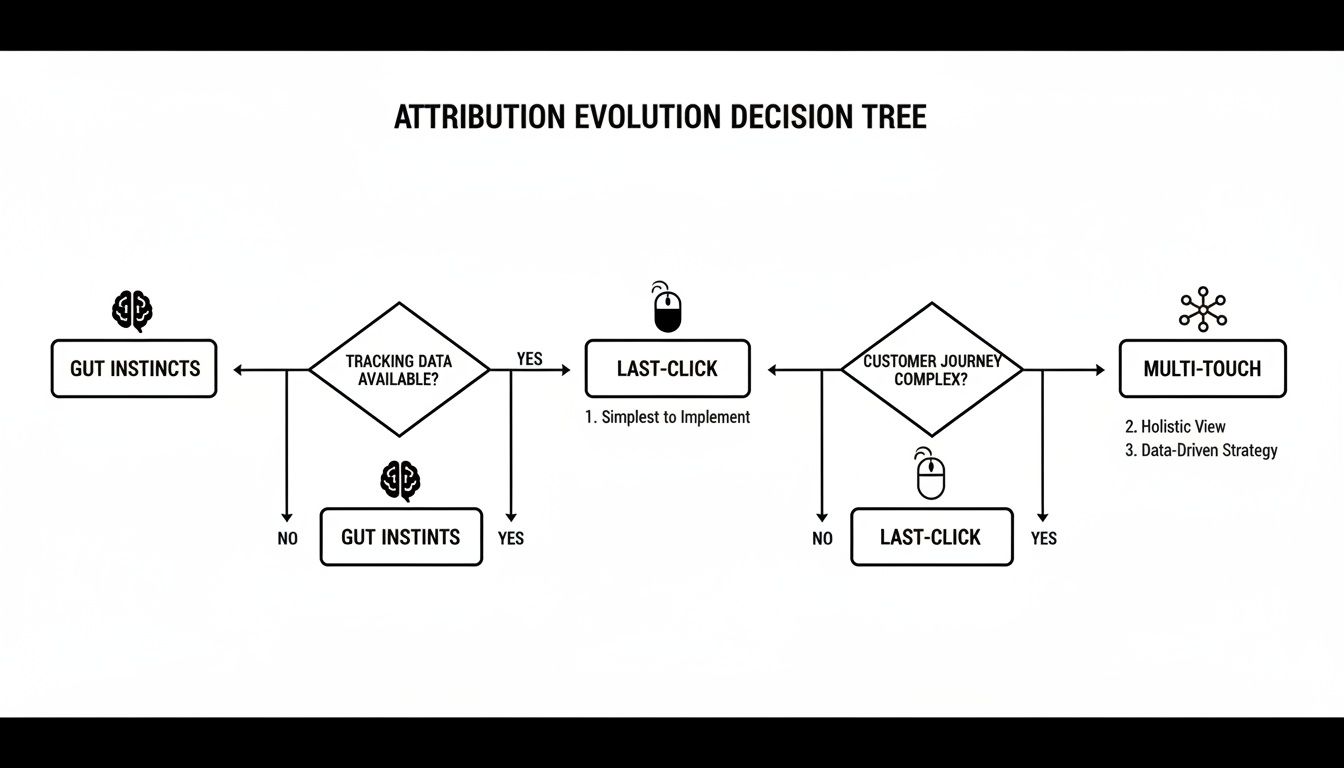
You can see a clear path from basic measurement to more nuanced models that try to capture the messiness of modern marketing.
Data-Driven Algorithmic Models
While rules-based models are easy to grasp, they’re still based on human assumptions. Data-driven attribution, also called algorithmic attribution, throws those assumptions out the window. It uses machine learning to crunch the numbers on all your converting and non-converting customer paths to figure out how much each touchpoint actually contributed.
This approach is much more accurate because it’s tailored specifically to your business and how your customers behave. It can reveal insights you’d never find with a simple rule, like discovering the surprising value of a mid-funnel blog post or the supporting role of a niche social campaign. You can get a deeper look into the mechanics by reading our guide on what attribution modeling is.
The catch? It needs a lot of data to work well and can sometimes feel like a "black box" if you aren't familiar with the statistics behind it. But for teams who need the most precise view of marketing performance, it's the gold standard.
Rules-Based vs Data-Driven Attribution Models
To make the choice clearer, let's put these two approaches side-by-side.
| Model Type | How It Works | Pros | Cons | Best Suited For |
|---|---|---|---|---|
| Rules-Based | Assigns credit based on predefined, static rules (e.g., last-click, linear, U-shaped). | Simple to understand and implement. Doesn't require massive data sets. | Based on assumptions, not actual performance. Can misrepresent channel impact. | Teams new to attribution, smaller businesses, or those with limited data and resources. |
| Data-Driven | Uses algorithms and machine learning to analyze all touchpoints and assign credit based on their statistical impact on conversions. | Highly accurate and customized to your specific business. Uncovers non-obvious insights. | Requires significant data volume. Can be complex ("black box"). Often requires a vendor tool. | Mature marketing teams, businesses with high conversion volume, and those seeking maximum accuracy. |
Ultimately, rules-based models provide a good starting point for understanding your customer journey, while data-driven models offer a far more precise and actionable picture once you have the scale to support them.
Navigating Measurement in a Privacy-First World
The old ways of measuring marketing are officially broken. For years, we all relied on cookies and other user-level breadcrumbs to follow customers across the web, but that entire foundation is crumbling under our feet. With privacy regulations tightening and third-party cookies going extinct, dependable user-level tracking has become a massive headache.
This shift has thrown marketers straight into a modern measurement crisis. The granular, user-path data that once fueled multi-touch attribution (MTA) is now patchy and unreliable. If you can't see the whole journey, how can you possibly assign credit with any confidence?
The Rise of Hybrid Measurement
To survive, the industry is pivoting toward hybrid measurement. This isn't just a buzzword; it's a practical approach that combines the strengths of different attribution methods to build a more complete and resilient picture of performance. It blends the big-picture, top-down view of Marketing Mix Modeling (MMM) with whatever is left of the granular, user-level data from MTA.
Here’s a simple way to think about it:
- MMM is your satellite image. It shows you the broad, strategic patterns, like how your TV ad spend is influencing overall sales.
- MTA is your street-view map. It zooms in on the individual customer paths you can still see.
By layering these two views, you get a much more robust understanding of your marketing's real impact. The satellite view from MMM helps fill in the glaring holes left by the increasingly fragmented street-view data from MTA. This convergence became essential in the late 2010s, as rules like GDPR and Apple's ATT framework vaporized trackable users, sometimes by 50-70% in major markets. As a result, traditional MTA started drowning in signal loss. By 2023, a staggering 80% of enterprises admitted their attribution accuracy had dropped below 60%. To get the full picture, check out how data trends are shaping attribution.
Proving Causality with Incrementality
While hybrid models help piece together a fractured view, they still mostly rely on correlation—just observing that one thing happened after another. But the true gold standard for proving your marketing caused a conversion is incrementality testing.
Incrementality gets straight to the point, answering one vital question: did my ad campaign actually make someone convert, or were they going to buy from us anyway? It moves beyond just assigning credit and focuses on proving true, undeniable lift.
Incrementality is the ultimate test of causality. It tells you the true value your marketing adds by measuring the difference between what happened with your marketing and what would have happened without it.
The most common way to measure this is with a classic lift test. You simply split your target audience into two groups:
- Test Group: This group sees your marketing campaign (e.g., your new series of Facebook ads).
- Control Group: This group is intentionally held back and does not see the campaign.
By comparing the conversion rate of the test group to the control group, you can measure the "lift"—the actual number of conversions directly caused by your ads. It's the most definitive way to prove the real-world impact of your budget.
Why This Matters for Modern Marketers
In a world with less data, being able to prove causality is a superpower. When you can’t perfectly track every single user journey, incrementality tests give you concrete evidence that your budget is generating real, additional business, not just taking credit for sales that were already in the bag. For any marketing leader who has to defend their budget and prove ROI, this is absolutely non-negotiable.
This approach also fits perfectly with other privacy-first technologies. As user data becomes more aggregated and anonymous, techniques that can measure impact without needing individual-level tracking are becoming indispensable. To see how marketers are navigating this new reality, you might find our deep dive on what data clean rooms are and how they enable secure analysis insightful.
Ultimately, navigating measurement today requires a shift in mindset. Instead of chasing a perfect, all-seeing view of the customer journey, the goal is to build a resilient and defensible framework that combines broad modeling with rigorous, causal testing.
Building Your Technical Attribution Foundation

Great marketing attribution is way more than just picking a model from a dropdown menu. It's about building a solid technical engine that powers your insights. This is where all the theory we've been talking about gets real. If you want reliable answers, you need a dependable system to collect, stitch together, and analyze data from every corner of the customer journey.
Think of it like cooking a gourmet meal. The foundation starts with the raw ingredients—the data itself. Without high-quality ingredients, even the most sophisticated recipe (or attribution model) will fall flat.
Gathering the Essential Data Inputs
To really figure out what drives conversions, you need to look far beyond simple website clicks. A robust attribution setup brings together data from multiple sources, with each one providing a unique piece of the puzzle.
Here's your essential data checklist:
- Ad Platform Data: This is your top-of-funnel fuel. It includes impressions, clicks, cost, and campaign metadata from platforms like Google Ads, Meta, and LinkedIn. It tells you what people saw and clicked on.
- Web and App Analytics Events: This is the digital breadcrumb trail. User interactions like page views, button clicks, form submissions, and video plays from your website or mobile app are critical for mapping the journey.
- CRM Data: Here's where the story gets serious. Information from your CRM, like Salesforce or HubSpot, gives you context on lead status changes, opportunity creation, and—most importantly—closed-won deals.
- Offline Conversion Data: For so many businesses, the journey doesn't end online. You have to account for in-store purchases, phone calls, or event attendance and tie them back to your digital efforts.
Just collecting this data is the first hurdle. The real magic—and the real challenge—is connecting it all to a single person.
The core technical challenge of marketing attribution isn't just data collection; it's identity resolution. This is the complex process of stitching together a user's scattered interactions across different devices and platforms into one cohesive journey.
Architecting Your Attribution System
Once you know what data you need, you have to decide where to put it all and how to analyze it. Your technical architecture can be as simple as an out-of-the-box tool or as complex as a fully customized data platform. It all depends on your team's needs and maturity.
Teams usually go down one of a few common paths:
- Packaged Analytics Platforms: Tools like Google Analytics 4 (GA4) come with built-in attribution reporting. This is a fantastic starting point for smaller teams, offering accessible models without needing a dedicated data engineering squad.
- Specialized Attribution Vendors: These are the specialists. Companies that live and breathe attribution offer sophisticated platforms that handle all the data integration and modeling for you, often with advanced features like data-driven models.
- The Modern Data Warehouse: This is the power move. For maximum control and flexibility, many organizations build their attribution systems in a central data warehouse like BigQuery, Snowflake, or Redshift. This approach lets you combine marketing data with product, sales, and support data for a truly 360-degree view.
That last approach is definitely the most resource-intensive, but it creates an incredibly powerful foundation for not just attribution but all of your marketing analytics. It does, however, demand strong data governance and a crystal-clear event tracking plan to ensure the data flowing in is clean and consistent.
To improve the quality of that data, many teams are exploring new methods of data collection. You can learn more about one such method in our guide on what is server-side tracking and how it provides more reliable data streams.
Ultimately, building a solid technical foundation is about creating a single source of truth for your marketing performance. It’s a critical investment that turns messy, raw data into a reliable system for making smarter, more profitable decisions.
Putting Your Attribution Insights into Action
Let's be honest: an attribution model, no matter how precise, is totally useless if it just sits in a dashboard. The real win isn't the report itself, but how you use its insights to make smarter decisions that actually grow the business. This is where the rubber meets the road—turning complex data into better budget allocations, stronger campaigns, and a marketing culture that runs on data, not guesswork.
The first step is figuring out where you stand today. Before you can improve, you need to get real about your measurement gaps. What critical questions can't you answer right now? Where do you have a gut feeling that your budget is going to waste? By setting clear, measurable goals—like boosting return on ad spend (ROAS) by 15% or trimming your customer acquisition cost (CAC)—you turn attribution from a nerdy technical exercise into a powerful strategic tool.
From Data to Actionable Strategy
With your goals locked in, you can start building a playbook for applying what you learn. The secret is to turn raw attribution data into specific, testable hypotheses. Don't just stop at "social media is underperforming." A real insight sounds more like a question: "If we shift 10% of our social budget from top-of-funnel awareness campaigns to mid-funnel consideration campaigns, will we see an improvement in our lead quality?"
This kicks off a continuous cycle of analysis, action, and measurement.
- Analyze the Data: Use your chosen model to pinpoint the strongest and weakest paths to conversion.
- Formulate a Hypothesis: Create a simple "if-then" statement (e.g., "If we reallocate budget from Channel X to top-performing Channel Y, then our overall ROAS will increase").
- Take Action: Go and actually make the change. Adjust your channel mix, tweak your ad creative, or update your landing page offers based on the hypothesis.
- Measure the Impact: Circle back and monitor the results. Did your change actually produce the outcome you expected?
The whole point is to create a tight feedback loop where attribution insights directly fuel your next campaign sprint. It’s about moving from passively watching performance reports to actively shaping outcomes with hard evidence.
Applying Insights in the Real World
How you use this data will look very different depending on your business. The insights that are gold for a B2B SaaS company might be irrelevant for an e-commerce brand.
For example, a B2B SaaS company with a long, complex sales cycle might lean on a position-based model. They’d analyze which whitepapers or webinars (the first touch) are best at generating new leads, and which case studies or demos (the last touch) are most effective at sealing the deal. This directly informs both their content strategy and their sales team's playbook.
On the other hand, an e-commerce brand is all about driving quick conversions, so a time-decay model makes more sense. They’d focus on which channels, like retargeting ads or last-minute promotional emails, have the most influence in the final hours before a purchase. This lets them fine-tune their ad spend for maximum short-term ROAS.
Ultimately, putting attribution into action means weaving this data into your team's day-to-day workflow. It’s the critical final step that transforms a measurement system from a nice-to-have into a powerful engine for sustainable growth.
Common Questions About Marketing Attribution
As teams start digging into attribution, the same questions pop up time and time again. Getting these sorted out early on saves a lot of headaches and helps you build momentum much faster. Let's walk through some of the most common ones I hear.
One of the first is, "How often should I be checking my attribution model?" Think of it like a seasonal check-up. A good rule of thumb is to review your model at least quarterly. This ensures it’s keeping up with any new marketing channels you’ve launched or big strategic shifts you've made.
Another big one is complexity. I get it—marketers often worry that attribution is too technical and that you need a data science degree to make sense of it. While the math behind some models can get intense, modern tools are built for marketers, not statisticians. The whole point is to give you clarity on where to spend your budget, not to drown you in algorithms.
Navigating Common Challenges
A huge, and often unspoken, challenge is internal politics. Let’s be honest: when budgets are on the line, different teams might push for an attribution model that just happens to make their channels look amazing.
The best way to sidestep this is to create a clear governance process from the start. Have a neutral team or person own the attribution process and get everyone to agree on a single, standardized model for the company. This creates one source of truth and stops the endless arguments over who gets credit.
Finally, everyone wants to know: which model is the "best" one? The short answer is, there isn't one. The right model depends entirely on how your business and your customers operate.
- Long Sales Cycles: If you're in B2B or sell high-ticket items, the customer journey can take months. A first-touch or position-based model might give you better insight into what initially sparks interest.
- Short Sales Cycles: For e-commerce brands where a purchase can happen in minutes, a last-touch or time-decay model often makes more sense, as it gives more weight to the final touchpoints that sealed the deal.
At the end of the day, the best approach is the one that actually reflects your customer’s path to purchase and helps you make smarter, more confident investment decisions.
Ready to turn messy data into reliable signals and prove your marketing ROI? The Data Driven Marketer offers actionable guides, frameworks, and blueprints to help you master your marketing stack. Start making data-backed decisions with confidence at https://datadrivenmarketer.me.