
At its core, a data integrity solution is the combination of systems, processes, and tools you put in place to keep your data accurate, consistent, and trustworthy. Think of it as the quality control team for all your marketing information, catching problems before they poison your strategy and drain your ad budget.
For marketers, these solutions are what turn a chaotic mess of data into a reliable asset you can actually use to grow the business.
Why Your Marketing Data Is Silently Sabotaging Growth
Picture this: your marketing strategy is a high-performance race car, engineered down to the millimeter for speed and precision. You’ve invested in the best engine (your ad platforms), hired a world-class driver (your team), and mapped out the perfect race plan (your campaign strategy). But right before the race, someone fills the tank with contaminated fuel.
The car sputters. It underperforms. Eventually, it just breaks down on the side of the track. This is exactly what happens when you try to run a sophisticated marketing operation on broken data.

When you don't have robust data integrity solutions, your entire marketing effort is built on a shaky foundation. Inaccurate analytics, inconsistent tracking, and incomplete customer profiles don't just create messy spreadsheets—they lead directly to bad decisions.
The Hidden Costs of Bad Data
The fallout from ignoring data integrity is huge, and the damage often stays hidden until it’s far too late. When your data is unreliable, you’re exposing the business to some serious risks:
- Wasted Ad Spend: You might be pouring money into a channel that looks like a top performer, only to find out months later that the conversion data was duplicated or misattributed.
- Flawed Strategic Decisions: Your leadership team could approve a major budget shift or a new campaign pivot based on reports that don't reflect reality, sending everyone scrambling in the wrong direction.
- Missed Growth Opportunities: If you can't accurately map the customer journey, you can't see what's truly working. That means you miss the chance to double down on your most effective tactics or personalize the user experience.
- Eroded Trust in Analytics: Nothing kills momentum faster than when different reports show conflicting numbers. Teams lose confidence, analysis paralysis sets in, and everyone reverts to making decisions based on gut feelings.
In short, poor data integrity isn't just a technical problem; it's a strategic liability that silently undermines every marketing dollar you spend and every decision you make.
This guide is your blueprint for building a solid data foundation. We'll break down the core components of modern data integrity, show you how to architect a resilient system, and give you the tools to turn chaotic information into your most valuable asset for predictable growth.
The Five Pillars of Modern Data Integrity for Marketers
To build a marketing engine you can actually rely on, you have to understand what makes data trustworthy in the first place. Think of data integrity less like a single tool and more like a system held up by five essential pillars. Each one addresses a different weak point in your data's journey, and together, they form a solid foundation for any modern marketing stack.
Getting your head around these concepts is the first step toward building data integrity solutions that don't fall apart under pressure. Let's break down what each pillar really does in your day-to-day world.
Data Validation: The Quality Control Inspector
First up is data validation. This is your quality control inspector, standing right at the factory door. Its only job is to make sure that the data coming into your systems is properly formatted and looks the way you expect it to. Without it, you’re basically letting anything and everything into your warehouse, which is a recipe for chaos.
For example, a validation rule might check that every purchase event has a valid order_id and a revenue value greater than zero. Simple, right? But if a broken tracking tag sends an event without those fields, the validation process flags or rejects it on the spot.
This is a proactive defense. It stops simple mistakes from poisoning entire datasets, preventing bad data from ever influencing your reports, ad optimizations, or personalization campaigns.
Data Observability: The 24/7 Security System
Next is data observability. This acts like a 24/7 security system monitoring your entire data pipeline. While validation checks data at the front door, observability keeps an eye on the health and behavior of your data as it moves between all your different tools.
Observability is all about answering critical questions in real-time:
- Did the volume of
add_to_cartevents just plummet by 90%? - Is our CRM suddenly getting sign-ups with missing email addresses?
- Why did the schema for our mobile app events change without warning after the last release?
This pillar is about spotting the "unknown unknowns." Instead of waiting for a stakeholder to Slack you that a dashboard looks weird, an observability platform alerts you the second a data stream breaks. That gives you the power to fix issues before they ever impact a business decision.
Data Lineage: The GPS Tracker
Think of data lineage as a GPS tracker for your data. It gives you a complete, visual map of your data's journey, from its origin all the way to its final destination in a report or dashboard. For marketers, this is absolutely critical for building trust and debugging tricky issues.
Imagine your CMO questions the ROAS figure in the weekly report. With data lineage, you can trace that single number all the way back. You can clearly show that it came from conversion events in GA4, was processed by your CDP, got enriched with cost data in the warehouse, and was finally visualized in your BI tool. This end-to-end visibility makes it easy to pinpoint exactly where a calculation might have gone wrong—or to prove the numbers are correct.
Data lineage turns opaque data pipelines into transparent, auditable pathways. It replaces guesswork with certainty, empowering teams to answer "Where did this number come from?" with absolute confidence.
Data Governance: The Rulebook
The fourth pillar, data governance, is the official rulebook that everyone in the organization agrees to follow when they handle data. It defines who owns what, sets quality standards, and establishes clear policies for security and privacy. Governance is what creates consistency and accountability across all your teams.
This pillar answers fundamental operational questions, like:
- Who is the official owner of the customer data?
- What is the exact naming convention we use for campaign UTM parameters?
- How do we identify, mask, and protect personally identifiable information (PII) to comply with rules like GDPR and CCPA?
Without a solid governance framework, you get data chaos. Different teams use different definitions for the same metric, data access is a free-for-all, and compliance becomes a nightmare. Governance brings order to that complexity, ensuring everyone is playing by the same set of rules.
Data Reconciliation: The Auditor
Finally, data reconciliation serves as your independent auditor. Its sole job is to verify that the numbers match up across different systems. This is a huge, persistent challenge for marketers who rely on multiple platforms that rarely agree with each other.
For instance, reconciliation answers questions like: "Does the number of leads Facebook reported match the number of new contacts created in our CRM for that campaign?" or "Does the revenue in our analytics tool actually align with the sales data in Stripe?"
Discrepancies are inevitable, but a reconciliation process helps you find, measure, and understand them. This lets you build a single source of truth and make decisions based on numbers that have been cross-checked for accuracy. It's a cornerstone for any truly effective data integrity solution.
Architecting a Resilient Marketing Data Pipeline
Knowing the core pillars of data integrity is one thing, but actually weaving them into the tangled web of your marketing tech stack is a whole different ballgame. To build a system that actively prevents data chaos, you need an intentional architecture—a blueprint that strategically places validation, observability, and governance throughout your data’s journey. This is how you stop firefighting and start building a truly resilient pipeline.
A modern marketing stack is a symphony of tools. Data flows from sources like your website (tracked via GA4 or Segment), moves into a CDP for unification, and finally lands in a data warehouse for the deep analysis. A single breakdown anywhere can poison everything downstream. That's why effective data integrity solutions aren't just bolted on at the end; they're built into the very fabric of this flow.
The trick is to place your integrity checks where they'll have the most impact. Validation, for example, needs to be the gatekeeper right at the point of ingestion. Observability, on the other hand, is the watchdog that needs eyes on the entire pipeline, monitoring data as it moves from one system to the next.
Core Architectural Principles
Designing a resilient pipeline isn’t about buying one magic tool. It's about applying a set of core principles to the infrastructure you already have. This mindset ensures your foundation stays solid, no matter how your stack evolves.
- Validate at the Source: The absolute best place to catch bad data is before it even gets in the door. Implement your validation checks right where data is collected—in your analytics tracking, on your forms, and at every API endpoint.
- Monitor Every Handoff: Data is most vulnerable when it's moving between systems, like from your CDP to your data warehouse. This is where you need observability monitors to flag discrepancies, delays, or unexpected schema changes the second they happen.
- Centralize Your Rulebook: Your data governance policies—things like naming conventions and privacy rules—should be defined in one central place but enforced everywhere. This creates consistency, whether an analyst is building a report or an engineer is connecting a new data source.
This diagram shows how these pillars work together to protect your data as it travels through your marketing systems.
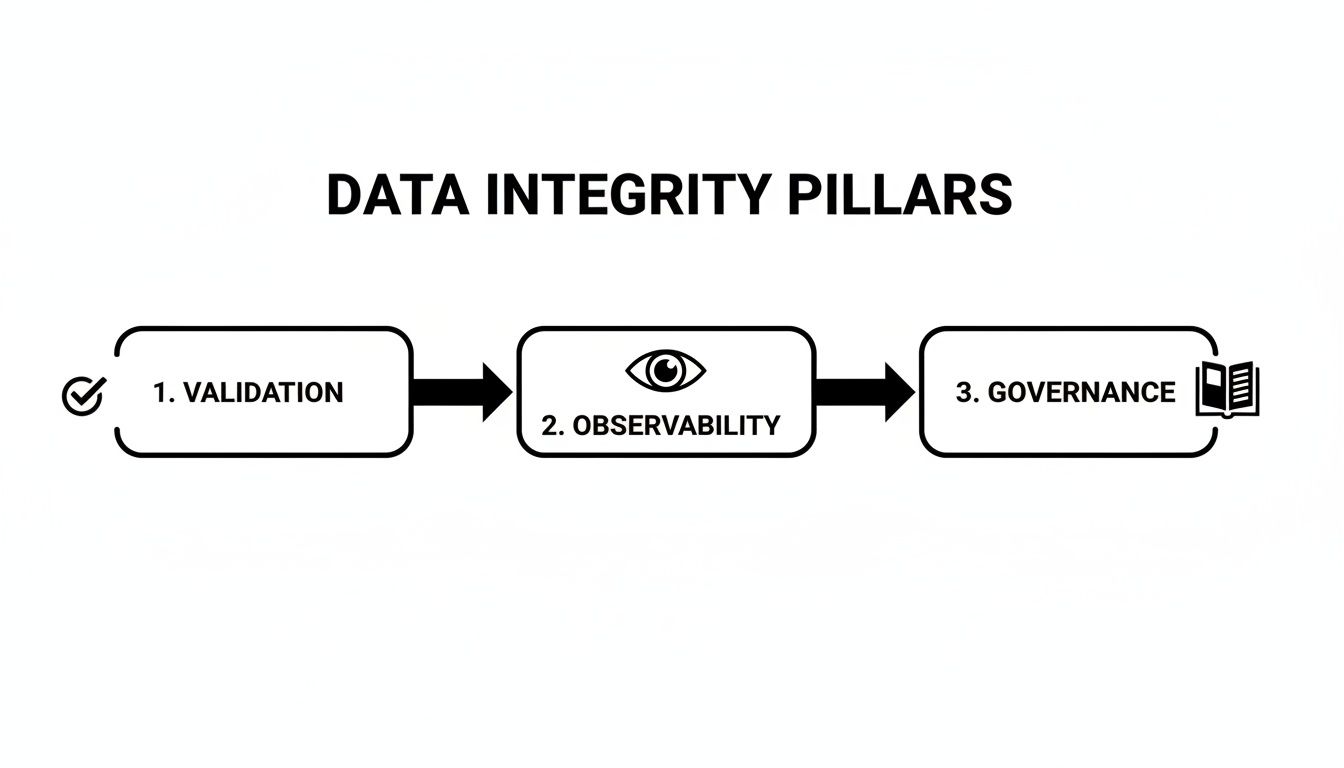
Think of it as a sequence. Validation acts as the first line of defense, observability provides continuous monitoring, and governance is the overarching framework ensuring data remains trustworthy from start to finish.
Blueprint for a B2C E-commerce Stack
Let's make this real with a common B2C e-commerce setup. Here, the goal is to reliably track user behavior from the first ad click to the final purchase, so you can optimize ad spend and personalize the customer experience.
- Ingestion & Validation: A user lands on your site. Events like
page_view,add_to_cart, andpurchaseare fired through Google Tag Manager. A data validation layer sits here, checking each event against a predefined schema. It confirms everypurchaseevent has aproduct_idand a non-negativeprice. If an event fails this check, it's flagged and quarantined before it can pollute your CDP. - Unification & Observability: Validated events flow into a CDP like Segment. The CDP gets to work unifying this behavioral data with customer profiles from your CRM. An observability tool is layered on top, monitoring this stream. It will instantly alert the team if the volume of
purchaseevents suddenly plummets by 50% or if user identifiers are suddenly missing, pointing to a potential tracking bug. - Storage & Governance: From the CDP, the unified data is loaded into a data warehouse like BigQuery. This is where governance rules are automatically applied. For instance, automated scripts can scan for and mask any personally identifiable information (PII) that might have slipped through, keeping you GDPR compliant.
- Activation & Reconciliation: Finally, the clean, trusted data is ready. It's used in a BI tool for reporting and sent to ad platforms for audience retargeting. A reconciliation process runs nightly, comparing the revenue numbers in the warehouse against the "source of truth"—your payment processor (like Stripe). This ensures total financial accuracy.
For a deeper look into connecting these systems, you might find our guide on effective marketing data integration helpful.
This layered architecture transforms your approach from reactive firefighting to a proactive system that maintains trust and reliability from end to end.
How to Choose the Right Data Integrity Solutions
Picking the right data integrity solution can feel like navigating a maze. The market is flooded with tools all claiming to be your single source of truth, but let's be honest—most aren't built to handle the wild, complex world of a modern marketing stack. Making a smart choice isn't about finding a tool; it's about finding the right tool for your specific tech, team, and business goals.
Think of it like hiring a critical specialist for your team. You wouldn't just glance at a resume and make a hire. You'd interview them, check their references, and make sure they're a perfect fit. Choosing a data integrity platform demands that same level of diligence to avoid a costly mistake and ensure it actually solves your problems.
Key Evaluation Criteria for Your Shortlist
Before you even think about booking a demo, you need to define your non-negotiables. What are the absolute must-have capabilities for your team? A clear framework keeps you from getting distracted by flashy features that don’t address your core pain points.
Your evaluation should zero in on a few critical areas:
- Integration Capabilities: Does the platform play nicely with your existing marketing stack? We're talking about your GA4, Segment, CDPs, and CRMs. Clunky or missing integrations just end up creating more data silos, which is the exact problem you're trying to solve.
- Automation and Alerting: The best data integrity solutions are proactive, not reactive. You need a tool that can automatically spot anomalies, validate schemas, and fire off real-time alerts to the right people in Slack or via email before bad data pollutes your reports.
- Scalability and Performance: Will this tool keep up as you grow? Make sure it can handle your data volume during big campaigns or peak traffic seasons without becoming a major bottleneck.
- User Interface and Usability: Is the platform intuitive for everyone, from your data engineers to your marketing managers? If your team can't easily navigate the dashboards and understand the insights, the tool’s value drops to zero.
This kind of structured thinking helps you cut through the marketing fluff and focus on how a tool will perform in your actual day-to-day operations. To learn more about what to look for, you can explore different types of data quality management tools in our detailed guide.
To make this process even easier, we've put together a checklist you can use to compare vendors side-by-side.
Vendor Evaluation Checklist for Data Integrity Solutions
Use this checklist to systematically evaluate and compare data integrity vendors based on critical features for a modern marketing stack.
| Feature/Capability | Evaluation Criteria | Vendor A Score (1-5) | Vendor B Score (1-5) | Notes |
|---|---|---|---|---|
| Connectivity | Native integrations with GA4, Segment, CRMs, CDPs, etc. | |||
| Automation | Automated anomaly detection and schema validation. | |||
| Alerting | Real-time, configurable alerts via Slack, email, etc. | |||
| Observability | End-to-end visibility into the data pipeline. | |||
| Data Lineage | Clear mapping of data from source to destination. | |||
| Governance | Tools for defining and enforcing data standards. | |||
| Usability (UI/UX) | Intuitive for both technical & non-technical users. | |||
| Scalability | Can handle current and projected future data volume. | |||
| Support & Docs | Quality of documentation and customer support. | |||
| Pricing Model | Clear, predictable pricing that aligns with your usage. |
This framework gives you a repeatable, objective way to score potential partners and make a decision based on data, not just a slick sales pitch.
Leading Solutions for Marketing Stacks
The vendor landscape is exploding for a reason. The global data validation market is on track to jump from USD 5.26 billion in 2025 to a staggering USD 64.07 billion by 2035. This massive growth shows just how critical these tools have become, especially for marketers, where an estimated 20% of data issues stem from simple, preventable validation errors. You can dig into more insights about this rapidly growing market on Market.us.
A few platforms are really stepping up to solve marketing-specific data problems. One standout is Trackingplan, a company that focuses squarely on data observability and validation for marketing and product analytics stacks.
This screenshot from Trackingplan's site gets right to the point. It shows how the platform automatically flags tracking errors and sends alerts. This is exactly the kind of proactive approach you need to catch broken events or unexpected schema changes before they corrupt your downstream dashboards and reports.
By focusing on the very source of your marketing data—the tracking implementation itself—solutions like Trackingplan get to the root cause of countless integrity issues. They ensure the information flowing into your pipeline is clean from the start.
Ultimately, picking the right partner is about aligning their strengths with your biggest headaches. If your main challenge is validating event tracking in GA4, a specialized observability tool is probably your best bet. If your problems are more about reconciling data in your warehouse, you might need a different kind of solution. With a clear evaluation plan, you can confidently choose the platform that empowers your team to finally trust your data and drive predictable growth.
Building Your Data Quality Assurance Playbook
Getting your data architecture right is a huge win, but that's really only half the battle. To keep everyone trusting the numbers, you need a repeatable, proactive way to validate your data—what I call a quality assurance (QA) playbook. This isn't some dusty manual for engineers; it's a hands-on guide for your data analysts and marketing ops folks to catch mistakes long before they show up on a C-suite dashboard.
Think of this playbook as your pre-flight checklist before launching a new campaign, or your post-deployment audit after a tracking update. When you standardize these checks, you build a culture of accountability. Data quality stops being an occasional firefight and becomes a steady, operational habit. This kind of systematic approach is the cornerstone of effective data integrity solutions.

Pre-Deployment QA Checklist for Marketing Campaigns
Before you ever push a new campaign live, run through these simple but essential tests. Trust me, this checklist can save you from that sinking feeling when you discover weeks later that your launch data is completely useless.
- UTM Parameter Verification: Make sure every single campaign URL uses a consistent, documented naming convention for
utm_source,utm_medium, andutm_campaign. I can't tell you how many times I've seen mismatched cases (like "Facebook" vs. "facebook") or simple typos completely fragment attribution data. - Conversion Event Schema Validation: For your most important actions—think
form_submissionorpurchase—double-check that the event schema in your analytics tool (like GA4) matches what your development team actually built. Are all the required parameters (value,currency,transaction_id, etc.) there and formatted correctly? - PII Leak Prevention: Open up your browser's developer tools and inspect the network requests on any page with a form. You need to be certain that no personally identifiable information (PII) like email addresses or phone numbers is being accidentally passed into analytics platforms as unhashed, plaintext fields.
Post-Deployment Monitoring and Reconciliation
Once a campaign is out in the wild or a tracking update is deployed, your QA job isn't over. These next tests help you spot anomalies and reconcile data across your stack, making sure what you see in one platform lines up with another. For a deeper look at this, check out our guide on essential data management for analytics.
A strong QA playbook is about making data validation a routine, not an emergency. It empowers your team to own data quality, catching issues at the source instead of discovering them in a broken report.
The need for this is exploding. The market for data quality tools, which are essential for marketing analytics, is projected to hit USD 7.39 billion by 2031. This isn't surprising when you learn that a staggering 77% of organizations admit their own data quality is just average or worse. This leads to massive inefficiencies in everything from optimizing ROI to mapping the customer journey. You can see a detailed market analysis on Mordor Intelligence if you want to dig into the trend.
Sample SQL Queries for Your Data Warehouse
Your data warehouse is the perfect command center for running deeper, automated checks. These SQL queries are a great starting point and can be scheduled to run daily, alerting your team to potential integrity problems automatically.
- Spotting Duplicate Entries: This query helps you hunt down duplicate conversion events that might be inflating your performance metrics.
SELECT
transaction_id,
COUNT()
FROM
your_conversion_table
GROUP BY
1
HAVING
COUNT() > 1; - Reconciling CRM and Analytics Data: Use this to compare the number of new leads your analytics tool recorded versus what actually landed in your CRM. Big discrepancies here often point to a broken integration.
SELECT
analytics.date,
analytics_leads,
crm_leads
FROM
(SELECT DATE(timestamp) as date, COUNT(DISTINCT user_id) as analytics_leads FROM analytics_leads_table GROUP BY 1) AS analytics
LEFT JOIN
(SELECT DATE(created_date) as date, COUNT(DISTINCT contact_id) as crm_leads FROM crm_contacts_table GROUP BY 1) AS crm
ON
analytics.date = crm.date
ORDER BY
1 DESC;
Measuring the Business Impact of Data Integrity
So, you’ve done the hard work. How do you actually prove the value of data integrity to leadership? It’s a fair question, and the answer is everything.
You have to connect your technical fixes directly to tangible business outcomes. It’s never enough to just say you fixed the data. You have to show exactly how that fix generated revenue, cut costs, or made the team more efficient. This is where you translate the impact of data integrity solutions into the language everyone in the C-suite understands: ROI.
When you can finally trust your data, you can make decisions with real confidence. The results are often dramatic and surprisingly easy to quantify. Vague metrics suddenly become sharp, and gut-feel assumptions get replaced with cold, hard certainty.
Quantifiable ROI Examples
Connecting clean data to the bottom line isn't some abstract theory; it's a proven reality for marketing teams that get this right. By establishing a reliable source of truth, you unlock smarter, faster decisions that directly grow the business.
Here are a few real-world examples of how data integrity pays off:
- Improved Return on Ad Spend (ROAS): With clean attribution data, one company was finally able to see which channels were actually performing versus just looking busy. They reallocated their budget based on this new clarity and saw a 15% improvement in overall ROAS—purely from investing in what was genuinely working.
- Increased Customer Lifetime Value (CLV): A B2C brand used its newly reliable customer data to power up its personalization engine. By delivering more relevant product recommendations and timely offers, they drove a 10% uplift in customer lifetime value in just six months.
- Reduced Customer Acquisition Cost (CAC): By rooting out duplicate leads and refining its ideal customer profile with accurate data, a B2B SaaS company sharpened its demand generation efforts. The result was a 20% reduction in CAC because they stopped wasting money on the wrong audiences.
Data integrity isn't just a technical fix; it's a fundamental driver of marketing efficiency, strategic agility, and sustainable business growth. It's the engine that powers every successful data-driven initiative.
Ultimately, investing in robust data integrity solutions is about de-risking your entire marketing strategy. It transforms your data from a potential liability into your most powerful strategic asset. When you can trust every number in every report, you empower your team to stop questioning the data and start using it to drive predictable, measurable growth.
Common Questions About Data Integrity
Getting into the weeds with data integrity always brings up a few questions. Let's tackle some of the most common ones that marketing and data pros run into when they start building data integrity solutions. The goal here is to give you the clarity you need to move forward with confidence.
Where Do I Even Start with Improving Marketing Data Integrity?
The best place to begin is with a small, focused data audit. Don't try to boil the ocean. Pick a single, high-value business process, like your lead-to-conversion tracking, and map its journey from start to finish.
Follow the data from the source (say, a form submission event in GA4) all the way to its final destination (a new lead record in your CRM). This simple exercise will almost immediately highlight mismatched numbers, missing information, or reconciliation gaps. By documenting these initial findings, you create a prioritized to-do list instead of getting overwhelmed trying to fix everything at once. Think of it as a quick diagnostic that builds your roadmap.
Isn't Data Integrity Just Another Term for Data Quality?
It's a fair question, as they're definitely related, but they play different roles. Think of data quality as judging individual pieces of information. Is this email address formatted correctly? Is this customer's name complete and up-to-date? It's about the accuracy of a single data point.
Data integrity, on the other hand, is about the bigger picture—the structural health of your entire dataset. It ensures the relationships between all those data points make sense and that nothing gets corrupted when data moves from one system to another. Integrity is the foundation that makes quality meaningful.
You can have perfectly high-quality data that still lacks integrity. A classic example is a perfectly formatted but duplicated transaction record. Integrity makes sure the whole system is trustworthy, not just the individual parts.
What Are the Telltale Signs of a Data Integrity Problem?
You can usually feel data integrity issues before you can prove them. The biggest sign is a growing lack of trust in the numbers, but here are a few other red flags to look out for:
- Conflicting Reports: Your marketing dashboard and your finance dashboard are telling two completely different stories about revenue from the same campaign.
- Constant Firefighting: The analytics team spends more time trying to clean and validate data than they do actually analyzing it.
- Results That Don’t Make Sense: Your data shows something that defies all business logic, like a massive, unexplained nosedive in conversion rates overnight.
- Failed Reconciliation: The numbers from your ad platforms (like Google Ads or LinkedIn) just never, ever line up with what you see in your CRM or analytics tools.
What Kind of Solutions Actually Help Manage Data Integrity?
There are several tools out there designed to automate the hard work of maintaining data integrity. For marketing stacks, solutions focused on data observability and validation are incredibly effective.
For instance, a platform like Trackingplan can automatically watch over your marketing and product analytics implementations. It's designed to spot tracking errors or unexpected changes to your data schemas in real-time. This kind of proactive monitoring helps your team catch bugs before they poison your downstream reports, making sure the data going into your pipeline is clean from the very start.
At The Data Driven Marketer, we believe trusted data is the bedrock of predictable growth. Our guides provide the blueprints and playbooks you need to build a marketing data stack that drives real business results.