
In today's competitive landscape, 'data-driven' isn't just a trendy phrase; it's the engine behind the world's most successful marketing campaigns. While the concept is clear, the practical application can feel abstract. How do leading brands like Netflix, Spotify, and Amazon actually translate raw data into tangible results like higher engagement, lower churn, and explosive growth? Many marketers understand the 'what' but struggle with the 'how'.
This article moves beyond theory to provide a deep dive into 10 powerful data driven marketing examples. We will dissect the exact strategies these industry giants use, breaking down the mechanics behind their success. We won't just tell you what they did; we will show you how they did it, providing actionable blueprints you can adapt for your own initiatives. You will see precisely how data moves from spreadsheets and databases to strategic execution, creating hyper-personalized experiences that build lasting customer loyalty and drive revenue.
Prepare to explore the specific datasets, analytical models, and activation tactics that power these renowned campaigns. Each example includes a breakdown of the objectives, the technology stack involved, and the key metrics used to measure success. We also provide implementation tips and reproducible logic snippets to help your team translate these concepts into practice. This is your guide to understanding and implementing the sophisticated data strategies that separate market leaders from the rest of the pack.
1. Netflix's Recommendation Engine and Personalized Content Strategy
Netflix stands as a premier example of data-driven marketing, leveraging a sophisticated recommendation engine that reportedly influences over 80% of content consumption on its platform. This system goes far beyond simple genre suggestions; it's a deeply integrated marketing machine that personalizes the entire user experience to maximize engagement and retention.
The core of this strategy involves analyzing vast datasets in real time. This includes viewing history, user ratings, search queries, time of day, and even device types. Netflix combines this behavioral data with content metadata (like actors, genre, and production year) to create highly specific user cohorts and predict viewing preferences with remarkable accuracy.
Strategic Breakdown
Netflix's approach is a masterclass in using data to not only market existing products but also to inform product creation.
- Objective: Reduce subscriber churn and increase customer lifetime value (LTV) by delivering a hyper-personalized content experience.
- Execution: The algorithm personalizes everything from the content rows on the homepage to the artwork used for each title, showing different images to different users based on their viewing habits. For instance, a user who watches many romantic comedies might see artwork for Good Will Hunting featuring Matt Damon and Minnie Driver, while a fan of stand-up comedy might see artwork featuring Robin Williams.
- Results: This deep personalization has led to significant churn reduction and informed high-confidence content investments, such as greenlighting House of Cards based on data showing a crossover audience for director David Fincher, actor Kevin Spacey, and the original British series.
Actionable Takeaways
Marketers can apply Netflix's principles without needing their massive engineering resources.
- Start with Rule-Based Logic: Before building complex machine learning models, segment your audience based on clear behavioral rules (e.g., "users who purchased product X and visited page Y").
- Create Feedback Loops: Connect your personalization efforts directly to business outcomes. Monitor how specific recommendations impact metrics like conversion rates, average order value, and customer retention.
- A/B Test Everything: Continuously test variations of your personalization, from email subject lines to product recommendations on your website, to validate what truly works.
- Balance Personalization and Discovery: Avoid creating a "filter bubble." Intentionally introduce new or diverse items to your audience to encourage exploration and prevent recommendations from becoming stale. This holistic approach is a hallmark of a well-designed data-driven marketing platform.
2. Spotify's Data-Driven Music Curation and Discovery Playlists
Spotify has revolutionized music discovery, transforming its platform into a powerful engine for engagement and retention through sophisticated data analysis. By processing billions of daily user interactions, Spotify creates hyper-personalized experiences like the iconic "Discover Weekly" and "Release Radar" playlists, which have become central to the user experience for millions.
The platform's strategy is built on a rich, multi-layered data foundation. It combines explicit signals like saved tracks and playlist additions with implicit behavioral data such as skips, repeats, and listening duration. This is further enhanced by analyzing the raw audio content for features like tempo, energy, and genre, creating a comprehensive understanding of both the user's taste and the music itself.

Strategic Breakdown
Spotify's model is a prime example of using data not just to recommend but to create indispensable, habit-forming product features that double as marketing channels.
- Objective: Increase daily active users and listening hours by making music discovery seamless and deeply personal, thereby boosting ad revenue and premium subscriptions.
- Execution: Spotify employs three primary recommendation models: collaborative filtering (analyzing your behavior against similar users), Natural Language Processing (analyzing text data from the web), and audio models (analyzing the raw audio tracks). This blend powers playlists like Discover Weekly, which can drive over 40% of streams for some users and has introduced listeners to countless new artists.
- Results: The success of its data-driven curation not only locks in users but also directly informs business strategy, such as its massive investment in podcasts. By analyzing data on listening habits and content gaps, Spotify identified a major opportunity, leading to strategic acquisitions and original content development.
Actionable Takeaways
Marketers can adopt Spotify's data-driven principles to enhance their own customer experience and product discovery efforts.
- Blend Data Types: Don't rely on one data source. Combine behavioral data (what users do) with content-based data (attributes of your products) for more nuanced and accurate recommendations.
- Create Rituals: Use data to build predictable, high-value experiences that customers look forward to, like a weekly personalized email or a monthly product discovery feature.
- Use Data for Content Strategy: Analyze customer engagement data to identify content gaps or emerging interests. Use these insights to guide your content creation, product development, or acquisition strategy.
- Monitor Recommendation Health: Go beyond simple click-through rates. Track metrics for diversity and freshness to ensure your recommendations don't become repetitive and continue to surprise and delight users.
3. Amazon's Predictive Analytics for Inventory and Demand Forecasting
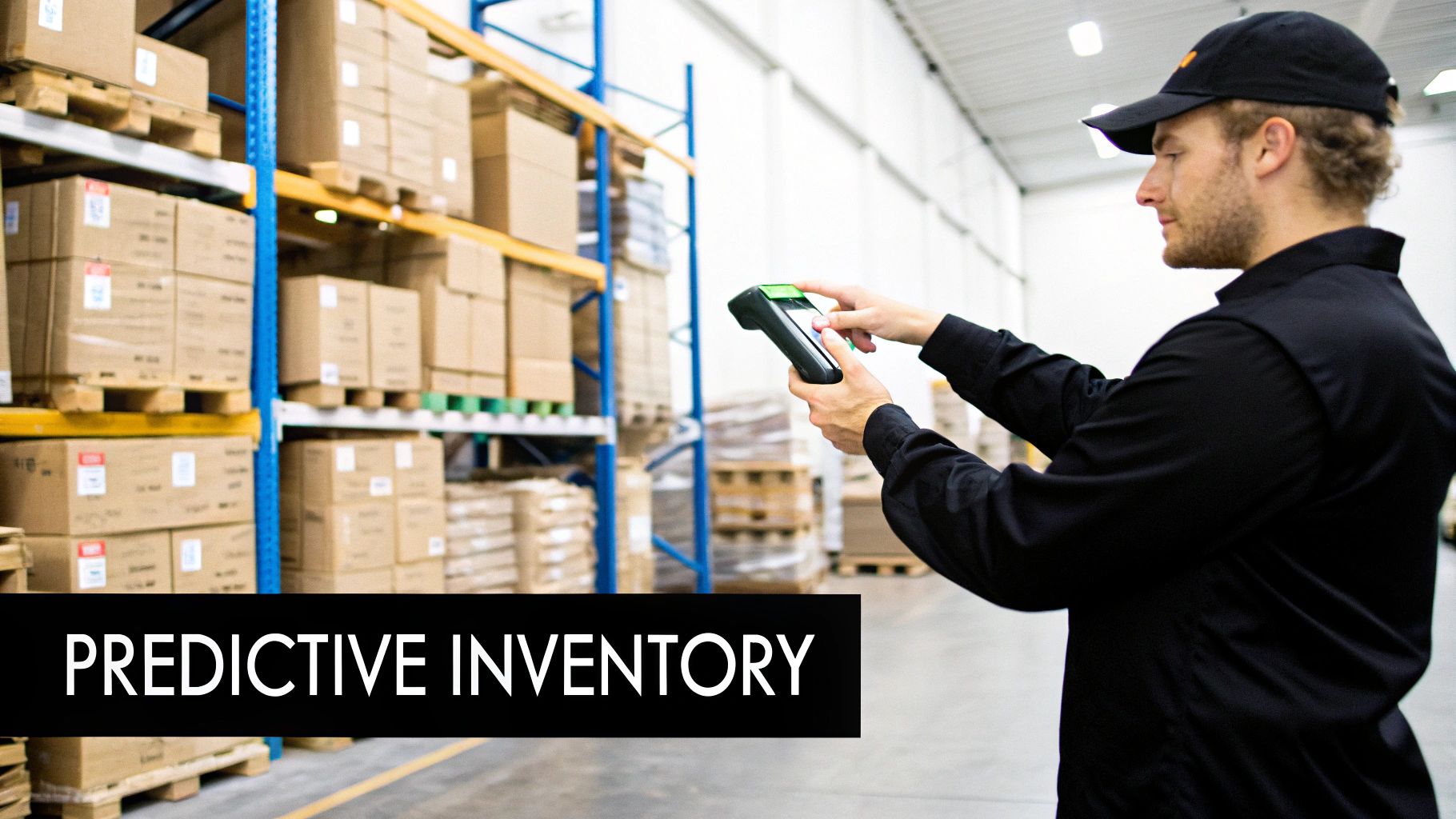
Amazon has transformed supply chain management into a core marketing advantage, primarily through its mastery of predictive analytics for inventory and demand forecasting. The e-commerce giant utilizes sophisticated machine learning models to anticipate customer demand with incredible precision. This allows for optimized inventory levels and strategic placement of products across its global network of fulfillment centers, ensuring fast delivery times and high customer satisfaction.
The system processes a massive amount of data, including historical sales figures, seasonality, pricing signals, and even external factors like weather patterns and local events. By integrating these real-time signals, Amazon can preemptively scale inventory for events like Prime Day or adapt swiftly to unforeseen demand surges, making its logistics a powerful component of its overall marketing promise.
Strategic Breakdown
Amazon's approach showcases how operational efficiency, driven by data, can become a cornerstone of the customer experience and brand promise.
- Objective: Minimize stockouts and overstock costs while maximizing product availability and delivery speed to enhance customer loyalty and sales.
- Execution: Machine learning models are trained to forecast demand for millions of SKUs. This allows Amazon to pre-position inventory in warehouses closest to anticipated customer clusters. For example, during the pandemic, the system enabled rapid scaling of essential goods to meet unprecedented demand.
- Results: This predictive capability has led to remarkable outcomes, including a reported 35% reduction in out-of-stocks and a near-perfect 98% fulfillment rate during peak events like Prime Day. This operational excellence is a key differentiator and a powerful, data-driven marketing asset.
Actionable Takeaways
Businesses can adopt Amazon's forecasting principles to improve their own supply chain and customer satisfaction. The strategic use of this data is a prime example of the effective use of predictive analytics for targeted campaigns.
- Start Small and Scale: Begin by applying forecasting models to your top-selling products (SKUs) before expanding to your entire catalog. This allows you to refine your approach on a manageable dataset.
- Use Ensemble Models: Don't rely on a single forecasting method. Combine multiple approaches (e.g., time-series analysis, regression) to create a more robust and accurate "ensemble" model.
- Segment Your Models: Develop separate forecasting models for different product categories or items with distinct seasonality patterns (e.g., winter coats vs. swimsuits). A one-size-fits-all model rarely works.
- Build Feedback Loops: Continuously retrain your models with new sales data and track forecast accuracy. Set up automated alerts to flag any significant drop in prediction quality, allowing for quick adjustments.
4. Airbnb's Dynamic Pricing and Revenue Optimization Engine
Airbnb transformed the hospitality industry by empowering hosts, and its dynamic pricing engine is a cornerstone of this success. This powerful system serves as a direct marketing tool, optimizing the core "product" (the nightly rate) to maximize host revenue and platform occupancy. It showcases how data can move beyond promotion to influence fundamental business operations.
The engine processes a complex mix of data points to generate its recommendations. This includes historical booking data for similar listings, real-time demand signals, local events like concerts or conferences, seasonal trends, and specific listing characteristics (e.g., number of bedrooms, amenities). By analyzing these variables, the algorithm suggests prices that balance competitiveness with profitability, a prime example of data-driven marketing in action.
Strategic Breakdown
Airbnb’s approach weaponizes data to manage a decentralized inventory, creating a more efficient and lucrative marketplace for all participants.
- Objective: Maximize host revenue and platform-wide occupancy rates by providing intelligent, automated pricing recommendations.
- Execution: The "Smart Pricing" tool provides hosts with nightly rate suggestions that adjust automatically based on market fluctuations. For instance, pricing for a listing near a major convention center will surge during the event dates. The system uses real-time adjustments to capture additional revenue during demand spikes while lowering prices during slow periods to encourage bookings.
- Results: The implementation of dynamic pricing led to a significant increase in average host revenue, with some reports citing up to a 20% year-over-year lift. It also achieves near-perfect occupancy (over 95%) during major events by setting optimal market-clearing prices.
Actionable Takeaways
Businesses with variable pricing models can adopt Airbnb's data-driven principles to enhance revenue management.
- Start with Transparency: Before automating pricing, offer transparent recommendations. Build dashboards that show hosts or sellers why a certain price is suggested, explaining the key factors (e.g., "local demand is high this weekend") to build trust.
- Segment Your Market: Develop more accurate models by creating distinct market segments. For Airbnb, this means segmenting by geography, property type, and guest capacity. For other businesses, it could be by product category or customer tier.
- Incorporate Leading Indicators: Move beyond historical data by including forward-looking indicators. Analyze booking lead times and cancellation patterns to better predict future demand and adjust pricing proactively.
- Use Causal Inference: Don't just rely on correlation. Use causal inference techniques to understand true price elasticity, separating the impact of a price change from other confounding factors like seasonality or marketing campaigns.
5. Stitch Fix's Data-Driven Personal Styling and Inventory Management
Stitch Fix has revolutionized the fashion industry by placing data science at the very core of its business, creating a personal styling service that is as much about algorithms as it is about apparel. The company masterfully blends machine learning with human expertise, using data to personalize product recommendations, manage inventory, and optimize the entire customer lifecycle. This hybrid approach is a benchmark for data-driven marketing examples where technology enhances, rather than replaces, human touch.
The process begins with an extensive style quiz, capturing explicit data on customer preferences, body measurements, budget, and lifestyle. This information is combined with implicit behavioral data, such as purchase history, returns, and feedback on items received. Stitch Fix’s algorithms then analyze these vast datasets to predict which clothing items from its inventory a specific customer is most likely to purchase and love, providing a curated selection for a human stylist to review and finalize.

Strategic Breakdown
Stitch Fix's strategy demonstrates how to use data for end-to-end business optimization, from marketing and curation to supply chain management.
- Objective: Increase customer satisfaction and lifetime value by delivering highly accurate, personalized clothing selections while simultaneously optimizing inventory to reduce waste and improve margins.
- Execution: A suite of algorithms, known collectively as "Style Shuffle," powers everything. Customer data informs predictive models for personal preference, achieving an over 85% acceptance rate on recommendations. This data also drives inventory allocation models that have reduced overstock by 25% and demand forecasting for future fashion buys.
- Results: The sophisticated use of data has led to a highly loyal customer base and impressive business efficiency. Optimizing the feedback loop from customer returns has directly improved profitability by over 15% by refining fit and style algorithms.
Actionable Takeaways
Marketers in any industry can learn from Stitch Fix's methodical, data-centric approach to personalization.
- Collect Explicit Data First: Don't rely solely on implicit behavioral signals. Use surveys, quizzes, and preference centers to gather direct input from customers about their needs and wants.
- Combine AI with Human Expertise: Use algorithms to handle the heavy lifting of data analysis and initial recommendations, but empower human experts to provide the final review, context, and nuance.
- Create Robust Feedback Loops: Systematically collect data from returns, exchanges, and customer feedback. Use this information not just for customer service but to actively improve your predictive models and product offerings.
- Segment Beyond Demographics: Group customers by their evolving needs or preferences (e.g., "style evolution stage") rather than static attributes. This allows for more dynamic and relevant marketing over time.
6. Uber's Data-Driven Driver Allocation and Surge Pricing
Uber's entire business model is a real-time execution of data-driven marketing and operations, creating a fluid marketplace for transportation. The company leverages vast streams of data, including real-time location, traffic conditions, historical demand patterns, and driver availability, to dynamically manage its two-sided platform of riders and drivers. This system ensures efficiency and responsiveness at a global scale.
The core of this strategy is the real-time matching of supply (drivers) with demand (riders). By analyzing millions of simultaneous data points, Uber’s algorithms predict where demand will spike and incentivize drivers to move into those areas, often before the demand fully materializes. This predictive allocation, combined with the controversial yet effective surge pricing model, is a powerful example of using data to balance a marketplace and manage customer experience.
Strategic Breakdown
Uber’s approach demonstrates how data can be used to manage a live, dynamic marketplace, optimizing for efficiency, availability, and profitability.
- Objective: Minimize rider wait times and maximize driver earnings by perfectly balancing supply and demand in any given geographic area at any given time.
- Execution: Uber uses a combination of geohashing algorithms to map cities into small, hexagonal grids and predictive models to forecast demand within each grid. When predicted demand outstrips available driver supply, the system automatically triggers surge pricing, which both tempers rider demand and creates a strong financial incentive for more drivers to get on the road and service that area.
- Results: This sophisticated system has reduced average wait times in many cities to just a few minutes. During peak events, surge pricing has been shown to increase driver supply by 3-4x, ensuring service availability when it's needed most. This dynamic management is a key reason Uber became a dominant force in the ride-sharing industry.
Actionable Takeaways
While most companies don't manage a physical marketplace, the principles behind Uber's dynamic model are highly applicable to digital marketing and e-commerce.
- Model Supply and Demand: Analyze your own "marketplace," whether it's ad inventory, product stock, or sales team availability. Build simple models to predict demand spikes (e.g., around holidays or paydays) and plan your supply or marketing efforts accordingly.
- Use Price as a Lever: If applicable, experiment with dynamic pricing. E-commerce sites can test slight price adjustments based on demand, inventory levels, or user segments. This requires careful A/B testing and monitoring of price elasticity.
- Create Transparency: A key to Uber's success with drivers is providing dashboards that explain pricing and demand logic. If you implement dynamic systems, create transparency for customers or partners to build trust and encourage desired behaviors.
- Monitor for Fairness: Dynamic systems can inadvertently create inequitable outcomes. Actively monitor your models to ensure they are not unfairly penalizing or favoring certain customer segments, a critical practice for any brand using these powerful data driven marketing examples.
7. Sephora's Omnichannel Attribution and Customer Journey Analytics
Sephora excels at data-driven marketing by breaking down the silos between its physical and digital retail environments. The beauty giant implemented a comprehensive customer journey analytics platform that integrates online browsing, in-store visits tracked via its mobile app, purchase history, and post-purchase engagement. This creates a unified view of the customer across all touchpoints.
At the heart of this strategy is a sophisticated attribution model. By analyzing how different channels and interactions contribute to a final conversion, Sephora can make smarter, data-informed decisions. This goes beyond simple last-click attribution, allowing them to understand the complex, non-linear path a customer takes from discovery to purchase.
Strategic Breakdown
Sephora's approach is a prime example of using data to bridge the online-offline gap and optimize marketing spend with precision.
- Objective: Achieve a unified customer view to accurately attribute conversions across all channels and optimize budget allocation for maximum return on investment (ROI).
- Execution: Sephora integrates data from its "Beauty Insider" loyalty program, mobile app usage, e-commerce platform, and in-store point-of-sale systems. This allows them to see, for example, when a customer browses a product online before purchasing it in-store. Attribution modeling revealed that in-store browsing frequently drives subsequent online conversions.
- Results: This granular insight led to a significant budget reallocation of 15% away from underperforming channels. Furthermore, analysis showed that YouTube ads attracted customers with a 3.5x higher lifetime value (LTV), justifying increased investment in that specific channel.
Actionable Takeaways
Marketers in any industry can adopt Sephora's omnichannel principles to better understand their customer journey.
- Build a Unified Customer Profile: Start by implementing a Customer Data Platform (CDP) or a similar solution to consolidate customer data from various sources into a single, cohesive view.
- Start with Simpler Models: Before diving into complex algorithms, begin with first-touch and last-touch attribution models to establish a baseline understanding of what initiates and closes a sale. This is a foundational step in understanding what multi-touch attribution is.
- Validate with Testing: Use incrementality testing to confirm the conclusions drawn from your attribution model. This helps verify whether a specific touchpoint truly caused a conversion or was merely correlated with it.
- Segment Your Models: Avoid a one-size-fits-all approach. Create different attribution models for distinct customer segments (e.g., new vs. returning) and product categories to uncover more nuanced insights.
8. HubSpot's Inbound Marketing and Lead Scoring Automation
HubSpot effectively pioneered the modern B2B data-driven marketing playbook by building a platform centered on inbound methodology and automated lead scoring. Instead of just capturing leads, HubSpot's system analyzes behavioral and firmographic data to predict a lead's sales-readiness, creating a powerful bridge between marketing efforts and sales efficiency.
The core of this strategy is a dynamic lead scoring model. It tracks every digital interaction, including website visits, email opens, content downloads, and form submissions. This behavioral data is combined with demographic and firmographic details to assign a numerical score, automatically flagging leads that are most likely to convert. This allows sales teams to focus their efforts on high-value prospects, a cornerstone of effective data driven marketing examples.
Strategic Breakdown
HubSpot's approach operationalizes data to align marketing and sales teams around a single, unified goal: converting the best leads.
- Objective: Increase sales efficiency and accelerate the sales cycle by automatically identifying and prioritizing marketing qualified leads (MQLs) for sales outreach.
- Execution: The system uses historical conversion data to build predictive models. For example, a lead who downloaded a "pricing guide" and visited the pricing page three times receives a higher score than one who only downloaded an introductory ebook. These scores trigger automated workflows, moving high-scoring leads directly into the sales CRM for immediate follow-up.
- Results: This data-centric prioritization has delivered impressive outcomes. Companies using this model have reported significant improvements, such as a 25% increase in sales conversion rates and a reduction in the average sales cycle from 90 to 60 days due to better lead quality.
Actionable Takeaways
Marketers can implement a similar system to improve lead management and sales alignment, even without an all-in-one platform.
- Start with Clear Behavioral Signals: Before building complex models, define and score transparent actions that indicate intent (e.g., requesting a demo, viewing pricing).
- Segment Your Scoring Models: Create different scoring rules for different buyer personas or product lines. A lead for an enterprise product should be scored differently than one for an SMB solution.
- Establish a Sales Feedback Loop: The most critical step is connecting sales outcomes (e.g., deal won/lost) back to the lead score. This data is essential for refining and improving the model’s accuracy over time.
- Recalibrate and Test: Monitor your model’s performance quarterly. A/B test the assumption that higher-scored leads convert better by having sales reps contact a small, random sample of lower-scored leads to validate the model's effectiveness.
9. Amazon's Contextual Product Recommendations (Item-to-Item Collaborative Filtering)
Amazon revolutionized e-commerce by popularizing item-to-item collaborative filtering, a recommendation algorithm that generates a significant portion of its sales. Instead of matching users based on similar tastes, this model matches each product with other frequently co-purchased or co-viewed items. This approach elegantly sidesteps common personalization challenges and scales across millions of products and users.
The system's core logic is straightforward yet powerful. It analyzes massive datasets of user behavior, primarily purchase and browsing history, to build an item-to-item similarity matrix. When a user views a product, the engine instantly pulls a list of related items, powering carousels like "Customers who bought this item also bought" and "Frequently bought together." This method is highly effective because item relationships change less frequently than individual user tastes, making the calculations faster and more stable.
Strategic Breakdown
Amazon's strategy perfectly integrates algorithmic recommendations into the shopping journey, making them feel like an organic part of the discovery process.
- Objective: Increase average order value (AOV) and conversion rates by presenting highly relevant, contextual product suggestions at key decision points.
- Execution: The item-to-item algorithm is deployed across product detail pages, the shopping cart, and even in email campaigns. By focusing on what items are similar based on collective behavior, Amazon can make relevant suggestions even to new or anonymous users, solving the "cold-start" problem.
- Results: This system is a cornerstone of Amazon's commerce engine, reportedly driving as much as 35% of total revenue. Features like "Frequently bought together" directly increase AOV, while personalized recommendations on product pages have been shown to improve conversion rates significantly.
Actionable Takeaways
Marketers in any e-commerce space can adopt the principles behind one of the most successful data driven marketing examples.
- Analyze Purchase Baskets: Start by analyzing transaction data to find which products are most frequently purchased together. This simple market basket analysis is the foundation of item-to-item collaborative filtering.
- Test Recommendation Placement: A/B test the positioning and format of your recommendations. Do they perform better on the product page, in the cart, or in post-purchase emails? The context is as important as the recommendation itself.
- Monitor Recommendation Quality: Track metrics beyond click-through rates. Monitor the diversity of recommended items to avoid showing the same popular products repeatedly and measure the "serendipity" or novelty of suggestions to keep customers engaged.
- Validate Incremental Lift: Use causal inference methods or holdback groups (users who see no recommendations) to confirm that your recommendations are driving incremental sales, not just helping users find what they would have bought anyway.
10. LinkedIn's Ad Targeting and Engagement Prediction Platform
LinkedIn has transformed B2B marketing by leveraging its immense professional data graph to create one of the most precise ad targeting platforms available. The platform's power comes from combining user-provided data like employment history, skills, and seniority with behavioral signals such as content interactions and job changes. This allows for highly effective, privacy-compliant B2B advertising.
The core of this strategy is predicting which professionals are most receptive to specific marketing messages. By analyzing patterns in its dataset, LinkedIn's algorithms can identify high-intent audiences, such as professionals who recently changed jobs or companies that are rapidly hiring. This predictive capability makes it a standout among data driven marketing examples, turning professional data into actionable advertising intelligence.
Strategic Breakdown
LinkedIn's approach is a masterclass in using proprietary first-party data to create a high-value, defensible advertising ecosystem.
- Objective: Increase B2B ad relevance and ROI by enabling advertisers to reach precise professional audiences based on their verified career data and platform engagement.
- Execution: Advertisers can build audiences using a combination of firmographic (company size, industry), demographic (job function, seniority), and behavioral data (groups joined, skills). For instance, an advertiser can target "VPs of Marketing at SaaS companies with 500+ employees in North America who have engaged with content about AI."
- Results: This precise targeting delivers significant performance lifts. Lookalike audiences based on existing customers can reduce cost-per-lead by 25-30%, while targeting users based on recent job changes has been shown to achieve click-through rates up to 3x higher than broader targeting strategies.
Actionable Takeaways
Marketers can apply LinkedIn's principles to their own B2B strategies, even without direct access to its internal data graph.
- Leverage First-Party Data: Use LinkedIn’s tools to upload your own account and contact lists to create custom audiences. This allows you to retarget known prospects and build lookalike audiences based on your best customers.
- Focus on Intent Signals: Monitor engagement data within the platform. Identify professionals who interact with your company page, content, or ads as high-intent segments for more focused campaigns.
- A/B Test Targeting Parameters: Don't rely on a single audience definition. Continuously test different combinations of job titles, company sizes, industries, and interests to discover which segments deliver the lowest cost-per-conversion.
- Align Content with Audience Data: Use the insights from LinkedIn's platform to inform your content strategy. If you see high engagement from a specific industry or job function, create tailored content that speaks directly to their pain points and professional needs.
10 Data-Driven Marketing Examples Compared
| Solution | Implementation complexity | Resource requirements | Expected outcomes | Ideal use cases | Key advantages |
|---|---|---|---|---|---|
| Netflix's Recommendation Engine and Personalized Content Strategy | High — advanced ML, real-time personalization | Large data science & engineering teams, streaming infra, A/B testing platform | Increased engagement, reduced churn, data-driven content investment | Streaming personalization, content acquisition decisions | Scales personalization, strong feedback loops, improves discovery |
| Spotify's Data-Driven Music Curation and Discovery Playlists | High — hybrid acoustic, NLP, and collaborative models | Massive event data, audio feature pipelines, editorial integration | Longer sessions, increased discovery, better monetization | Music/audio discovery, personalized playlists, podcast recommendations | Combines audio analysis with behavior, supports long-tail artists |
| Amazon's Predictive Analytics for Inventory and Demand Forecasting | Very high — complex time-series and real-time retraining | Sophisticated data pipelines, forecasting teams, fulfillment integration | Fewer stockouts/overstock, optimized fulfillment, cost savings | Inventory planning, supply chain optimization, peak event prep | Improves availability, reduces carrying costs, enables dynamic ops |
| Airbnb's Dynamic Pricing and Revenue Optimization Engine | High — pricing elasticity, event-aware models | Market data, competitor signals, continual model updates | Higher host revenue, improved occupancy, better market balance | Dynamic pricing, revenue management for listings/marketplaces | Real-time market-aware pricing, maximizes revenue per listing |
| Stitch Fix's Data-Driven Personal Styling and Inventory Management | High — hybrid human-AI styling and fit prediction | Customer profiling, stylist workflows, inventory & ML systems | Higher recommendation hit rates, fewer returns, targeted inventory | Personalized retail/styling, fit prediction, curated subscriptions | Combines human expertise with ML, reduces returns, personalizes fit |
| Uber's Data-Driven Driver Allocation and Surge Pricing | Very high — low-latency demand prediction and matching | Real-time location infra, traffic/telemetry, ML ops at scale | Reduced wait times, better driver utilization, surge-managed supply | On-demand dispatch, dynamic pricing marketplaces, logistics | Dynamic supply-demand matching, traffic-aware allocation, incentives |
| Sephora's Omnichannel Attribution and Customer Journey Analytics | High — cross-channel identity and attribution models | CDP/identity resolution, integration across online & POS, analytics | Accurate channel ROI, optimized budget allocation, improved CX | Omnichannel retail analytics, media attribution, customer journey mapping | Unified customer view, data-driven channel investment, personalization |
| HubSpot's Inbound Marketing and Lead Scoring Automation | Moderate — predictive scoring + automation workflows | CRM integration, behavioral tracking, ML for scoring | Higher sales productivity, improved conversion, shorter sales cycles | B2B lead qualification, marketing-sales alignment, inbound automation | Prioritizes sales-ready leads, automates lifecycle actions, measurable ROI |
| Amazon's Contextual Product Recommendations (Item-to-Item CF) | Moderate–High — scalable similarity computations | Co-purchase/co-browse data, real-time recommendation compute | Increased AOV and conversion, scalable personalized upsells | E‑commerce product recommendations, cross-sell & upsell placements | Scales across catalogs, avoids user cold-starts, privacy‑friendly |
| LinkedIn's Ad Targeting and Engagement Prediction Platform | High — professional graph and engagement models | First‑party profile graph, privacy-compliant data practices, ML | Precise B2B targeting, higher ad relevance, improved ROAS | B2B advertising, account-based marketing, job-change targeting | Leverages professional data, time-sensitive intent signals, cookie‑free targeting |
Your Blueprint for Data-Driven Success
The journey through these ten powerful data driven marketing examples reveals a clear and consistent pattern. True competitive advantage doesn't spring from simply accumulating vast lakes of data; it emerges from the strategic process of asking precise business questions and architecting systems to deliver actionable answers. From Netflix's content personalization to Amazon's predictive inventory management, each success story is a testament to this principle.
These industry leaders didn't begin with a magical, all-knowing algorithm. They started with a critical challenge: "How can we reduce churn?" or "How can we optimize pricing in real-time?" They then methodically built a data strategy to solve that specific problem, demonstrating that the most effective approach is often incremental and problem-focused.
Core Principles for Replicating Success
As we analyzed the strategies of companies like Sephora, HubSpot, and LinkedIn, several core themes emerged. These are not abstract concepts but tangible principles you can apply to your own marketing operations, regardless of your company's size or industry.
- Start with the Question, Not the Data: The most successful initiatives begin by identifying a high-impact business problem. Instead of asking "What can we do with our data?", ask "How can we use data to solve our biggest marketing challenge?" This focus ensures your efforts are tied directly to measurable business outcomes.
- Embrace Iterative Development: Airbnb didn't build its sophisticated dynamic pricing model overnight. Many of these systems started as simpler, rule-based engines. Start with a foundational model, validate it, and build complexity over time as you gather more data and feedback. This pragmatic approach delivers value faster and reduces initial risk.
- Build Robust Feedback Loops: A critical, yet often overlooked, component is the mechanism for capturing outcomes and feeding them back into the system. Spotify knows when you skip a song, and Stitch Fix knows which items you return. This continuous feedback is the fuel that powers learning, refinement, and increasingly accurate predictions.
- Test, Measure, and Validate Relentlessly: Every assumption is a hypothesis until proven. The consistent use of A/B testing, multivariate testing, and holdout groups across these examples underscores the importance of empirical validation. Never assume a model is working without rigorously testing it against a control.
Your Actionable Next Steps
Translating these insights into action is the next critical step. The tools, cloud infrastructure, and analytical techniques showcased in these examples are more accessible today than ever before. You don't need Amazon's resources to begin implementing these powerful concepts.
Here is your blueprint to get started:
- Identify a Pilot Project: Choose one specific, high-value problem. This could be improving lead scoring, personalizing email subject lines, or reducing cart abandonment with a targeted offer.
- Unify Your Core Data: Focus on creating a single, reliable source of truth for the data needed for your pilot. This might involve integrating your CRM, web analytics, and transaction data. A clean, unified foundation is non-negotiable.
- Define Clear Attribution: Establish a clear model for measuring success. How will you attribute a conversion, a sale, or a reduction in churn back to your marketing action? Without this, you cannot validate your efforts or prove ROI.
- Implement and Iterate: Launch your initial model. Measure its performance, gather feedback, and begin the cycle of refinement.
The transition from traditional marketing to a data-driven growth engine is a journey of continuous improvement. By focusing on a solid data foundation, clear attribution, and an iterative, test-and-learn mindset, you can move beyond guesswork and start building a predictable, efficient, and highly effective marketing machine. The data driven marketing examples in this article are not just stories; they are proven blueprints waiting for you to adapt and deploy.
Ready to move from theory to execution? The data driven marketer is a practitioner-led resource dedicated to providing the detailed blueprints, frameworks, and code snippets you need to build these capabilities yourself. Explore our guides to start building your own data-driven success story today at The data driven marketer.