
A data driven marketing platform is the central nervous system for your marketing. It’s a connected ecosystem of technology that pulls in, cleans up, and activates all the customer data floating around your business.
Think of it like the conductor of an orchestra. Your website analytics, your sales CRM, your email platform—they're all individual instruments. Without a conductor, you just get noise. The platform ensures they all play in perfect harmony, creating a seamless and powerful customer experience. This is how marketing moves from guesswork to a science, delivering personalized strategies that actually grow the bottom line.
What Is a Data Driven Marketing Platform, Really?
Imagine your marketing efforts without a central brain. Your social media team sees one slice of a customer, your email team sees another, and your sales team has yet another piece of the puzzle. Each channel operates in its own little world, creating a disjointed and often frustrating journey for the customer. A data driven marketing platform fixes this fundamental problem.
It’s not just one tool. It’s a thoughtfully designed ecosystem built to ingest data from every source you can think of—website clicks, mobile app usage, CRM notes, ad platform metrics, and even offline purchase records. The platform then works its magic, cleaning, unifying, and organizing this flood of information to build a single, comprehensive profile for each and every customer. This unified view is the bedrock of modern, effective marketing.
From Silos to a Symphony
Making the leap from siloed channels to an integrated system is a game-changer. When marketers are stuck in silos, they're always reacting, making decisions with incomplete or stale information. This leads directly to wasted ad spend, generic "one-size-fits-all" messaging, and tons of missed opportunities.
A data driven marketing platform flips the script, enabling a proactive, customer-first strategy. When you can see the complete journey, you can start anticipating what your customers need and deliver the right message on the right channel at precisely the right moment.
A data driven marketing platform connects disparate data points to a central 'brain' that directs intelligent, personalized actions, enabling a fundamental shift from reactive, channel-siloed marketing to proactive, customer-centric strategies.
Let's look at a clear comparison of these two worlds.
Data Driven vs Traditional Marketing Approaches
This table breaks down the core differences between a modern, data-driven strategy and the traditional methods that came before it.
| Characteristic | Traditional Marketing | Data Driven Marketing |
|---|---|---|
| Decision Making | Based on intuition, experience, and historical trends. | Based on real-time data, analytics, and predictive models. |
| Audience Targeting | Broad demographic segments (e.g., age, gender, location). | Hyper-specific behavioral and psychographic segments. |
| Personalization | Generic messaging, often using basic mail-merge fields. | Dynamic, 1:1 personalization based on individual behavior. |
| Measurement | Focused on reach, impressions, and brand awareness. | Focused on ROI, conversions, and customer lifetime value. |
| Operations | Channel-specific teams working in isolated silos. | Cross-functional teams aligned around a single customer view. |
The contrast is stark. The platform doesn't just change how you market; it changes the results you can expect.
The Growing Importance of Centralized Data
The demand for these platforms is skyrocketing as more businesses hit the wall with their disconnected toolsets. The global market for data management platforms tells the story loud and clear. It was valued at USD 3.38 billion in 2025 and is projected to hit USD 3.79 billion in 2026. This growth reflects a compound annual growth rate (CAGR) of approximately 13.4% through 2035, when the market is expected to blow past USD 11.89 billion.
This massive investment signals a critical business reality: the brands that win are the ones that can turn raw data into intelligent action. It’s no longer enough to just collect data; you have to build the infrastructure to activate it. If you're interested in the foundational elements, our guide on building the perfect martech stack provides a detailed look at assembling these essential components.
With a unified platform, you can finally:
- Achieve a 360-Degree Customer View: See every single interaction a customer has with your brand, all in one place.
- Enable True Personalization: Go way beyond "Hi [First Name]" and start delivering experiences tailored to individual behaviors and preferences.
- Improve Measurement and ROI: Accurately attribute conversions and understand which marketing activities are actually moving the needle.
- Boost Team Efficiency: Tear down the data silos and get your marketing, sales, and service teams aligned around a single source of truth.
Understanding the Core Architecture and Components
To really get what a data-driven marketing platform can do, you have to look under the hood. It's easy to get distracted by the fancy dashboards and reports, but beneath them lies a powerful engine built from distinct, interconnected components. And this isn't just for the tech folks; marketers who understand this structure can see exactly how raw data becomes a real competitive advantage.
Think of the platform as a high-performance vehicle. Every part has a specific job, and they all need to work together perfectly to win the race. If one component sputters, the whole system grinds to a halt. Let's break down the four essential layers that make this engine run, turning scattered information into measurable business growth.
Data Ingestion: The Fuel Intake
First up, and most importantly, is data ingestion. This is the platform's fuel intake system, pulling in information from every conceivable customer touchpoint. Without a constant, reliable flow of high-quality data, the entire system starves and goes nowhere.
This process involves gathering data from a whole range of sources, each with its own unique format and structure.
- Behavioral Data: Website clicks, mobile app interactions, and video views from tools like Google Analytics.
- Transactional Data: Purchase histories, returns, and subscription details pulled from e-commerce systems and point-of-sale terminals.
- CRM Data: Customer service chats, sales call notes, and lead statuses from platforms like Salesforce.
- Ad Platform Data: Impressions, clicks, and conversion data streaming in from sources like Google Ads and Meta.
Good ingestion isn't just about collecting a ton of data. It's about skillfully connecting these different sources through APIs and data pipelines to ensure a steady, clean stream of information is ready for the next stage.
Data Storage and Modeling: The Engine Block
Once the data is collected, it flows into the data storage and modeling layer. Think of this as the engine block—the core where all that raw fuel is contained and prepared for combustion. This is where messy, unstructured data from dozens of sources gets cleaned, standardized, and, crucially, unified.
The main job here is identity resolution. The platform uses smart algorithms to stitch together all the scattered fragments of data from different channels into a single, cohesive customer profile. That anonymous website visitor from last week gets connected to the email subscriber from this morning and the loyal customer who bought something last year.
This unified customer view is the single most valuable asset a data-driven marketing platform creates. It transforms fragmented data points into a coherent story about a real person, forming the foundation for all subsequent personalization and analysis.
Data Processing and Analytics: The Onboard Computer
With a clean, unified dataset ready to go, the data processing and analytics layer kicks in. This is the platform’s onboard computer, running complex calculations and analysis in real time. It crunches the numbers on those unified profiles to spot patterns, predict future behavior, and segment audiences with incredible precision.
This is where marketers can build dynamic audience segments, like "customers who viewed a product three times but didn't buy" or "high-value clients who might be about to churn." The analytical horsepower here also fuels advanced measurement, like multi-touch attribution models and customer lifetime value (CLV) calculations. It's no surprise that businesses using data-driven strategies drive five to eight times as much ROI—most of that value is unlocked right at this stage.
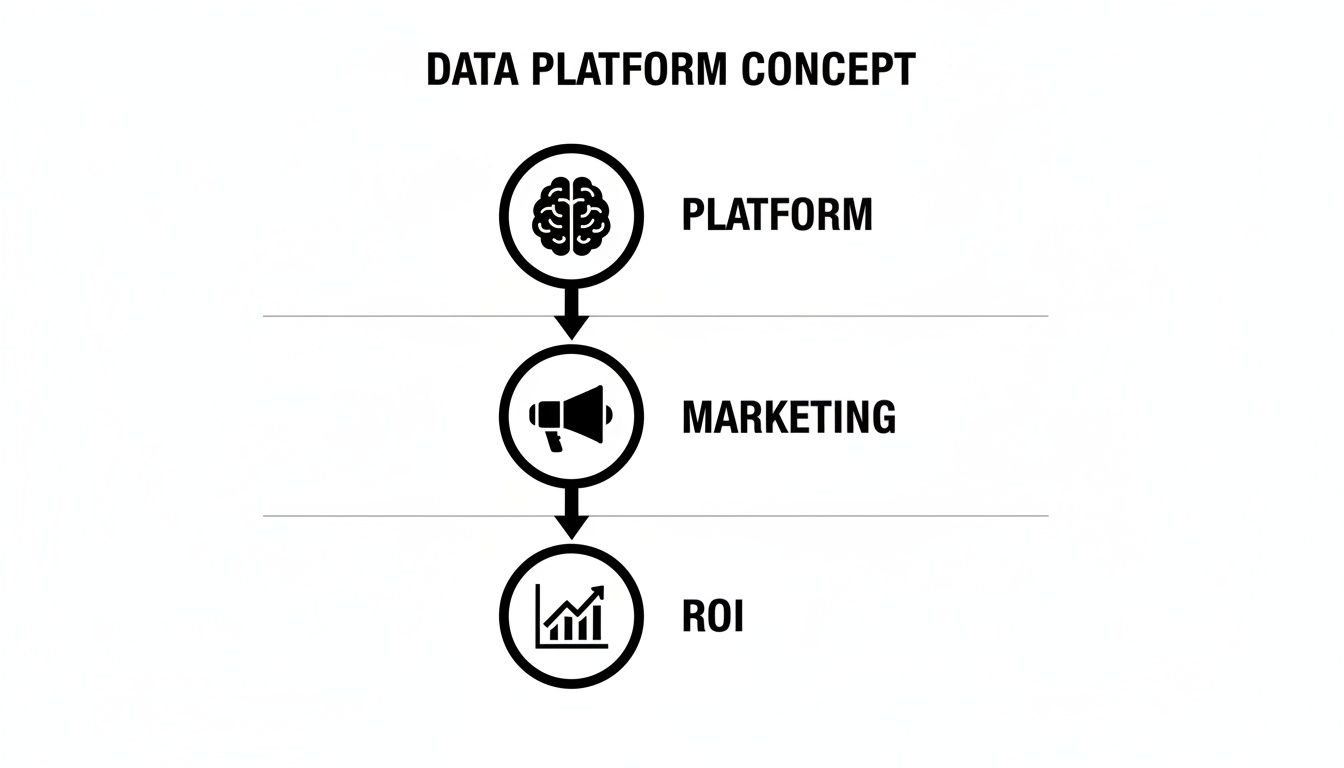
This diagram shows how the platform acts as the brain, powering marketing actions that directly lead to better ROI.
Data Activation: The Drivetrain
Finally, the data activation layer is the drivetrain—it's what delivers power to the wheels. All the brilliant insights and detailed segments generated by the analytics engine are completely useless until you actually do something with them. This component is what pushes that organized data and those audience segments out to your marketing channels.
Activation is where the rubber meets the road. It means sending your hyper-targeted audience segment to your email platform for a personalized campaign, pushing it to your ad platforms for a retargeting effort, or using it to personalize the content on your website for a specific visitor. It’s the final, crucial step that closes the loop, turning raw data into a relevant and timely customer experience that actually drives conversions.
Connecting Your Disparate Data Sources
A powerful data-driven marketing platform is just a shiny object without high-quality fuel—and that fuel is your data. The problem is, customer information rarely shows up in a neat, tidy package. It’s usually scattered across a dozen or more systems: your CRM, website analytics, ad platforms, email service, and even those offline spreadsheets everyone forgets about.
The real work starts here, by wrangling all those disparate sources into a single, coherent stream of information.
This process is the absolute foundation for building a unified customer view. If you don't get the integration right, your platform is running on incomplete data, which leads to flawed insights and campaigns that just don't land. It's like trying to assemble a puzzle with half the pieces missing; you'll never see the full picture.
When you finally connect these systems, every team is working from the same playbook. Those data silos that cripple so many marketing departments start to disappear.
Choosing Your Connection Method
There's no single "best way" to handle data integration. The right method for you depends on the systems you're using, your team's technical chops, and how quickly you need that data to flow.
Let's break down the three main approaches.
- Native Connectors: Think of these as the plug-and-play option. They are pre-built, out-of-the-box integrations offered by your platform vendor. They’re usually the fastest and easiest to set up, often requiring just a few clicks to get data syncing from major players like Salesforce or Google Analytics. The only catch is they're typically limited to the most popular tools on the market.
- APIs (Application Programming Interfaces): An API acts as a translator between two different software applications, allowing them to talk to each other. This route gives you way more flexibility than native connectors, letting you create custom data flows that fit your exact needs. The trade-off? You'll likely need some development resources to get it built and keep it running smoothly.
- ETL (Extract, Transform, Load) Pipelines: When you're dealing with massive, complex datasets, ETL pipelines are the heavy-duty solution. The process involves pulling data from a source (Extract), reshaping it into a standardized format (Transform), and pushing it into your data platform (Load). ETL is perfect for handling huge volumes of data and merging online and offline records, but it definitely requires significant technical expertise and infrastructure.
Getting your head around the different ways to pull information together is a big deal. You can dig deeper into marketing data integration in our more detailed guide.
The Non-Negotiable Role of Data Governance
Just connecting your data sources is only half the battle. Without strong data governance, you're walking right into the classic "garbage in, garbage out" trap. Data governance is simply the rulebook—the processes and standards that ensure your data stays accurate, consistent, and secure as it moves between systems.
Think of it as the air traffic control for your data. It directs what information comes in, checks that it's clean and standardized, and guides it to the right destination.
A solid data governance framework is the single most important factor in preventing data chaos. It ensures that the insights your platform generates are based on reliable, trustworthy information, giving you the confidence to make critical business decisions.
Putting governance into practice involves a few key activities:
- Data Mapping: Documenting exactly where each piece of data comes from, what it means, and where it’s supposed to go.
- Standardization: Setting up consistent naming conventions and formats. For example, making sure "United States," "USA," and "U.S." are all cleaned up to a single, standard value.
- Quality Checks: Building automated checks to spot and flag incomplete or dodgy records before they can contaminate your unified profiles.
Achieving the 360-Degree Customer Profile
When you pair the right connection methods with rigorous data governance, you get the grand prize: a true 360-degree customer profile. This is the magic moment where an anonymous website visitor, a known email subscriber, and a past purchaser all merge into a single, recognizable identity.
This unified view is what powers genuinely personal experiences. It allows you to see the entire customer journey, understand how people behave across different channels, and launch campaigns with incredible precision. You can finally stop thinking in channel-specific silos and start orchestrating seamless, customer-first marketing that actually drives growth.
From Raw Data to Measurable Business Growth
Collecting and unifying data is a huge first step, but raw information sitting in a database doesn't generate revenue. The real magic of a data driven marketing platform is its ability to turn all that organized data into tangible business outcomes. This is the moment your investment flips from an operational cost into a strategic growth engine.
It’s not actually magic, though. It’s a logical process that bridges the gap between clean data and real results. It all starts by using those unified customer profiles to get a crystal-clear picture of what’s actually working. From there, you can activate those insights to deliver the hyper-relevant experiences customers now demand.

Transforming Measurement from Guesswork to Science
With a complete, 360-degree view of the customer journey, you can finally move beyond simplistic last-click attribution. A modern platform lets you implement sophisticated measurement models that reveal the true impact of every single touchpoint—from the first ad a customer saw to the final email that sealed the deal.
This scientific approach to measurement lets you answer critical business questions with confidence.
- Advanced Attribution: You can deploy multi-touch attribution models (like linear, time-decay, or data-driven) to fairly assign credit to every marketing channel that contributed to a sale. This stops you from overvaluing bottom-of-funnel tactics and underfunding the crucial awareness-building activities that got the ball rolling.
- Customer Lifetime Value (CLV) Calculation: By tracking every purchase and interaction over time, the platform can accurately calculate the total predicted worth of a customer. This metric is absolutely essential for making smarter decisions about acquisition spending and retention efforts.
- Return on Ad Spend (ROAS) Analysis: You can connect ad spend data directly to actual revenue, giving you a clear and defensible analysis of your ROAS for every single campaign, ad set, and creative.
This shift is what finally allows marketers to prove their value in the boardroom. Instead of reporting on vanity metrics like clicks and impressions, you can report on pipeline generated, customer lifetime value increased, and direct contributions to the bottom line.
This capability is driving huge market growth, especially for technologies that excel at unifying first-party data. The Customer Data Platform (CDP) segment is a perfect example, with projections showing the market will reach between USD 5.7 and USD 7.39 billion by 2026. One forecast even predicts the CDP market will hit USD 7.39 billion by 2026, growing at a compound annual rate of 29.2%. You can explore more about these trends and what they mean for marketers in these CDP industry statistics on cdp.com.
Activating Data with High-Impact Use Cases
Once you have trustworthy measurement in place, you can confidently activate your data. This is where you put your insights to work, using your unified profiles to orchestrate highly effective, personalized campaigns across all your channels. The goal is to deliver the right message to the right person at the right time—every time.
A well-architected data driven marketing platform makes this activation seamless. Here are a few powerful use cases you can implement almost immediately:
1. Create Dynamic Audience Segments for Ads
Move beyond static demographic targeting. You can build and automatically update audience segments based on real-time behavior. For instance, you could create a segment of "cart abandoners in the last 24 hours" and push it directly to your ad platforms for a timely retargeting campaign with a special offer.
2. Trigger Automated Email and SMS Journeys
Use behavioral triggers to launch personalized communication flows. If a high-value customer visits a specific product category page three times but doesn't buy, the platform can automatically trigger a targeted email journey offering more information or a helpful guide related to that product.
3. Arm Your Sales Team with Actionable Insights
Integrate your platform with your CRM to give your sales team a serious competitive edge. When a lead shows buying intent—like visiting the pricing page or downloading a case study—that activity can be pushed to the CRM in real time. This alerts the sales rep to follow up when the prospect is most engaged and ready to talk.
How to Choose the Right Platform for Your Business
Picking a data-driven marketing platform is a huge decision. It's not just another software subscription; it's the new central nervous system for your entire marketing operation, and it will shape your team's capabilities for years. The right choice requires you to look past the flashy demos and get real about the core functions that will actually move the needle for your business.
This isn't a small commitment, and the market trends back that up. Global spending on big data and analytics is on track to hit a staggering USD 420 billion by 2026. Within that, the marketing technology space alone is projected to reach USD 406.56 billion in 2024. If you want to dig deeper into these numbers, you can explore the full data trends analysis on blog.bismart.com.
With so much on the line, you can't just wing it. You need a structured way to evaluate your options and ask the tough questions that reveal how a platform will really perform inside your unique ecosystem.
Defining Your Core Evaluation Criteria
Before you even start taking calls from vendors, you need to define what a "win" looks like for your team. Your evaluation criteria should be a direct reflection of your most critical marketing use cases and business goals. Start by building your checklist around these five non-negotiable pillars.
-
Integration Depth and Flexibility: How well does this platform play with others? You need to see a deep library of pre-built, native connectors for the tools you already rely on—your CRM, ad platforms, and analytics suites. For any custom or niche systems, dig into the API. Is it robust? Is the documentation clear?
-
Scalability and Performance: Let's be honest, your data volume is only going in one direction: up. The platform has to handle not just today's data load, but what you expect to see in three to five years. Grill potential vendors about their architecture and processing limits so you don't find yourself boxed in later.
-
Identity Resolution Accuracy: This is arguably the platform's most important job: stitching together customer data from a dozen different sources into one clean, unified profile. You have to investigate their methodology. How do they handle conflicting data points? How good are they at matching anonymous website visitors to known customer profiles?
-
Real-Time Processing Capabilities: Marketing moves fast. A platform that only updates in slow, overnight batches will always leave you a step behind your customers. You need to verify that the system can ingest, process, and activate data in real-time (or something very close to it) to power the timely, behavior-triggered campaigns that actually work.
-
Security and Compliance: In an age of GDPR and CCPA, this is an absolute deal-breaker. Any platform you consider must be fully compliant with the regulations that matter to your customers. Ask for their security protocol documentation, data encryption standards, and the specifics on their access control features.
A platform's true value isn't in a long list of shiny features. It’s in mastering these five core competencies. A vendor who nails these fundamentals gives you a solid foundation to build on, while weaknesses here will cause nothing but operational headaches down the road.
Clarifying the Different Platform Flavors
The market is a sea of acronyms—CDP, DMP, marketing cloud—and it’s easy to get confused. While they all manage data, they're built for fundamentally different jobs. Knowing the difference is the key to picking the right tool.
-
Customer Data Platforms (CDPs): Think of these as the masters of your first-party data. A CDP's main job is to collect the data you own (website behavior, purchase history, CRM info) and build durable, unified customer profiles. They are purpose-built for creating deep, 1-to-1 personalization with the customers you already have.
-
Data Management Platforms (DMPs): DMPs, on the other hand, live in the world of anonymous, third-party data like cookies and device IDs. Their goal is to build large, anonymous audience segments for digital advertising and media buys. They’re great for top-of-funnel acquisition but don't have the rich, individual profiles a CDP does.
-
Marketing Clouds: These are the big, all-in-one suites from giants like Adobe, Salesforce, or Oracle. They bundle a whole range of tools, from email to analytics, under one roof. While that convenience is tempting, their data unification features can sometimes be less specialized than a dedicated CDP.
The right choice comes down to your primary goal. If you're trying to deepen relationships and personalize experiences for existing customers, a CDP is your best bet. If your main objective is broad-reach advertising to find new audiences, a DMP is probably the better fit. Many larger companies actually end up using both, integrating their CDP and DMP to cover the entire customer lifecycle.
Vendor Evaluation Checklist
To cut through the sales pitches and systematically compare your options, a checklist is your best friend. This framework helps you ask consistent questions across every demo and ensures you’re evaluating each platform on the same terms. Use it to keep your team focused on what truly matters for your business.
| Evaluation Category | Key Questions to Ask | Importance (High/Med/Low) |
|---|---|---|
| Data Integration | Does it have native connectors for our CRM, ESP, and ad platforms? How robust and well-documented is the API? | High |
| Identity Resolution | What is your matching methodology (deterministic vs. probabilistic)? How do you handle profile merging and conflicting data? | High |
| Scalability | What are the data processing limits (events/month)? What is the underlying architecture? Can it handle a 5x increase in data volume? | High |
| Real-Time Capabilities | How quickly is data ingested and available for activation? Can we trigger campaigns based on real-time user behavior? | High |
| Audience Segmentation | How intuitive is the segmentation builder? Does it support complex "AND/OR" logic? Can we build segments based on predictive scores? | Med |
| Activation & Orchestration | Which channels can we activate audiences on directly from the platform? Does it have journey orchestration capabilities? | Med |
| Analytics & Reporting | What out-of-the-box dashboards are included? Can we build custom reports? Can we export raw data for analysis in other tools? | Med |
| Security & Compliance | Is the platform GDPR/CCPA compliant? What are your data encryption and access control policies? | High |
| Ease of Use | How much technical expertise is required for daily use? Is the interface intuitive for a non-technical marketer? | Med |
| Support & Onboarding | What does the onboarding process look like? What level of ongoing technical support is included? Is there a dedicated account manager? | Low |
| Pricing Model | Is pricing based on profiles, events, or users? Are there extra costs for integrations or support? What is the total cost of ownership? | High |
This checklist isn't just a to-do list; it’s a strategic tool. By filling it out for each vendor, you create a powerful side-by-side comparison that makes your final decision much clearer and easier to defend to leadership. It forces you to move beyond features and focus on the outcomes that will drive your business forward.
Your Phased Implementation Roadmap
Rolling out a data-driven marketing platform isn't like flipping a switch. It's a journey, and the best way to travel is with a map. A phased implementation is your map to getting it right, letting you score early wins, build momentum, and manage the change without overwhelming your teams.
Think of it less like a sprint and more like a carefully planned expedition with clear checkpoints. This approach takes the risk out of the investment and proves the platform's value every step of the way. By breaking it down, you show ROI faster and build the cross-team buy-in you need to succeed.
Phase 1: Discovery and Strategy
Before you connect a single data source, you need to know what you're aiming for. This first phase is all about getting everyone on the same page and creating a rock-solid plan. The goal is to move from a vague idea of "being more data-driven" to a concrete set of business objectives the platform will help you hit.
Get your marketing, IT, sales, and analytics folks in a room. This is a team sport from day one.
- Define Clear Use Cases: What specific problems will this platform actually solve? Start by identifying 2-3 high-impact use cases, like "slashing cart abandonment rates" or "finding better cross-sell opportunities."
- Establish Key Performance Indicators (KPIs): How will you know if it's working? Set measurable KPIs for each use case. Be specific, like "increase our cart recovery rate by 15%" or "lift customer lifetime value by 10%."
Good project governance has to start now. Setting clear rules and responsibilities for data quality is non-negotiable if you want a smooth rollout. A solid plan ensures everyone knows their part in keeping the data clean. To get started, you can explore a data governance framework template to guide your initial setup.
Phase 2: Foundational Setup
With a clear strategy in hand, it’s time to lay the groundwork. This phase is all about connecting your most critical data sources to nail that first, valuable outcome. You're not trying to boil the ocean here—the goal is to create a single source of truth for your initial use cases.
This is where you integrate the heavy hitters: your CRM (think Salesforce), your web analytics platform (like Google Analytics), and your e-commerce system. The objective is simple: create a unified profile for a specific customer segment and prove this thing works, fast.
This foundational integration is your first major milestone. By successfully bringing together even two or three core data sources, you've already created an asset that’s far more powerful than any of those systems working alone.
Phase 3: Pilot Activation
Okay, the data is in one place. Now what? It's time to put it to work. The pilot phase is where you launch your first data-driven campaigns based on the use cases you defined back in Phase 1. This is the moment of truth—where you prove the platform can directly move the needle.
Using your newly unified data, build out a few target audience segments and activate them in one or two channels. You could launch a hyper-personalized email campaign to your "high-value, at-risk customers" or run a targeted social media ad campaign for "recent cart abandoners." Then, watch your KPIs like a hawk to measure the impact.
Phase 4: Scale and Optimize
With a successful pilot in the books, you've earned the right to go bigger. This final phase is all about expansion and continuous improvement. You'll start methodically adding more data sources, like mobile app data, customer support tickets, or ad platform metrics.
At the same time, you'll start automating more processes and dipping your toes into more advanced analytics, like predictive modeling. This becomes your new rhythm: integrate new data, launch new use cases, measure the results, and tweak your strategy based on what you learn. It's an ongoing cycle that ensures your platform grows and evolves right alongside your business.
Frequently Asked Questions
When you start digging into data-driven marketing platforms, a few questions always seem to pop up. We get it. It's a complex space. Here are some straightforward answers to the questions we hear most often.
What Is the Difference Between a CDP and a DMP?
This one trips up a lot of people, but the distinction is actually pretty simple.
A Customer Data Platform (CDP) is all about your own data—the first-party stuff you collect directly from your customers. Think names, email addresses, what they've bought, and how they've interacted with your site. The whole point of a CDP is to stitch all that information together into a single, unified profile for each person, letting you create incredibly personal, 1-to-1 experiences. It’s about knowing your customer by name.
A Data Management Platform (DMP), on the other hand, lives in the world of anonymous, third-party data. It deals in things like browser cookies and device IDs to help you find and target broad audience segments for advertising. A DMP understands anonymous audience traits, not individual people.
How Long Does It Take to Implement a Data Driven Marketing Platform?
The honest answer? It depends entirely on how ambitious you are out of the gate.
For a basic implementation—say, connecting a few of your most important systems to get some initial value—you're probably looking at 3-6 months. This is the route we always recommend. Get a quick win on the board, show what's possible, and build from there.
But if you're talking about a massive, enterprise-wide rollout with dozens of data sources and a long list of complex use cases, that can easily take 12-18 months. The key is to approach it in phases. Don't try to boil the ocean; manage the complexity and build momentum over time.
Justify your platform investment by tying it directly to clear business goals. Measure the return by tracking key metrics like increased Customer Lifetime Value (CLV), improved campaign conversion rates, and lower Customer Acquisition Cost (CAC).
How Do You Justify the Investment and Measure ROI?
You can't just say, "we need this cool new tech." To get buy-in, you have to connect the platform's features directly to business outcomes. Frame it in terms your leadership understands, like "this platform will help us increase customer retention by 15%." Critically, you need to establish a performance baseline before you start. Without that, you'll never be able to prove the platform's financial impact.
When it comes to measuring the return on investment (ROI), focus on concrete metrics that matter to the bottom line. Track things like:
- Increased Customer Lifetime Value (CLV): Are your best customers sticking around longer and spending more?
- Improved Conversion Rates: Are your new data-informed campaigns outperforming the old ones?
- Lower Customer Acquisition Cost (CAC): Are you spending less to bring in each new customer?
At The data driven marketer, we provide in-depth, actionable guides to help you de-risk these critical decisions and accelerate your results. Explore our resources at https://datadrivenmarketer.me.