
So, what exactly is a marketing data strategy? Think of it as the blueprint for how your business collects, organizes, analyzes, and ultimately uses data to hit your marketing goals. It’s not about hoarding information. It's about creating a deliberate framework that ties every piece of data you collect back to a real business outcome, so you can stop guessing what works and know what drives results.
Why a Marketing Data Strategy Is a Business Imperative
Trying to run a modern marketing team without a solid data strategy is like sailing in a storm without a compass. It’s no longer some 'nice-to-have' for the analytics nerds; it's the central nervous system of your entire business and a top priority for any CMO who wants to keep their job. At its core, the goal is to build a clear, undeniable bridge between marketing spend and business growth.

The Shift From Agency-Led Metrics to In-House Ownership
Not long ago, most companies outsourced media buying and measurement to agencies. But the explosion of data and the sheer size of today's marketing budgets have forced a massive shift. More and more, businesses are bringing their data architecture and analysis in-house.
Why the change? It comes down to a few critical needs:
- Greater Control: When you manage your own data sources and infrastructure, you can be far more agile and make changes on the fly.
- Full Transparency: Owning your data stack means you’re no longer staring at a "black box" of vendor reports. You get a crystal-clear view of what's actually happening.
- Optimized ROAS: With direct access to raw, granular data, you can run much more sophisticated analyses, like incrementality testing and attribution modeling, to defend every dollar of your budget.
A robust data strategy is what transforms marketing from a cost center into a predictable revenue engine. It gives you the evidence needed to make smarter budget allocations, prove value to the board, and gain a significant competitive edge.
To get started, it helps to break down the key pillars of a data strategy. This framework provides a high-level view of what you'll need to build.
Marketing Data Strategy Core Components
| Component | Objective | Key Activities |
|---|---|---|
| Business Alignment | Connect data initiatives directly to company goals (e.g., revenue, market share). | Define KPIs, map marketing objectives to business outcomes, secure stakeholder buy-in. |
| Data Governance | Ensure data is accurate, consistent, secure, and compliant. | Create data dictionaries, establish access controls, manage privacy (GDPR/CCPA). |
| Data Architecture | Design the systems for collecting, storing, and processing data. | Select tools (CDP, warehouse), map data sources, define data flows and schemas. |
| Data Activation | Use data to drive marketing actions and personalized experiences. | Build audience segments, power personalization engines, inform media buying. |
| Measurement | Quantify the impact of marketing efforts on business results. | Develop attribution models, conduct incrementality tests, create performance dashboards. |
Each of these components is a critical piece of the puzzle. Without one, the entire structure becomes wobbly.
The Financial Stakes of Data Cohesion
The sheer scale of modern marketing spend has made data strategy a board-level conversation. Globally, marketers are on track to spend around USD $1.16 trillion on advertising in 2025, and digital channels are expected to account for 54% of that. That’s a staggering investment creating an even more staggering data trail.
Without a unified strategy, you're essentially letting more than half of your brand's entire investment run on opaque systems you don't control. For a deeper dive, you can explore the full breakdown of these spending trends to grasp the financial gravity of the situation.
This reality is why we're seeing more in-house analytics teams, CMOs with deep data backgrounds, and serious funding for the modern data stacks needed to turn petabytes of information into profit. A solid marketing data strategy isn't just a marketing function—it's a core business imperative that secures your company's future growth.
Connecting Your Data Strategy to Business Goals
Let's be honest: a marketing data strategy without clear business goals is just an expensive hobby. You can collect terabytes of information, but without a purpose, it’s just digital noise. This is where we stop talking theory and start taking action, turning high-level corporate objectives into a practical, data-driven plan. The whole point is to build an architecture that answers questions that actually matter to the business.

This process doesn’t start with technology. It starts with people.
I’ve seen more data initiatives fail from being built in a silo than for any other reason. To get ahead of this, you absolutely must conduct insightful stakeholder interviews across different departments. This isn't just a courtesy—it’s a critical discovery phase to understand what success truly looks like for the entire business.
Conducting Insightful Stakeholder Interviews
Your first job is to map the data needs of teams well beyond marketing. Get time on the calendar with leaders in sales, finance, and product. The mission is to uncover their biggest pain points, their most pressing goals, and the questions they simply can't answer right now.
This approach does two crucial things at once: it gives you the raw material for your strategy and starts building buy-in from the very beginning.
When you sit down with them, focus on their objectives, not your data. Ask targeted questions that get to the heart of their world:
- For the Head of Sales: "What's the number one roadblock your team faces when trying to identify high-quality leads? If you had the right data, what would it take to make your forecasting 90% accurate?"
- For the CFO: "Which marketing channels are the toughest to tie back to actual revenue in our financial reports? Where are the biggest gaps in proving ROI?"
- For the Head of Product: "What critical user behaviors are you completely blind to right now? What information would help you confidently prioritize the next feature on your roadmap?"
These conversations reveal the true business drivers. They ensure your marketing data strategy is designed to solve real problems, not just marketing ones.
The most effective data strategies are built on a foundation of documented business needs. When stakeholders see their own challenges reflected in the plan, they become its biggest champions, not its biggest obstacles.
Building Your Business Questions Inventory
The output from these interviews should become your "business questions inventory." Think of it as a prioritized list of every critical question your data must be able to answer. This document becomes the blueprint for your entire data architecture, guiding every decision you make about what to collect, how to store it, and which tools you’ll need.
This inventory is what translates vague goals into specific, measurable queries. For example, a high-level objective like "increase market share" gets broken down into a set of concrete questions:
- Which of our customer segments have the highest lifetime value (LTV)?
- What is our true customer acquisition cost (CAC) by channel, once you factor in all operational overhead?
- Which marketing touchpoints have the greatest influence on a customer’s decision to buy our highest-margin products?
- At what specific point in the customer journey are we losing our most valuable prospects?
Organize these questions in a simple framework to help you prioritize what to tackle first.
| Business Question | Impact (High/Med/Low) | Feasibility (High/Med/Low) | Owning Department |
|---|---|---|---|
| What is our LTV to CAC ratio by campaign? | High | Medium | Marketing & Finance |
| Which features drive the highest user retention? | High | High | Product & Marketing |
| Can we predict customer churn with 80% accuracy? | High | Low | Sales & Data Science |
| How does web engagement correlate with sales pipeline? | Medium | High | Marketing & Sales |
This simple matrix helps you focus on high-impact, high-feasibility projects first. Nailing these delivers quick wins that build momentum and trust for your broader strategy. By starting with the end in mind—the questions the business needs answered—you avoid the common trap of collecting data for its own sake and instead build a powerful engine for growth.
Designing Your Marketing Data Architecture
Alright, you've nailed down your business goals and the big questions you need to answer. Now for the fun part: building the technical foundation that makes it all happen. This is more than just picking a few shiny tools. We’re talking about designing a smart, scalable infrastructure that turns raw data into your most reliable asset.
Get this part wrong, and you're stuck with data silos and reports nobody trusts. All that strategic work? Wasted.
The first move is a full-blown audit of your current MarTech stack. You need a complete inventory of every single place your marketing and customer data lives. Trust me, this is often a surprisingly eye-opening exercise for a lot of teams.
Mapping Your Data Sources
Start by creating a practical data source map. I don't just mean a list of logos. This needs to be a detailed catalog. For every single source—from your CRM and web analytics to ad networks and customer support tools—you have to document a few key things.
For every platform, your map should answer:
- What data is collected? (e.g., website clicks, email opens, purchase history, lead status)
- Where does it live? (e.g., Google Analytics 4, Salesforce, HubSpot, Facebook Ads API)
- What is the data format? (e.g., structured SQL, unstructured logs, JSON)
- What is the data quality? (Be brutally honest here. Is it clean, complete, and consistent?)
This audit will almost certainly uncover redundancies, messy data, and glaring gaps. You might discover, for instance, that your CRM and email platform have completely different definitions for an "active" lead. Finding these landmines now is critical before you start wiring everything together.
Choosing Your Single Source of Truth
Once you have a clear picture of your data landscape, the next huge decision is figuring out where to bring it all together. Your goal is to establish a single source of truth—one central place where all your marketing data gets cleaned, combined, and ready for analysis. Without this, different teams will just keep pulling conflicting numbers from their favorite siloed systems, and you'll be stuck in reporting hell.
The two dominant ways to do this are either with a Customer Data Platform (CDP) or by building your architecture around a modern data warehouse.
A single source of truth isn't just a buzzword; it's a non-negotiable for any functional marketing data strategy. It's the only way to get the entire organization making decisions based on the same, trusted information.
Each model has its pros and cons, and the right choice really depends on your team's size, goals, and technical chops.
CDP vs. Modern Data Warehouse: A Comparison
A Customer Data Platform (CDP) is essentially packaged software built specifically to collect and unify first-party customer data from all your different sources. Its main job is to create a single, clean view of each customer.
On the flip side, a modern data warehouse (think tools like Snowflake, Google BigQuery, or Amazon Redshift) is a far more flexible and powerful cloud-based repository. It can handle massive amounts of structured and semi-structured data from just about any source you can imagine, not just customer profiles.
Here’s a practical breakdown to help you think through the decision:
| Feature | Customer Data Platform (CDP) | Modern Data Warehouse |
|---|---|---|
| Primary Function | Unify customer profiles and activate audiences. | Centralize and analyze all business data. |
| Ease of Use | Generally easier for marketers to use out-of-the-box. | Requires more data engineering and SQL skills. |
| Flexibility | More rigid; structured for specific marketing use cases. | Highly flexible; can be customized for any type of analysis. |
| Implementation | Faster to implement with pre-built connectors. | Longer setup time; requires building custom data pipelines. |
| Best For | Teams needing quick activation for personalization and segmentation. | Organizations wanting deep, custom analytics and full data control. |
For many businesses, the answer isn't a strict either/or. A hybrid approach is getting more common, where a data warehouse acts as the ultimate source of truth, and a CDP plugs into it for easy marketing activation. Understanding the fundamentals of a modern data-driven marketing platform is key to making the right long-term choice for your business.
Ultimately, the best architecture is the one that directly helps you answer the business questions you prioritized earlier. Every technical decision has to serve a clear strategic purpose.
Implementing Data Governance And Integration
Alright, you've aligned your strategy with business goals and sketched out the data architecture. Now for the hard part: bringing it all to life. A strategy is just a piece of paper until you put precise, disciplined implementation behind it.
This whole phase boils down to building trust in your data. Get this wrong, and the entire strategy falls apart. A tiny tracking error or an inconsistent naming convention might seem like no big deal, but these "small" issues snowball, leading to million-dollar budget mistakes and a complete loss of faith from your leadership team.
Establishing Unshakeable Data Governance
Data governance isn't about creating restrictive rules just for the sake of it. Think of it as the constitution for your data—a framework that guarantees your data is consistent, trustworthy, and compliant. It defines the laws, roles, and responsibilities that make everything else actually work.
Your first move? Create a data dictionary. This is your single source of truth, a centralized document that gives a clear, non-negotiable definition for every metric and dimension you use. What exactly is a "Marketing Qualified Lead" (MQL)? How is "customer lifetime value" calculated? Everyone on every team needs to be on the same page.
Next, lock down your naming conventions. A simple, standardized taxonomy for UTM parameters (e.g., utm_campaign=2024-q4-product-launch-linkedin-cpc) is a game-changer. It prevents the absolute chaos that comes from inconsistent campaign tracking and makes your analytics data clean enough to feed reliable attribution models.
Finally, you have to define data ownership and nail down privacy compliance. Assign specific people or teams as the official stewards for key data domains, like customer data or transactional data. These stewards are on the hook for data quality, access, and security, ensuring you stay compliant with regulations like GDPR and CCPA.
Ensuring Accurate Data Instrumentation
Your data is only as good as the way you collect it. Instrumentation is the technical work of setting up the tracking codes, tags, and events that capture user behavior across all your digital properties. There's no room for error here; flawless instrumentation is a must.
This means you need a rock-solid Quality Assurance (QA) process, especially for tools like Google Tag Manager (GTM). Before any new tracking goes live, it has to be rigorously tested in a staging environment. Your QA playbook should be a formal checklist, not a casual last-minute check.
A solid instrumentation QA checklist must include:
- Tag Firing Rules: Are tags firing only on the intended pages or actions?
- Data Layer Validation: Do the data layer variables (like product ID or transaction total) match the specs in your data dictionary?
- Event Naming Consistency: Do all event names (
add_to_cart,form_submission) follow your naming conventions to the letter? - Platform Data Reception: Is the data actually showing up correctly in downstream tools like Google Analytics 4, your CRM, and your ad platforms?
This is all about creating a clear, repeatable process from initial data discovery to a unified, trusted asset.
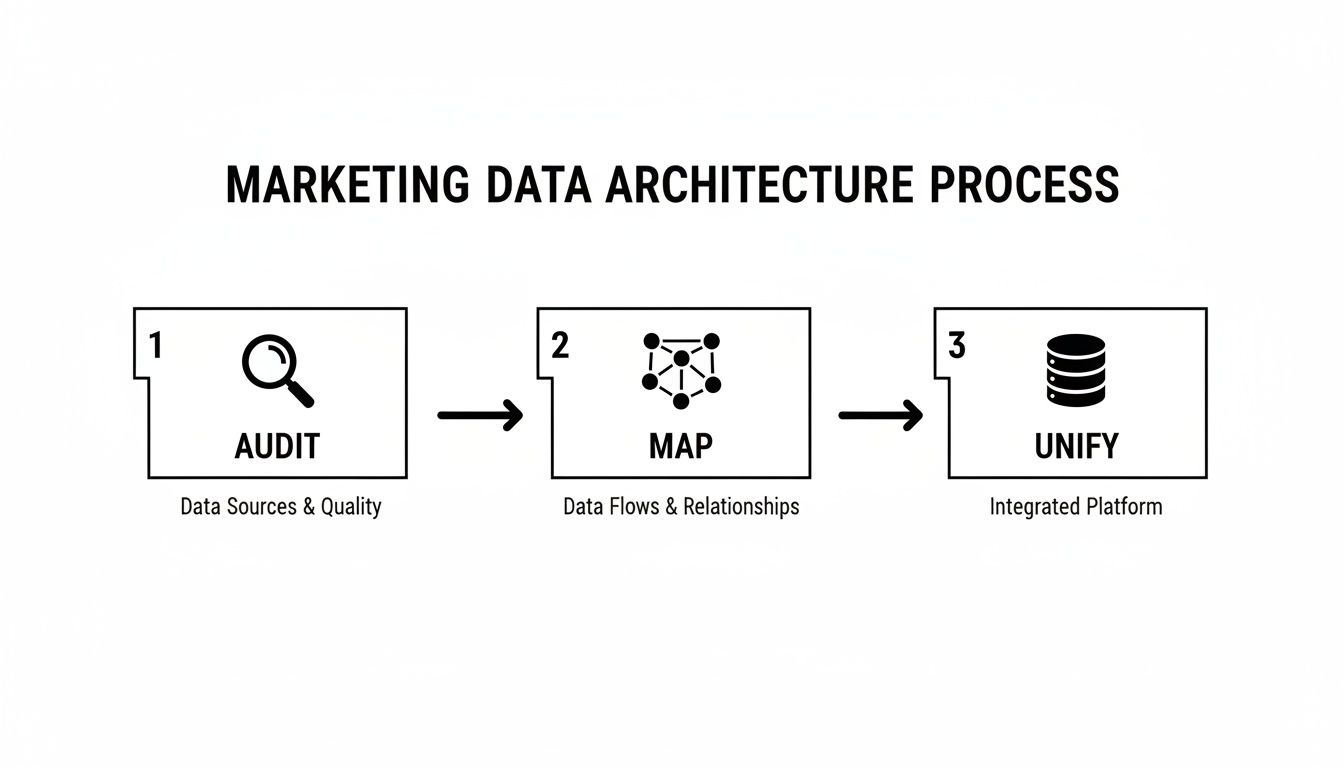
This workflow shows why a systematic approach is so critical. You start with a full audit, map every source, and then bring it all together into a single source of truth.
Unifying Systems Through Smart Integration
Once you have governed and well-instrumented data, the final piece is integration. This is where you connect all your separate systems to create a cohesive data flow, finally achieving that single customer view you've been working toward.
For some tools, native connectors are a simple, plug-and-play fix. But for a truly scalable marketing data strategy, you’ll need to get more sophisticated with ETL (Extract, Transform, Load) or ELT (Extract, Load, Transform) pipelines. These are automated processes that pull data from your tools, reshape it for consistency, and load it into a central data warehouse or CDP. Our guide to marketing data integration dives much deeper into these methods.
Consolidating fragmented tools is becoming more critical by the day. With U.S. marketing spend hitting nearly $481 billion in 2022, even a 2-3% error in attribution can misallocate tens of millions in budget. It’s no surprise that 98% of sales leaders say trustworthy data is essential, especially when things get turbulent. As detailed in Salesforce's State of Marketing report, enforcing governance across your CRM, analytics tools, and ad networks isn't optional anymore—it’s fundamental to credible planning.
The ultimate goal of integration is to break down data silos. When data flows freely and reliably between systems, your marketing team can move from reactive reporting to proactive, data-driven action.
Vendor Selection Checklist For Marketing Data Platforms
Choosing the right technology is a huge decision that will impact your team for years. Whether you're evaluating a CDP, an analytics platform, or a data observability tool, it's easy to get distracted by flashy features. This checklist is designed to keep you focused on what truly matters for a successful implementation.
| Evaluation Criteria | Key Questions to Ask | Red Flags to Watch For |
|---|---|---|
| Integration Capabilities | Does it have pre-built connectors for our key systems (CRM, ad platforms, email)? How complex is the API for custom integrations? | A very limited number of native integrations. Vague or poorly documented API. |
| Data Governance Features | How does the tool help enforce naming conventions and data dictionaries? What are the user permission and access control levels? | Lack of granular access controls. No features for managing data quality or schemas. |
| Scalability & Performance | Can the platform handle our projected data volume and user growth? What are the documented data processing times or latency? | Vague answers on performance benchmarks. A pricing model that punishes growth. |
| Usability & Adoption | How intuitive is the user interface for non-technical marketers? What training and support resources are provided during onboarding? | A cluttered interface that requires extensive coding for basic tasks. Poor customer reviews on support. |
| Compliance & Security | Is the vendor compliant with GDPR, CCPA, and other relevant regulations? How is our data encrypted and secured? | No clear documentation on security protocols or compliance certifications. Data hosted in unsecure regions. |
| Total Cost of Ownership | Beyond the license fee, what are the costs for implementation, training, support, and data storage? | Hidden fees for exceeding data limits or API calls. Required purchase of expensive "professional services." |
This checklist isn't just about ticking boxes. It’s about sparking the right conversations with potential vendors to uncover how their platform will really work within your ecosystem and whether they can truly support your strategic goals.
Activating Data for Smarter Marketing Decisions
Okay, you've done the hard work. Your data foundation is solid, governed, and ready to go. Now for the fun part: putting that data to work. This is the activation phase, where your data stops being a historical record and becomes the engine for smarter, faster, and more profitable marketing.
This is where your marketing data strategy really starts to pay off.

Activation isn't a one-off task; it's a constant cycle of insight and execution. You're finally using that clean, unified customer data to create tangible marketing outcomes that answer the core business questions you defined way back at the start of this journey.
Building Dynamic and Actionable Audience Segments
One of the first places you'll see a massive impact is in how you segment your audience. Forget static lists. With a unified data source, you can build incredibly nuanced segments based on real-time behaviors and predictive traits. This unlocks a level of personalization that just wasn't possible before.
Instead of a generic "newsletter subscriber" list, think about creating segments like these:
- High-Intent Abandoned Carts: Users who added a product over a certain price point to their cart in the last 24 hours but didn't check out. This group is prime for a hyper-targeted retargeting ad with a gentle nudge or a time-sensitive offer.
- Predicted High-LTV Customers: This segment is built from a model that flags new users sharing key traits with your best existing customers. You can roll out the red carpet for them with a premium onboarding experience.
- Disengaged VIPs: Customers who used to buy frequently but haven't engaged or purchased in the last 90 days. This is the perfect audience for a re-engagement campaign highlighting exclusive perks or what's new.
The beauty here is that these aren't "set it and forget it" segments. They are living, breathing audiences that update automatically as new data flows in, ensuring your marketing is always hitting the mark.
Implementing Predictive Models and Advanced Measurement
With clean, integrated data, you can finally move beyond looking in the rearview mirror. It's time to get into predictive analytics and sophisticated measurement, where you start answering forward-looking questions instead of just analyzing past performance.
A great place to start is with predictive lead scoring. Rather than relying on simple demographics, your model can analyze hundreds of signals—like specific pages visited, content downloaded, and email engagement patterns—to assign a score that accurately predicts a lead's likelihood to convert. This lets your sales team focus their energy on the leads that actually matter, making them far more efficient.
At the same time, you can finally tackle tough measurement challenges with models like:
- Multi-Touch Attribution (MTA): This model gives fractional credit to every marketing touchpoint along the customer journey, painting a much more accurate picture of channel performance than outdated last-click models.
- Marketing Mix Modeling (MMM): An MMM gives you a top-down statistical view, quantifying how different marketing inputs impact sales. This is invaluable for making those high-level budget allocation decisions with confidence.
The goal of activation is to make your data do something. Whether it's personalizing an email, scoring a lead, or informing a multi-million dollar budget decision, activated data creates a direct link between insight and action.
Crafting Insightful Dashboards for Every Stakeholder
For a data-driven culture to truly take hold, insights need to be accessible and relevant to everyone, not just locked away with the analytics team. This means creating tailored dashboards that translate raw data into a language each stakeholder understands and can act on.
- The C-Suite Dashboard: This needs to be a high-level view focused on core business outcomes. Think LTV-to-CAC ratios, marketing-sourced revenue, and overall pipeline contribution. It should quickly answer, "Is our marketing investment driving profitable growth?"
- The Channel Manager Dashboard: This gets more granular, focusing on channel-specific KPIs like ROAS, cost per acquisition, and campaign conversion rates. It's built to help them make daily and weekly optimization decisions.
- The Sales Leadership Dashboard: This view connects the dots between marketing and sales. It should show MQL-to-SQL conversion rates, lead velocity, and how marketing-generated leads are performing in the sales pipeline.
By democratizing data this way, you empower every team to make better decisions in their own corner of the business. For more practical ways to turn raw numbers into compelling narratives, check out our guide to unlocking powerful data-driven marketing insights. This is how you close the loop—turning complex analysis into the clear, actionable intelligence that fuels the entire organization.
Common Questions About Marketing Data Strategy
Even the most well-laid marketing data strategy is going to run into tough questions and practical roadblocks. Honestly, anticipating these challenges is half the battle. This section tackles the most common questions head-on, giving you the answers you need to navigate tricky conversations, justify your investment, and keep your strategy on track for the long haul.
How Do I Get Budget and Buy-In for a New Data Strategy?
Here’s the secret: stop talking about the technology. Leadership doesn't sign off on a "CDP" or a "data warehouse." They invest in solving expensive problems and chasing down profitable opportunities. You have to frame your entire proposal around tangible business outcomes.
Instead of asking for a technology budget, you need to present a clear, data-backed plan to do things like:
- Increase customer LTV by 15% by using unified data to power smarter personalization.
- Slash customer acquisition costs by 20% by cutting wasted ad spend on channels that just don't perform.
- Boost sales efficiency by handing them higher-quality, predictive-scored leads.
Use the numbers from your initial audits to show the real cost of doing nothing. How much money are you burning right now? How much revenue is being left on the table because of your current data gaps? When you tie your strategy directly to the P&L, it stops being a cost center and becomes a strategic investment.
The fastest way to get buy-in is to speak the CFO’s language. When you can draw a straight line from every dollar invested to a clear financial return, the argument is already half-won.
Should We Build Our Data Stack In-House or Buy a Platform?
Ah, the classic "build versus buy" debate. There's no single right answer here—it all comes down to your team's resources, technical chops, and where you're trying to go long-term. Each path comes with some serious trade-offs.
Buying a platform, like an off-the-shelf Customer Data Platform (CDP), gets you up and running much faster with less technical heavy lifting upfront. This is often the best move for teams that need to show value quickly and don’t have a large in-house data engineering crew.
On the other hand, building a custom solution on a modern data warehouse (think Snowflake or BigQuery) gives you total flexibility and control. This path is perfect for companies with very specific data needs or those who want to own their data asset from the ground up. Just be prepared for a significant and ongoing investment in specialized engineers to build and maintain it.
For many growing companies, a hybrid approach is the most practical way forward. You can use a central data warehouse as your single source of truth while layering a CDP on top for the marketing team to handle audience segmentation and activation. It’s the best of both worlds: the power of a custom foundation with the speed of a packaged tool.
What Are the Biggest Mistakes to Avoid?
The road to a great marketing data strategy is littered with common pitfalls. Steer clear of them from the get-go, and you’ll save yourself months of rework and lost credibility. Three mistakes pop up more than any others.
First, starting with the tech instead of the business questions. Too many teams get mesmerized by a shiny new tool and buy it before they’ve even figured out what problems it's supposed to solve. This almost always ends in a "data swamp"—a messy, useless pile of data that provides zero value.
The second huge mistake is pushing data governance to "later." It’s so tempting to skip creating a data dictionary or standardizing naming conventions, but that's a fatal error. Data that’s inconsistent and untrustworthy will completely destroy stakeholder confidence and make your analytics worthless.
Finally, creating the strategy in a silo is a guaranteed recipe for failure. If your plan is built without real input from sales, finance, and product, your marketing data will never connect to the bigger business picture. It'll just be a "marketing thing," limiting its impact and dooming the project to be seen as just another departmental expense.
At The Data Driven Marketer, we provide the blueprints and playbooks to navigate these challenges with confidence. Discover more in-depth guides and frameworks at https://datadrivenmarketer.me to build a data strategy that drives real business growth.