
Think about the last time you had a truly great customer experience. It probably felt like the company just got you. That’s the magic of customer intelligence, and a customer intelligence platform (CIP) is the engine that makes it happen.
At its core, a CIP is a tool that pulls together all the scattered pieces of your customer data to build a single, complete picture of who each person is and what they care about. This process turns a messy pile of information into clear, actionable insights that let you understand what your customers are doing, predict what they’ll do next, and deliver experiences that feel personal and relevant.
What Are Customer Intelligence Platforms Really?
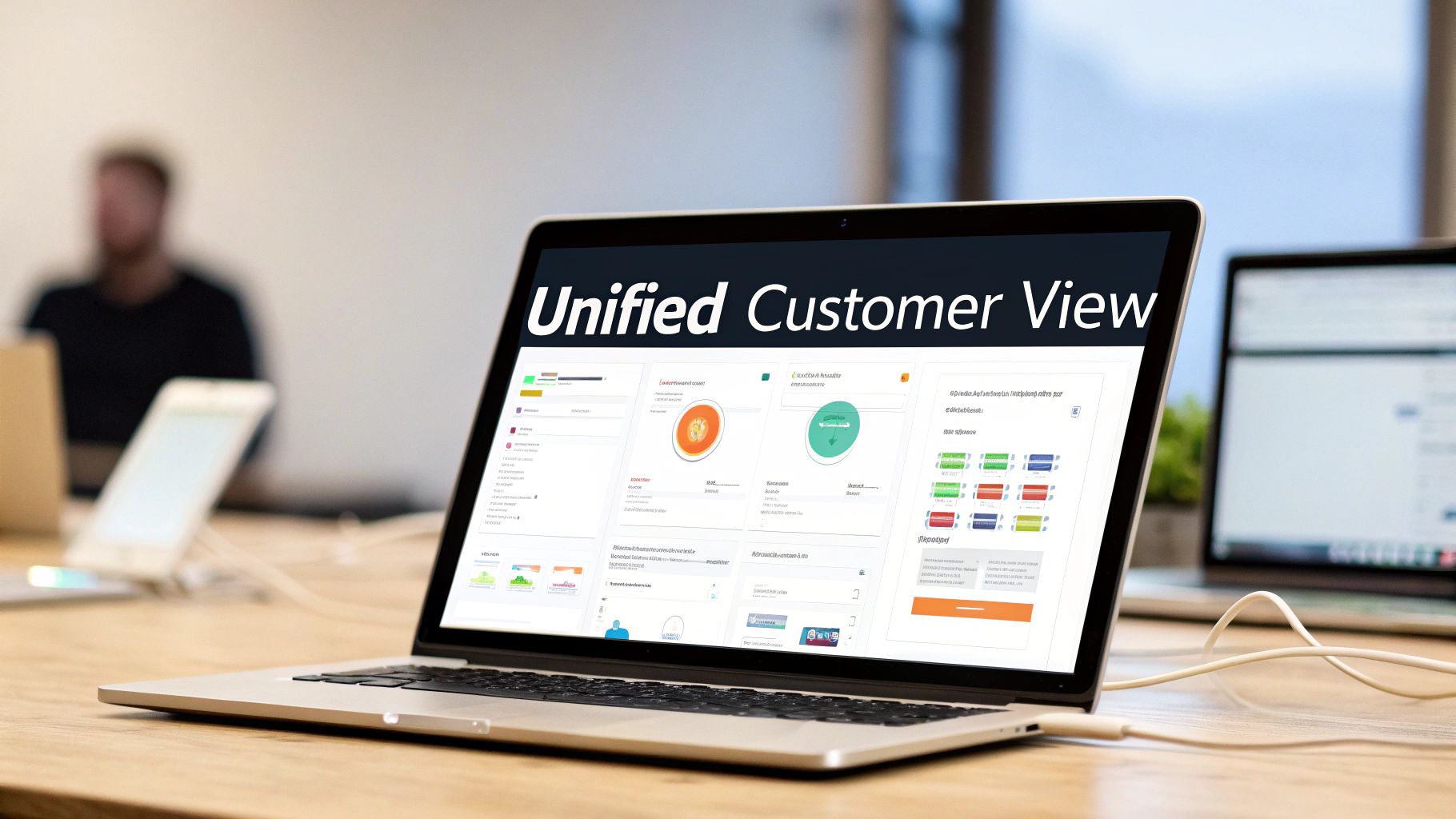
Here’s a simple way to think about it. Imagine trying to get to know someone new, but you only ever hear about what they do at work. You'd be missing the full picture—their hobbies, their friends, what they do on weekends. Many businesses operate this way, seeing customers only through the narrow lens of a single channel, like website analytics or sales data. The result is a fragmented, incomplete, and often misleading understanding.
A customer intelligence platform acts as the central hub where all those different pieces of the puzzle come together. It ingests data from every single touchpoint—website clicks, purchase history, support tickets, social media comments, and email opens—and stitches them together into one cohesive profile. Its main job is to solve the universal problem of scattered, siloed data.
The Power of a Unified View
Instead of seeing "Website Visitor #12345" and "Support Ticket #67890" as two separate entities, a CIP reveals they're the same person. This unified profile tells a coherent story about each individual's complete journey with your brand.
Once you can connect those dots, you can finally move beyond generic, one-size-fits-all marketing. You can start creating interactions that are genuinely helpful and feel like they were made just for that person. This single customer view empowers your team to:
- Understand customer behavior on a much deeper level, uncovering hidden patterns and preferences.
- Predict future actions, like identifying customers who are at risk of churning or who are ready to make their next purchase.
- Personalize communications across every channel, ensuring a consistent and meaningful experience from start to finish.
This shift from siloed data to a holistic, 360-degree view is the foundation of modern marketing. It’s no longer about simply collecting data; it’s about connecting it to build a clear picture that drives smarter decisions and, ultimately, stronger customer relationships.
More Than Just Data Collection
It's a common mistake to think of CIPs as just big digital filing cabinets for customer data. Their real value isn't in storage—it's in their ability to analyze and activate that information. These platforms use advanced analytics, and often AI, to find the insights hidden within all that raw data.
A customer intelligence platform doesn't just show you what customers are doing. It helps you understand why they're doing it and predict what they’ll do next. That predictive capability is the bridge between having raw data and achieving meaningful business growth.
This analytical engine is what truly separates a CIP from more basic data tools. And businesses are catching on fast. The global market for customer intelligence platforms was valued at a cool $1.9 billion in 2022 and is on track to hit $7.0 billion by 2027. This explosive growth, detailed in reports from firms like MarketsandMarkets, shows a massive industry shift toward using deep customer insights to guide strategy and fuel growth.
How a Customer Intelligence Platform Works
To really get what a customer intelligence platform does, you have to look under the hood. These systems aren't magic—they follow a pretty logical, four-step process to turn scattered, messy data into clear, actionable insights. Think of it like a sophisticated assembly line for customer understanding, where raw materials go in one end and a complete picture comes out the other.
The whole point is to centralize and make sense of information that’s already there but trapped in different tools. It’s about moving from a collection of snapshots to a full-length movie of your customer.
Step 1: Data Ingestion
It all starts with data ingestion. The platform plugs into all the different systems where your customer data is scattered. It acts like a universal adapter, pulling information from everywhere.
This isn't just one or two sources. We're talking about data from your:
- CRM System: Contact info, sales calls, and deal stages.
- Website Analytics: Page views, clicks, session times, and device info.
- E-commerce Platform: Purchase history, abandoned carts, and products viewed.
- Support Desk: Help tickets, chat logs, and customer feedback.
- Marketing Automation Tools: Email opens, ad clicks, and campaign engagement.
By pulling all this into one place, the platform shatters the data silos that keep you from seeing the whole picture. Solid marketing data integration is the bedrock; without it, everything that comes next is built on shaky ground.
Step 2: Identity Resolution
Once all the data is in, the platform gets to its most important job: identity resolution. This is where it figures out which pieces of data belong to the same person. It’s a bit like a detective connecting clues from different scenes to identify a single individual.
For example, an anonymous visitor browsing your site on their laptop gets a cookie ID. Later, that same person clicks a link in a marketing email on their phone and gives you their email address. A customer intelligence platform connects the cookie, the email, and the device info, stitching them together into a single, unified customer profile.
This unified profile is the cornerstone of customer intelligence. It combines behavioral, transactional, and demographic data into one coherent story, allowing you to see each customer as a complete individual, not just a collection of disconnected data points.
This single source of truth means every team—marketing, sales, support—is finally on the same page, working from the same complete and accurate information.
Step 3: Analysis and Prediction
With a clean, unified profile for every customer, the platform moves on to analysis and prediction. This is where the "intelligence" really shines. Using machine learning and advanced analytics, the system digs through the data to find patterns, spot trends, and predict what’s going to happen next.
Suddenly, you can answer the tough questions:
- Which customers are most likely to churn in the next 30 days?
- What’s the next product this specific customer is most likely to buy?
- Which marketing channels are actually bringing in our best customers?
This is what turns historical data into forward-looking insights. You can stop reacting and start marketing proactively.
Step 4: Activation and Orchestration
Finally, the platform puts those insights to work through activation and orchestration. The intelligence generated in the analysis phase is pushed back out to your marketing and sales tools to trigger personalized actions in real time.
This means you can automatically add a high-value customer to a VIP email flow, show a personalized discount to a user who’s about to leave, or stop showing ads to someone who just bought something. It creates a closed loop where insights immediately drive action.
The industry is catching on fast. The customer intelligence platform market is projected to rocket from $3,092.7 million to $13,812.8 million by 2030, according to a report from Grand View Research. What's telling is that the platform component itself—with its built-in AI segmentation and real-time audience building—is seeing the fastest growth. Businesses are realizing it’s smarter to invest in these ready-made intelligence engines than to try and build them from scratch.
Putting Your Customer Data to Work
All the technical features and predictive models in the world are just noise until they start solving real business problems. A customer intelligence platform isn't just a fancy database; it's a tool designed to drive specific outcomes—boosting sales, making marketing more efficient, and creating genuinely happier customers. When you connect the platform's capabilities to these real-world applications, you start to see how raw data transforms into actual growth.
The core process is pretty straightforward. It’s all about gathering data from your various systems, stitching it together into a single customer profile, running it through AI to find patterns, and then using those insights to power your marketing and sales efforts.
This visual breaks down that fundamental workflow, from scattered data points to activated intelligence.
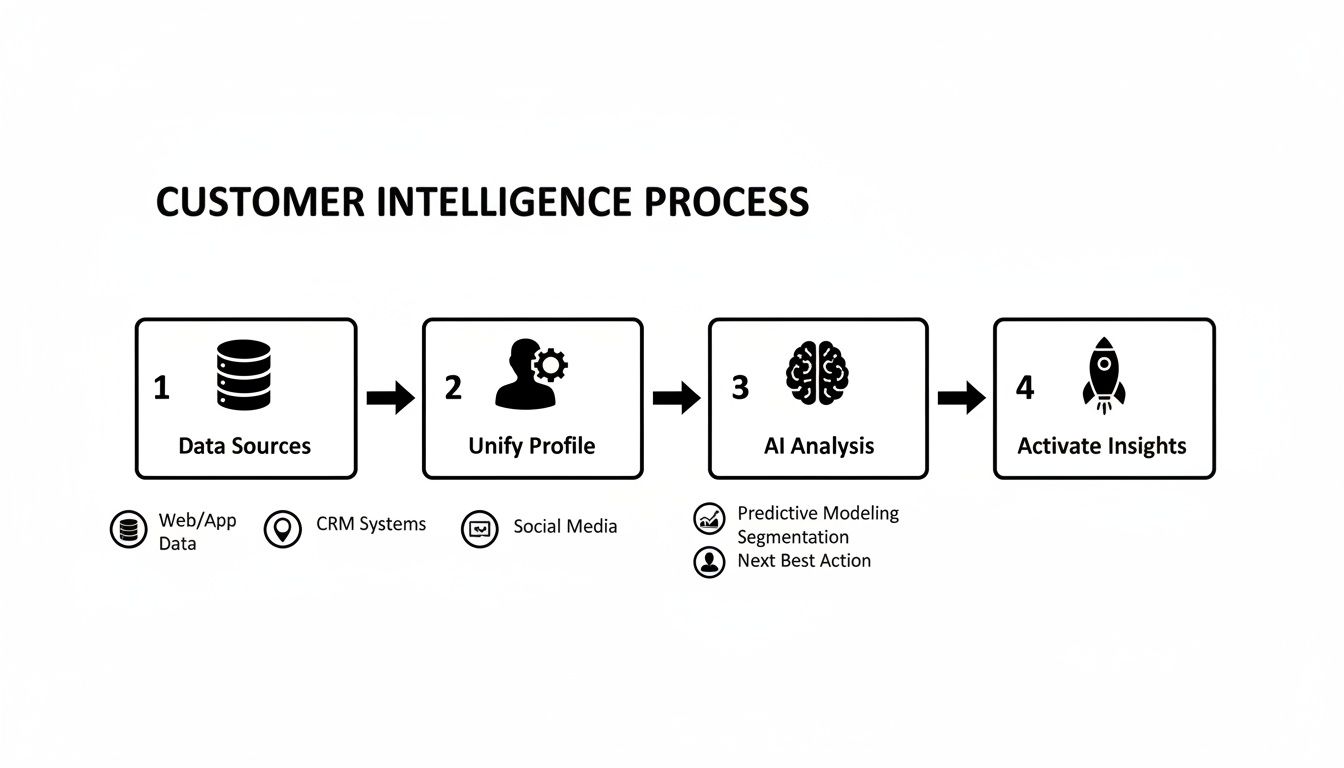
You can see how a CIP acts like a central brain, turning a mess of information into coordinated, intelligent actions that directly improve the customer experience.
Hyper-Personalization in E-commerce
If you run an e-commerce brand, you know that cart abandonment is a never-ending fight. A CIP helps you tackle this head-on by enabling hyper-personalization that leaves generic "You might also like…" suggestions in the dust. It looks at a user's entire history—what they've browsed, what they’ve bought, and even what they added to their cart before changing their mind.
Picture a shopper who keeps looking at a pair of high-end running shoes but never pulls the trigger. The platform can predict they're price-sensitive and automatically send an email with a 15% discount on that exact pair of shoes, maybe 24 hours after they left the site. That’s a world away from a generic site-wide sale announcement.
This kind of detail turns your website from a static catalog into a personal shopping assistant that anticipates what customers want and removes obstacles. The results are tangible.
- Higher Conversion Rates: Showing the right product at the perfect moment makes a purchase far more likely.
- Increased Average Order Value (AOV): Smart, relevant recommendations based on purchase history encourage useful add-ons.
- Reduced Cart Abandonment: Proactive offers and timely nudges can bring back sales you would have otherwise lost.
Sharpening B2B Lead Scoring and Journey Analysis
In the B2B world, sales cycles are long and messy. A customer intelligence platform gives you a serious edge by mapping out and analyzing the entire customer journey, from their first anonymous website visit to the day the deal is signed. It pulls together data from your CRM, marketing automation tools, and website analytics to build a complete picture of an account's engagement.
For example, a CIP might reveal that leads who download a specific whitepaper and then attend a webinar are 80% more likely to become customers. That’s a game-changer. Your sales team can immediately prioritize their follow-ups, focusing on accounts showing high-intent behavior instead of chasing cold leads. Suddenly, lead scoring moves from a basic point system to a predictive model based on what actually works.
By analyzing the complete journey, businesses can identify friction points where prospects drop off and optimize those stages. This intelligence turns the sales funnel from a black box into a clear, data-driven roadmap.
This approach is non-negotiable for any company serious about building a more efficient sales process. The insights a CIP provides are a core component of any effective data-driven marketing platform, giving you the intelligence needed to guide your entire strategy.
Optimizing Marketing Spend with Better Attribution
"Which of my marketing channels are actually working?" It’s the million-dollar question for every marketer. A customer intelligence platform helps you find the answer by creating a unified view of every single touchpoint a customer has before they convert. Instead of giving 100% of the credit to the last click, it shows you the entire sequence of interactions.
You might discover that while your paid search ads are great at closing the deal, many of your best customers first found you through a blog post or a social media ad weeks earlier. This multi-touch attribution uncovers the true influence of each channel. Armed with that knowledge, you can shift your budget to properly fund the channels that introduce and nurture prospects, not just the ones that get the final click. This leads directly to a better Return on Ad Spend (ROAS) and a much smarter marketing mix.
How to Choose the Right Platform
Picking the right customer intelligence platform is a big deal. The market is packed with vendors all promising the moon, and it’s way too easy to get bogged down in technical jargon and buzzwords. To find a true partner that fits your goals, budget, and current tech, you have to be methodical.
You’re not just buying a piece of software; you're investing in a capability that needs to grow with your business. That means looking past the flashy dashboards and zeroing in on the core functions that will actually solve your data headaches and open up new growth opportunities. A structured evaluation helps you cut through the marketing fluff and make a decision you can stand behind.
Core Technical Capabilities to Evaluate
Before you even think about booking your first demo, you need a crystal-clear set of technical criteria. These are the fundamentals that determine how well a platform will actually work within your ecosystem and how trustworthy its insights will be. Start your evaluation here.
- Integration and Connectivity: The platform has to play nice with your existing systems. Ask for a complete list of native integrations and scrutinize their API documentation for any custom connections you’ll need. If a platform can't easily get to your data, it's a non-starter.
- Identity Resolution Accuracy: This is the heart of the whole operation. You need to dig into the vendor’s methodology for matching customer identities across different devices and channels. Ask for real-world case studies or proof points that show their match rates and accuracy.
- Data Governance and Security: Your customer data is a critical asset, and it needs Fort Knox-level protection. Make sure the platform is compliant with regulations like GDPR and CCPA. Verify their security protocols, data encryption standards, and access controls to keep your data safe.
These technical pillars are the foundation of a successful rollout. A weak link in any of these areas will sink the entire value of the platform, no matter how slick its analytics look. Building a solid marketing technology stack means every component must integrate securely and effectively.
Key Questions to Ask During Demos
Sales demos are designed to show off a platform's best side. Your job is to uncover its true capabilities—and potential weak spots. Walking in with a list of sharp, specific questions will help you get past the sales pitch and really understand how the tool would work for your team.
Don't just ask "what" the platform does. Focus on "how" it does it. Understanding the underlying process reveals the platform's true power and flexibility, helping you differentiate between a superficial feature and a robust, well-engineered capability.
When you're in the demo, push beyond the standard feature tour with questions like these:
- "Show me how your identity resolution handles conflicting data points for a single user profile." This forces them to show you how the platform deals with messy, real-world data, not just pristine demo data.
- "How much technical skill does my team need to build a new audience segment or create a custom report?" This gets to the heart of day-to-day usability and tells you if you’ll need a dedicated specialist to run it.
- "What’s your typical implementation timeline, and what are the most common roadblocks customers run into?" This gives you a realistic picture of the onboarding process so you can plan for it.
- "How does your platform's predictive model work, and can we customize it with our own business inputs?" This helps you figure out if you're getting a flexible AI tool or just a rigid "black box."
Vendor Selection Checklist
To keep your evaluation organized, use a checklist to compare vendors on a level playing field. This ensures you're looking at the same critical factors for each potential partner, making the final decision much clearer. Here's a template to get you started.
| Evaluation Category | Key Questions to Ask | Importance (High/Med/Low) |
|---|---|---|
| Data Integration | Does it have native connectors for our CRM, ESP, and analytics tools? How robust is the API for custom sources? | High |
| Identity Resolution | What is the methodology (deterministic, probabilistic)? What are your average match rates? Can we see a demo with our own sample data? | High |
| Analytics & Insights | Can we build custom dashboards and reports without vendor help? Does it offer predictive models (LTV, churn)? | Medium |
| Activation & Orchestration | Can we push segments directly to our advertising and marketing channels in real-time? How does it handle journey orchestration? | High |
| Usability & Team Needs | How intuitive is the user interface for a non-technical marketer? What level of training and support is included? | Medium |
| Security & Compliance | Is the platform certified for GDPR, CCPA, and SOC 2? How is data encrypted at rest and in transit? | High |
| Scalability & Performance | How does the platform handle large data volumes and real-time processing? What is the pricing model as our data grows? | Medium |
| Vendor & Support | What does the implementation process look like? Do we get a dedicated customer success manager? What are the support SLAs? | Medium |
By focusing on these practical and technical points, you can build a complete picture of each vendor. This diligence ensures you select a customer intelligence platform that not only solves today's problems but also serves as a scalable foundation for your future data-driven marketing efforts.
Setting Your Platform Up for Success

Getting your hands on a powerful customer intelligence platform is a big deal, but it's just the starting line. The real magic happens during implementation, and frankly, this is where thoughtful planning separates a game-changing tool from a very expensive paperweight. Success comes down to a clear, strategic approach that considers both the tech and the people using it.
The most common trap teams fall into is trying to do everything at once. They go for a "boil the ocean" strategy, trying to connect every single data source and launch a dozen use cases from day one. This almost always ends in delays, confusion, and a whole lot of frustration. The smarter play? Start small with a focused, phased rollout.
Prioritize High-Impact Use Cases
Instead of a scattered, unfocused launch, lock in on two or three high-impact use cases that can deliver real, measurable value—fast. This approach creates momentum, proves the platform's worth to the people holding the purse strings, and lets your team learn the ropes in a manageable way.
A few great places to start could be:
- Slash Cart Abandonment: For an e-commerce business, this is a clear goal with a direct line to revenue.
- Spot At-Risk Customers: If you're a subscription service, building a solid churn prediction model can deliver an almost immediate ROI.
- Sharpen Lead Scoring: In the B2B world, helping your sales team focus on the best leads is a guaranteed win.
Zeroing in on a specific problem gives you a clear roadmap for your first data integration and activation efforts. This laser focus makes the whole project feel less overwhelming and delivers tangible results that justify future expansion.
The goal of a phased implementation is to secure early wins. A successful initial project builds organizational confidence and creates internal champions who will advocate for expanding the platform's use across the company.
Establish a Robust Data Governance Plan
As you start hooking up more data sources, keeping that data clean becomes absolutely critical. A data governance plan isn't just bureaucratic red tape; it's the essential rulebook that ensures the insights you pull from your platform are trustworthy. Without it, you risk making huge decisions based on flawed or messy information.
Your governance plan should be a simple, easy-to-find document that clearly defines the rules of the road for your customer data. This has to be a team sport, involving marketing, IT, and any other team that touches customer data.
A solid plan must answer these fundamental questions:
- Data Ownership: Who is ultimately on the hook for the quality and accuracy of each data source (e.g., the CRM, website analytics, etc.)?
- Data Standards: What are the consistent formats for key data points like names, addresses, and custom event naming conventions?
- Access Controls: Who gets to see, edit, or export sensitive customer data from the platform?
- Quality Checks: How will you regularly audit the data for completeness, accuracy, and duplicates to keep it in good shape?
This framework makes sure everyone knows their role in maintaining a clean, reliable data ecosystem. It transforms data from a siloed, messy liability into a trusted, central asset that empowers every team to act with confidence. This disciplined approach is what makes a customer intelligence platform a core part of operations, not just another tool in the stack.
How to Measure the ROI of Your Platform
So you’ve invested in a powerful customer intelligence platform. Great. But dropping significant budget on a new tool is just the first step—now you have to prove it was worth it. Proving its value isn't about building convoluted financial models; it’s about drawing a straight line from the platform's features to your bottom-line results.
You can't just hope it's working. You need a clear measurement framework that turns a platform expense into a growth engine you can't live without. This is how you show the C-suite that your marketing efforts are directly pumping money back into the business. Without it, your shiny new tool is just another line item waiting to get cut.
Key Performance Indicators That Actually Matter
To build your business case, you need to zero in on the metrics that directly reflect the financial impact of smarter customer engagement. Forget the vanity metrics. We're talking about direct indicators of a healthier, more profitable customer base, all powered by the insights your platform is uncovering.
- Customer Lifetime Value (CLV): This is the holy grail. A successful platform should help you spot and nurture your best customers, leading to a real, measurable increase in how much they spend with you over time.
- Conversion Rate on Personalized Campaigns: Are the hyper-targeted campaigns you're running with the platform's segments outperforming your generic, spray-and-pray efforts? This is a simple, direct way to prove that personalization pays off.
- Customer Churn Rate: One of the most powerful things a CIP can do is flag at-risk customers before they walk out the door. Showing a drop in churn tells a compelling ROI story, especially since keeping a customer is always cheaper than finding a new one.
Connecting Platform Features to Financial Outcomes
The next step is to connect the dots. You need to draw a clear line from a specific platform capability to one of the KPIs you're tracking. This makes the platform’s value tangible for everyone, from your marketing team to the CFO. Think of it as translating tech features into financial benefits.
For example, you can link the platform's predictive analytics directly to a lower churn rate. When the platform identifies customers with a high probability of leaving, your team can swoop in with retention offers. That's not just a cool feature; it's revenue you demonstrably saved.
The most effective way to demonstrate ROI is to establish a clear baseline before full implementation. Track your key metrics for a quarter, then compare those numbers after the platform has been actively personalizing experiences. The difference is your ROI.
This before-and-after snapshot provides undeniable proof. When you can walk into a meeting and say, "After using the platform's journey orchestration to personalize our onboarding, our 90-day retention rate shot up by 15%," you’re no longer talking about features. You’re talking about real, measurable business impact.
Frequently Asked Questions
When you start digging into customer intelligence platforms, a few practical questions always come up. How does this kind of tool actually fit into what we're already doing? What does it take to get it running? Let's clear up some of the most common questions.
The big thing to remember is that these platforms are built to be a smart layer on top of your existing tools. They’re meant to make your current stack more powerful, not force you to rip and replace everything.
How Do These Platforms Integrate with a CRM?
Think of a Customer Intelligence Platform (CIP) and a CRM as a power duo. Your CRM is fantastic for keeping track of sales pipelines and the history of your interactions. But a CIP gives that history incredible depth.
It connects directly to your CRM, pulling out all that valuable sales and contact data. Then, it stitches that information together with behavioral data from your website, your app, and any other place your customers interact with you.
This newly enriched profile gets pushed right back into the CRM. Suddenly, your sales team doesn’t just see a name and a contact record. They see what that person has been browsing, what they're actually interested in, and just how ready they might be to buy—all without leaving their familiar CRM screen.
It's like this: Your CRM holds the official transcript of your relationship. The CIP adds all the color commentary, turning a flat file into a living, breathing story about your customer's real-time needs and intent.
This relationship makes both systems exponentially more valuable.
What Is a Realistic Implementation Timeline?
While a full-scale, connect-everything implementation can take time, the smart money is on a phased approach. Most teams can get their first high-impact use case live within 60 to 90 days.
What does that look like? Usually, it means focusing on a specific goal, like identifying customers who are about to churn or building a few highly-targeted audience segments for a campaign.
This first phase typically involves:
- Connecting your most important data sources—think website analytics, your CRM, and maybe your e-commerce platform.
- Setting up the rules for identity resolution to start unifying profiles.
- Building out one or two initial automated workflows to prove the concept.
Trying to boil the ocean by connecting every single data source on day one is a recipe for delays. Start with a focused win, show the ROI fast, and you'll build the momentum you need for a wider rollout.
How Is Customer Intelligence Different from Business Intelligence?
This is a really important distinction. Business Intelligence (BI) tools are built to look inward. They analyze broad operational data to answer questions about the health of the company. Think dashboards showing sales revenue, supply chain metrics, and financial performance.
Customer Intelligence (CI), on the other hand, looks outward. It’s focused entirely on understanding customer behavior to answer questions about their motivations, needs, and what they might do next.
While BI can tell you what happened (e.g., "Sales dropped 10% last quarter"), CI helps you understand why it happened (e.g., "A key customer segment is showing signs of churn because of a recent product change"). One gives you the headline; the other gives you the story behind it.
At The data driven marketer, we create in-depth guides and frameworks designed to help you master your marketing data stack. Our resources bridge the gap between strategy and execution, so you can turn messy data into reliable signals that drive real growth. Explore our actionable guides at https://datadrivenmarketer.me.